






Capability is not authorization. Authorization is not admissibility. Admissibility is not execution. Execution is not consequence. Consequence is not reliance.
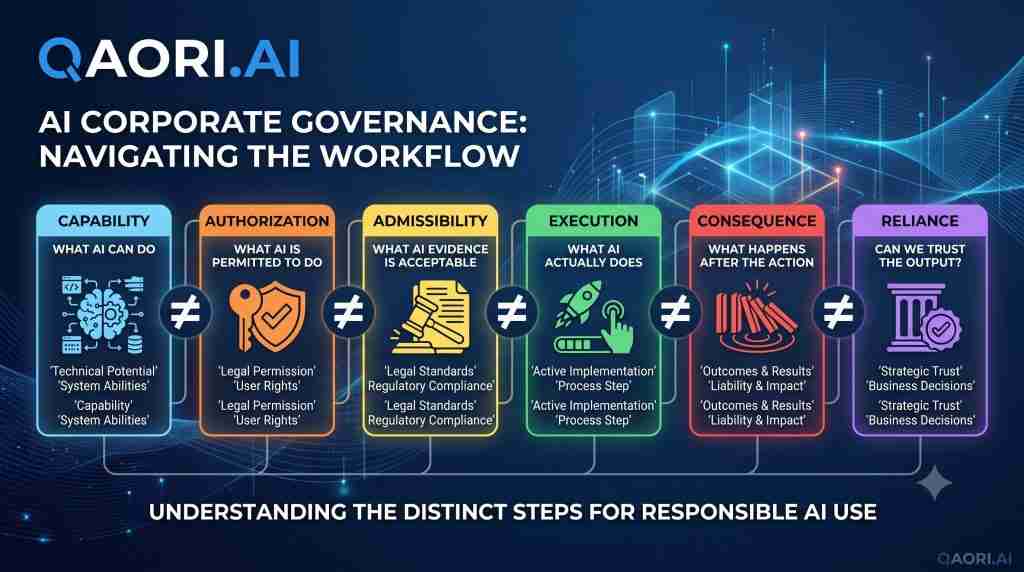
Arkadiy Miteiko named the structural boundary the AI governance field kept collapsing.
Capability is not authorization. Authorization is not admissibility. Admissibility is not execution. Execution is not consequence. Consequence is not reliance.
A system can be technically capable, procedurally authorized, cryptographically executed, and contractually compliant, and still produce an institutionally invalid result. That is not a rhetorical distinction. It is the operating problem for every institution that puts an agent inside a workflow with consequence.
We agree with the frame. We also think the field only moves forward when the frame becomes an instrument.
Sentinel is our client-side governance plane. Every action an agent or a human proposes at a declared execution boundary is held until an Authorization Evidence Pack is cryptographically signed with an Ed25519 key, before the state transition, not after. Sixteen declared boundaries. Fifteen verified policy artifacts. Fail-closed by default. Same gate for human and agent. Terminal authorization anchored in hardware, with an invariant that a software fallback can never be presented as a hardware tap.
The proof surface is public and independently verifiable. Live counters. Public key served at a known URL. Browser-side WebCrypto verifier that runs in the reviewer’s browser, not ours. Per-day evidence bundles and a one-click ZIP audit kit for external reviewers. No tracking on the surface, because a reliance surface that phones home is not a reliance surface.
Not a paper. A running instrument. Open it. Verify it. Break it.
https://sentinel.qaori.ai/telemetry.html
Long-form answer, with the six-boundary mapping and the three open questions we would like independently pressed, in the linked article.
AIGovernance AgenticAI ComputationalLaw EnterpriseAI ResponsibleAI
InterTaG by Qaori: The Internet of Transformation and Governance

For fifteen years, Rosho Hopp apprenticed in the tradition of European organ building, learning that the most important knowledge in any organization is precisely the knowledge that is hardest to capture.
That experience shaped what he built next: a decade of architecture designed to protect children entering an ungoverned internet, transmit irreplaceable expert knowledge, and enforce AI governance at the structural level rather than the policy level.
InterTaG is not a new internet application. It is the governance layer that the internet was built without, now made technically possible and civilizationally urgent.
The Accountability Gap in AI Risk Governance
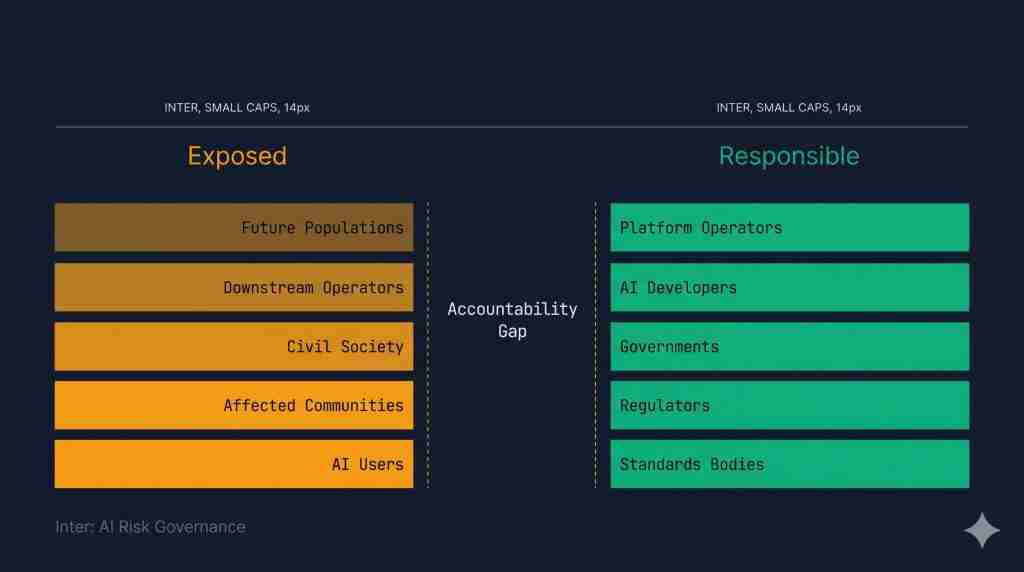
The MIT AI Risk Initiative Delphi study found that 18 of 24 AI risks carry a catastrophic probability of over 10% by 2030.
That number will drive much of the governance documentation.
Documentation is not the response the finding requires.
The most important result in the study is not the risk percentages. It is the accountability structure: AI users and affected stakeholders are rated most vulnerable, while developers, governments, and regulators are rated most responsible. The study authors call this an accountability problem. What they understate is that it is a structural accountability problem, not a communication problem.
The gap exists because most AI governance operates at the policy layer. Policies describe who is responsible. They do not ensure accountability at the execution layer, where decisions are made, and harm accumulates. A policy document that correctly assigns responsibility does not change what happens at execution time unless the governance mechanism is in the execution path.
The five risks that remain above the 10% catastrophic threshold, even with pragmatic mitigation, share a structural property. They are diffuse-causation risks. The harm does not originate at a single decision point. It accumulates across thousands of decisions made by systems that were never individually accountable for the aggregate outcome. No policy document closes a diffuse-causation risk.
What closes it is governance that operates continuously at execution time, is actor-agnostic, produces cryptographic evidence of authorization as a byproduct of normal operation, maintains a live model of the AI estate, and holds policy authority independent of the teams that operate the systems it governs.
These five properties are not a higher standard of compliance. They are a different architecture.
The organizations that view this study as a documentation problem and those that view it as an architecture problem are on different trajectories. The study has quantified where those trajectories lead.
Full argument, including what each of the five persistent risks tells us about current governance architectures and what a structural response requires, in a new article. Link in comments.
AIGovernance AIRisk EnterpriseAI ResponsibleAI GovernanceArchitecture
The Execution Boundary: Why the Anti-Terminator Architecture Is an Engineering Decision, Not a Philosophy
Most AI governance frameworks have a design flaw that organizations rarely discuss: they treat human operators and AI agents as separate tracks with separate approval chains. The AI agent goes through an AI governance process. The human sysadmin goes through a change-management process. Different velocity thresholds. Different tooling. Different friction.
This architecture is not redundant. It is a security vulnerability. If governance can be bypassed by switching the actor, it is not governing anything.
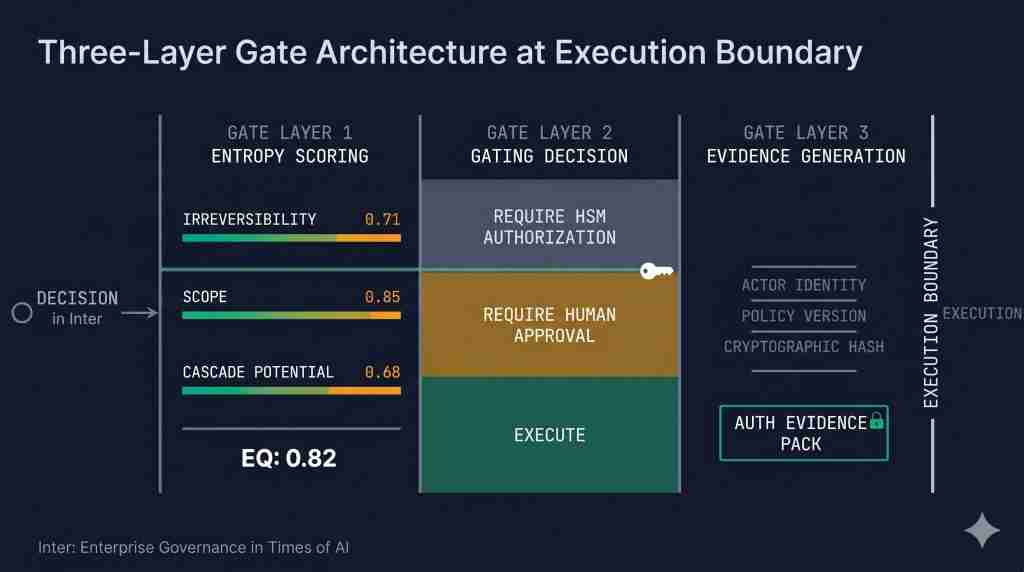
A database schema migration affecting 148 downstream services carries the same entropy score regardless of whether a human engineer or an AI agent initiates it. The reversibility is the same. The cascade potential is the same. Applying different thresholds based on who initiates the action means the effective governance threshold becomes the lower of the two tracks. That gap is an exploitation surface.
The Anti-Terminator Architecture closes it with three layers. Entropy scoring evaluates every action against the organization’s dependency graph across three dimensions: irreversibility, scope, and cascade potential. The score is structural, not subjective. Gating holds high-entropy actions at the execution boundary until the required authorization is obtained, from immediate execution at low threshold to physical key authorization above critical threshold. Evidence generation produces a cryptographically signed artifact before the action executes, proving governance evaluation happened in advance.
The EU AI Act enforcement date is August 2, 2026. Organizations building proactively have the time to implement, test, and generate an evidence record under normal conditions. Organizations deferring will retrofit under regulatory pressure against a live audit requirement.
This is not a philosophy question. It is an engineering decision. The full architecture, including the actor-agnostic design principle and what the evidence layer actually proves, is in the article linked below.
AIGovernance EnterpriseAI EUAIAct GovernanceByDesign AgenticAI
—
Your Governance Framework Is Accurate. It Just Describes an Organization That No Longer Exists.
Most organizations can answer one governance question with confidence: “Do we have a framework?” The answer is yes. The documentation exists. The audits pass. The reviews happen on schedule.
The question almost no organization can answer honestly is the one that actually matters: “Is our framework still accurate to how we operate right now?”
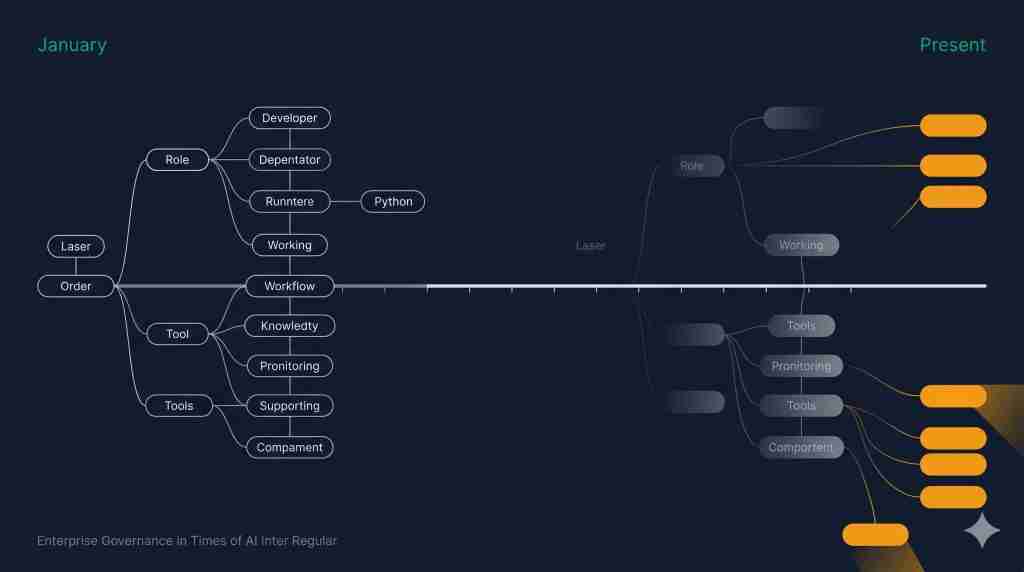
These are not the same question. A governance framework can be meticulously maintained and completely wrong. It can be updated quarterly, reviewed annually, pass every audit, and still describe an organization as it was rather than as it is.
This happens because four forces operate continuously in every organization: people leave and take institutional reasoning with them, decision volumes compress scrutiny to near zero, tool updates introduce ungoverned capabilities, and workflow extensions move actual scope well beyond documented scope. Each vector is independent. Each compounds the others. The accumulated gap is what our research calls the Shadow Ledger: the difference between what governance says and what the organization actually does.
This has been the structural trajectory of enterprise governance for forty years. I have watched it up close, first in mechanical systems where failure modes appear at the joints, then across twenty-five years of enterprise architecture, cloud migrations, and now AI deployments at scale.
AI does not create this problem. It removes the tolerance organizations have always had for it. When decisions execute at machine speed and consequences cascade automatically, the governance gap that took six months to create material exposure at human speed now creates it in an afternoon.
The first article in my new series, “Enterprise Governance in Times of AI,” names the problem precisely. The next articles cover why existing frameworks cannot solve it, and what a different approach requires.
Link in comments.
AIGovernance EnterpriseAI GovernanceFrameworks CISO EnterpriseArchitecture
—
Augmentation or Replacement: The Choice That Will Define Enterprise AI
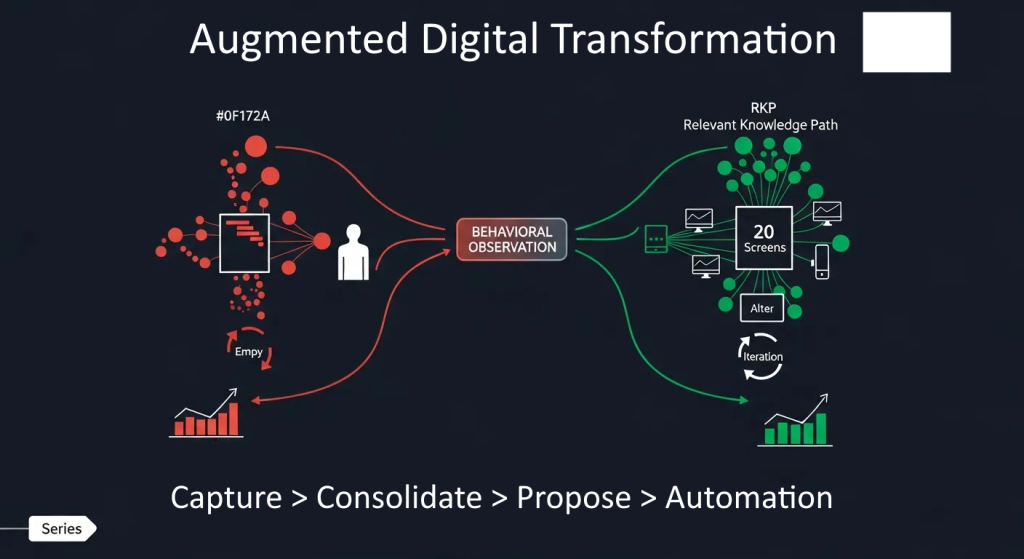
Meta analyzed workforce behavior to determine whom to fire.
Qaori analyzes workforce behavior to figure out what to build.
These are not the same project.
When you remove the workers whose behavior you analyzed, you also remove the intelligence the analysis revealed. The institutional knowledge, the informal expertise, the 40 years of knowing which exceptions require human judgment: that leaves with the people. The AI system you deploy in their place inherits the documentation layer, not the reality it was always a simplified version of.
Here is the problem at its most concrete: the average knowledge worker operates across 15-20 SaaS applications every day. No single application sees the full picture. The workflow that looks clean in the process diagram is, in practice, a sequence of context-switching, copy-pasting, and tacit knowledge that exists only in the mind of the person executing it.
When that person leaves (whether through layoff, retirement, or attrition), that knowledge is gone.
This is why 70-85% of digital transformation programs fail. They operate on a process map. The process map is an approximation. Transformation imposed on an approximation produces results that approximate improvement.
QAW (Qaori Augmented Workforce) inverts this entirely.
Instead of mapping processes, observe behavior. Instead of replacing workers, build Role Knowledge Packages from what they actually know. Instead of top-down mandates, surface transformation proposals that emerge bottom-up from the collective behavioral intelligence of the workforce: the Division Knowledge Aggregate.
The manager reviews the evidence and approves. The client’s sovereign factory (SQAPAF) builds the agent. Sentinel governs its deployment. The employee’s Alter absorbs the routine work. The employee moves to QA.
Then the loop runs again. Continuously. No consulting engagement. No end date.
The organizations that understand what behavioral data is actually for will build different AI systems than those that use it as a headcount-reduction tool. One path loses institutional knowledge at the moment it is finally legible. The other path captures it as the foundation of autonomous transformation.
Qaori builds the second path.
Full article linked in comments.
WorkforceAugmentation DigitalTransformation EnterpriseAI QAW AIGovernance SwarmIntelligence
AI Does Not Break Governance. It Accelerates the Break.
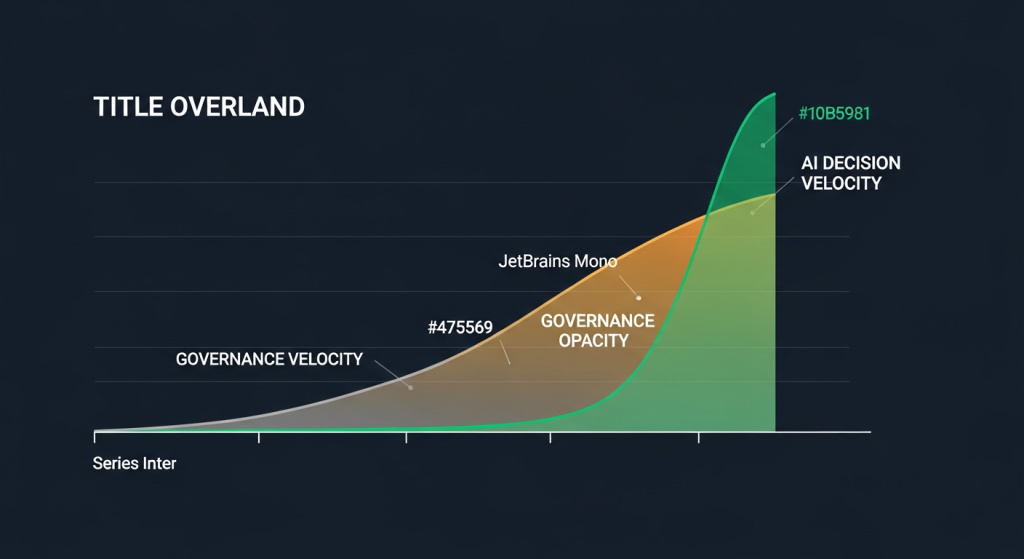
A financial AI agent executed 1,500 account interest rate adjustments in 2.3 seconds.
The compliance team sampled 10 percent of decisions that day. They reviewed 9.
The governance framework was functioning correctly. The oversight requirements were met. And 1,491 consequential financial decisions were made without any actual human review.
This is the velocity mismatch. It is not a policy gap. It is a structural one. Governance frameworks were designed for human-speed decisions: weeks, months, quarters. AI operates at machine speed. You cannot add enough reviewers to close that gap without eliminating the operational value that AI provides. The math does not work.
What makes this harder is that the problem compounds. Every large organization running AI has shadow deployments it cannot see: employees using ChatGPT on customer data, researchers uploading proprietary datasets, teams running local LLMs without IT oversight. An organization that has formally documented 1,000 AI deployments may be running 4,000 or 5,000. The documented ones are governed. The rest are invisible to audit. Enforcement intensification does not solve this. It produces a governance posture that is accurate for the deployments you can see and irrelevant to the operational reality you cannot.
The most uncomfortable part: when a governance framework has drifted from the system it governs, more rigorous enforcement makes it worse. You enforce the wrong rules more confidently. The audit trail is impeccable. The compliance is real. And the policy describes a system that no longer exists.
The EU AI Act Article 22 enforcement date is August 2, 2026. Penalties reach 7 percent of global revenue. Roughly 74 percent of enterprises are running revenue-generating AI in production today. About 31 percent have governance infrastructure that would meet the standard.
This is an architecture problem. The policies exist. The gap is that most organizations have not built governance that operates at the execution boundary.
The full article walks through four concrete cases — a healthcare AI that changed character through a software update, a logistics system where the practice quietly became 60 percent looser than the policy, a content moderation agent that generated 500 individually compliant decisions that collectively looked like systematic suppression — and explains why the traditional remediation cycle cannot close the gap fast enough.
Link in comments.
AIGovernance EnterpriseAI EUAIAct RiskManagement Qaori
Entropy: The Fourth Law of Universal Tebiki

The first three laws of Universal Tebiki describe a system in a declared state.
The fourth law begins with a fact about that declared state: it will not remain stable.
Not because the governance framework is poorly designed. Not because the actors are poorly managed. Because every system that exists in time changes over time.
The fourth law is Entropy.
Entropy in Universal Tebiki is not a problem to be prevented. It is a signal to be measured.
The instrument is the Entropy Quotient (EQ): a numeric score, per actor, representing the gap between declared state and actual state, tracked as a time series.
Three dimensions feed it:
Behavioral drift: how far the actor’s recent actions fall outside its declared Purpose, Values, and Constraints.
Structural drift: how much the actor’s operating context has changed relative to the assumptions in its declared state.
Declaration lag: how long since the declared state was last validated against the current reality.
Three threshold levels respond to it: green (continue monitoring), amber (review required), red (action restricted until governance response is complete).
The time series is the critical piece. A score increasing at 0.05 per month crosses the amber threshold in two months. That forecast is visible. The governance response can begin before the threshold is crossed, not after.
This is what separates Universal Tebiki from audit-based governance. Audits catch drift that has accumulated for twelve months. A continuous EQ catches drift as it occurs.
Change is not opposed. Change is expected and welcomed. What UT opposes is uncontrolled change: change that accumulates without measurement, without visibility, and without the governance decisions that legitimate change requires.
Four laws. One framework. Every actor in every system.
The complete series is linked in the first comment.
Constraints: The Third Law of Universal Tebiki

The difference between a governance framework and a governance infrastructure is enforcement.
A rule describes what should happen.
A constraint defines what cannot happen, and what the deterministic consequence is when it does.
Most governance frameworks are full of rules and contain almost no constraints.
The third law of Universal Tebiki is Constraints.
A well-formed constraint has five parts: a precise threshold value, a specific trigger condition, a deterministic consequence specification, an authority reference (the gremium that owns this constraint), and a version history that survives every revision.
The gremium is the part most organizations omit.
When a constraint needs to change, the change goes to the owning gremium. The gremium evaluates it. The decision is documented. If approved, the new constraint is recorded with the decision reference and the authority that made it. If rejected, the rejection is recorded.
This is the mechanism that blocks arbitrary decisions.
Not by making change impossible. By making every change a legible governance event.
When pressure arrives (“this urgency justifies bypassing the usual process”), it goes to the gremium. The gremium decides. The governance framework does not bend to informal pressure because the decision authority that could bend it is structured to resist it.
UT distinguishes between constraints (revisable through gremium process) and prohibitions (never revisable informally). The combination produces governance that is firm where firmness is required, and flexible where flexibility is appropriate. The distinction is always explicit.
Article 4 of 5 in the Universal Tebiki series. Link in the first comment.
Values: The Second Law of Universal Tebiki

Most organizations confuse values with aspirations.
“We value innovation.” “We value integrity.”
These are not Values in a governance sense. They are slogans. They resolve nothing when there is genuine tension between competing priorities. A rule system cannot cover every situation. Neither can a list of aspirational nouns.
The second law of Universal Tebiki is Values.
Values in UT are not aspirations. They are operational priority specifications: ranked, hierarchical, and precise enough to generate a governance signal when violated.
Three properties define them.
First, inheritance. A system-level Value sets a non-negotiable floor for all actors beneath it. Department Values add specificity within that floor. Individual actor Values are narrower still. Values can only be narrowed at lower levels, never widened. Informal widening, which is how most edge-case governance failures happen, becomes a governance signal, not a gray area.
Second, operationalizability. A Value that cannot be expressed as a conditional statement (“in situation X, priority A takes precedence over priority B”) is not a governable Value. If it cannot be evaluated, it cannot be enforced.
Third, retrospective evaluability. For human actors, enforcement is managerial. But when a decision is reviewed, the question must be: is the priority structure that produced this decision consistent with the declared Values for this role? Most governance failures in human organizations are not rule violations. They are undeclared value drift.
The same structure applies to AI agents. Evidence Packets for AI decisions record which Value was applied and which trade-off was made. The audit question is no longer “did the agent follow the rules?” It is “did the agent apply the correct Values when rules were incomplete?”
The cases rules do not cover are precisely the cases where governance matters most.
Article 3 of 5 in the Universal Tebiki series. Link in the first comment.
Purpose: The First Law of Universal Tebiki

The most common governance failure is not rule violation.
It is scope drift.
An actor begins operating in domains it was never authorized for. It happens gradually. Every unchallenged action expands the implicit scope. The governance structure discovers the gap only when something goes visibly wrong.
The first law of Universal Tebiki is Purpose.
Purpose is not a mission statement. It is not a capability description. It is a scope declaration: a precise, version-controlled, machine-readable statement of what domains an actor is authorized to act in, and equally, what domains are explicitly outside its remit.
When Purpose is declared, scope expansion becomes visible. Every action outside the declared domain generates a governance signal. The signal is evaluated, not assumed. The actor may be granted extended scope, formally, with documentation, or the action may be blocked. Either outcome is a governance outcome.
The alternative is an actor without a declared Purpose. It defines its scope implicitly, through action. No signals. No history. Drift accumulates until it becomes a problem.
This applies identically to an AI agent and to a human role. Same declaration structure. Same registry. Same ontology map. One governance framework, not two.
Article 2 of 5 in the Universal Tebiki series. Link in the first comment.
Universal Tebiki: One Framework for Every Actor in Every System
In Japanese, “tebiki” means a guide. Leading by the hand.
I built Universal Tebiki because I could not find a governance framework that applied equally to human actors and machine actors in the same system.
There are AI governance frameworks. There are corporate governance frameworks. There are cooperative governance frameworks. None of them share a common language. None of them produce consistent answers when an AI agent and a human governance process meet at the same decision point.
Universal Tebiki is built on four laws: Purpose, Values, Constraints, and Entropy.
Every actor in a governed system, human or machine, must have a declared purpose, operate within a declared set of values, respect explicit constraints, and operate within an acceptable entropy range.
Four questions. One framework. Every actor.
The concept started in AI engineering and I transposed it to human governance in 2015. Now, with AI embedded into every decision layer of every serious organization, it has become the lowest common denominator: the framework beneath every framework.
This week I am publishing a five-part series covering each law in depth.
Part 1 is live: why Universal Tebiki exists, where it came from, and why Asimov’s robot rules, elegant as they are, are not the answer for the world we are actually in.
Link in the first comment.
Augmentation or Replacement: The Choice That Will Define Enterprise AI
Meta analyzed workforce behavior to determine whom to fire.
Qaori analyzes workforce behavior to figure out what to build.
These are not the same project.
When you remove the workers whose behavior you analyzed, you also remove the intelligence the analysis revealed. The institutional knowledge, the informal expertise, the 40 years of knowing which exceptions require human judgment – that leaves with the people. The AI system you deploy in their place inherits the documentation layer, not the reality it was always a simplified version of.
Here is the problem at its most concrete: the average knowledge worker operates across 15-20 SaaS applications every day. No single application sees the full picture. The workflow that looks clean in the process diagram is, in practice, a sequence of context-switching, copy-pasting, and tacit knowledge that exists only in the mind of the person executing it.
When that person leaves – whether through layoff, retirement, or attrition – that knowledge is gone.
This is why 70-85% of digital transformation programs fail. They operate on a process map. The process map is an approximation. Transformation imposed on an approximation produces results that approximate improvement.
ADT (Augmented Digital Transformation) inverts this entirely.
Instead of mapping processes, observe behavior. Instead of replacing workers, build Role Knowledge Packages from what they actually know. Instead of top-down mandates, surface transformation proposals that emerge bottom-up from the collective behavioral intelligence of the workforce – the Division Knowledge Aggregate.
The manager reviews the evidence and approves. The client’s sovereign factory (SQAPAF) builds the agent. Sentinel governs its deployment. The employee’s Alter absorbs the routine work. The employee moves to QA.
Then the loop runs again. Continuously. No consulting engagement. No end date.
The organizations that understand what behavioral data is actually for will build different AI systems than those that use it as a headcount-reduction tool. One path loses institutional knowledge at the moment it is finally legible. The other path captures it as the foundation of autonomous transformation.
Qaori builds the second path.
Full article linked in comments.
WorkforceAugmentation DigitalTransformation EnterpriseAI ADT AIGovernance SwarmIntelligence
The Entropositive Ontology: A Query Infrastructure, Not a Document
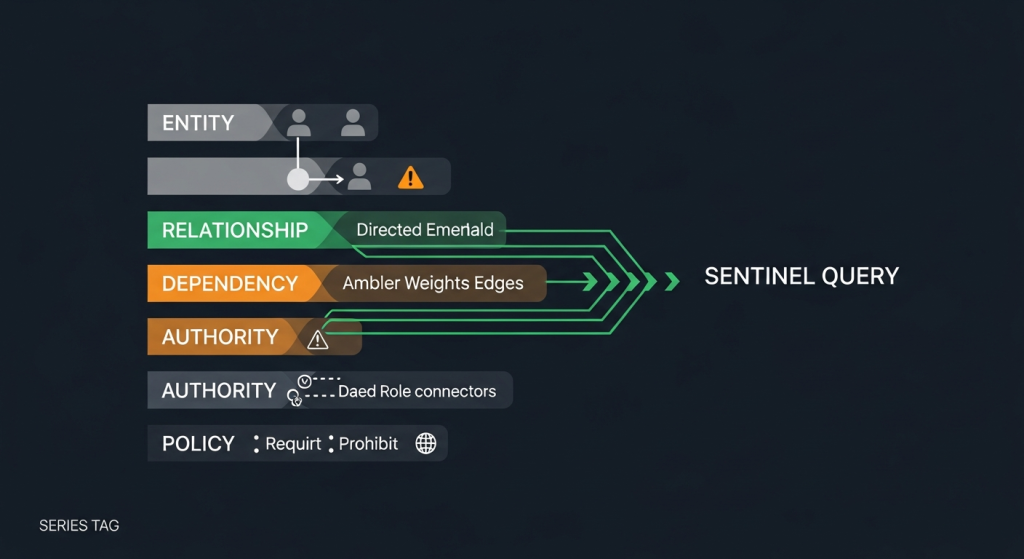
Most organizations building AI governance assume the ontology is documentation. A knowledge graph. A service catalog. Something humans read and update when the spirit moves them.
That assumption produces the wrong system.
The Entropositive Ontology is not built for humans to read. It is built for Sentinel to query. At decision time. In the hot path. Before execution proceeds.
When Sentinel intercepts an action, it runs a structured query across five layers: Entity (what is the target?), Relationship (what does it connect to?), Dependency (what does it cascade to?), Authority (who decides?), Policy (what is permitted, required, or prohibited?). The output is an Entropy Quotient, a gate decision, an authorization routing, and the evidence record that gets committed to the Authorization Evidence Pack before any execution happens.
This entire sequence runs in milliseconds. It does not work if the ontology is a wiki page.
The operational implication is that ontology construction is infrastructure work, not documentation work. It belongs in the deployment pipeline. When a new service is deployed, it gets registered in the graph. When a schema changes, the dependency layer updates. When ownership transfers, the Authority Layer reflects it. The ontology is a live system with availability and accuracy requirements. Treating it otherwise is the fastest path to governance that looks rigorous on paper and fails at decision time.
Documentation can be derived from the ontology. Service catalogs, architecture views, policy coverage reports: all of these can be generated as projections of the same graph that Sentinel queries. But the graph is the source of truth. The documentation follows from it.
The inversion matters. Documentation as a derivative of infrastructure is a different operational posture than infrastructure as an implementation of documentation. The first produces a governance system that stays current. The second produces a governance system that is accurate at deployment time and degrading from that moment forward.
This article, the eleventh in the enterprise governance series, covers the five-layer structure of the Entropositive Ontology, what Sentinel actually queries at decision time, how VEIP commits the ontology’s findings to a cryptographically verifiable evidence pack, and what the operational commitment to ontology maintenance looks like in practice.
Link in comments.
AIGovernance EnterpriseAI KnowledgeGraph Entropositive Qaori
The Entropositive Principle: Why Entropy Is the Right Unit of Governance
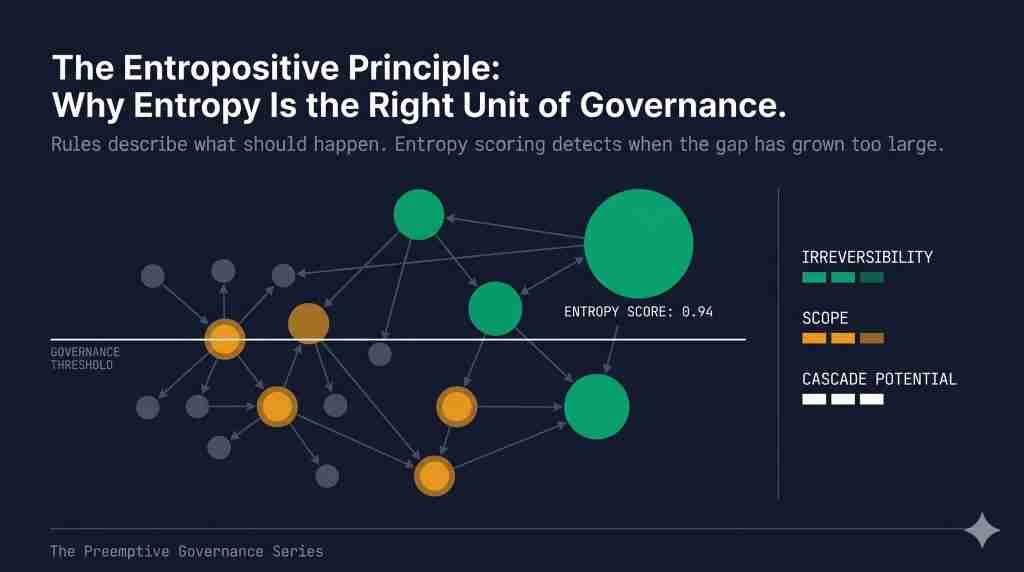
Most governance frameworks ask whether a rule was followed. The Entropositive principle asks a prior question: does this decision increase systemic entropy beyond a recoverable threshold? The answers are not the same question. In 1865, Rudolf Clausius gave physics a concept that has never stopped being true. Entropy, the measure of disorder in a thermodynamic […]
The Governance Layer That Operates Before the Decision, Not After It

Governance frameworks have historically been written at the policy layer: principles, codes of conduct, documentation requirements. They sit above the systems they are meant to govern and rely on human review happening sometime after a decision has already moved downstream. For most of the history of enterprise software, that lag was acceptable. For AI systems making real-time credit, hiring, clinical, and operational decisions, it is not.
The gap is architectural. Current frameworks assume that documentation and audit logs are a proxy for control. They are not. A log records what happened. It does not stop what is happening. That distinction matters enormously when the speed of AI execution outpaces the speed of human review by several orders of magnitude.
Qaori The Brain AI Company built Deterministic Hybrid Governance to close that gap at the execution boundary, not at the audit layer. DHG is a client-side sentinel installed on the enterprise’s own infrastructure. It captures every decision, whether generated by an AI model or a human operator, and maps each one against the organization’s knowledge graph. Each decision receives a trust score based on its consistency with validated past decisions, a measure of how far it deviates from established patterns. Decisions that cross the entropy threshold do not execute. They are routed to a physical Hardware Security Module requiring a physical key before they can proceed. That is what makes DHG hybrid: human decisions, AI decisions, and hardware-signed approval working together as a single enforceable layer. The system is deployable today.
This is not a roadmap item or a theoretical framework. It is a running architecture that treats the moment before execution as the only moment that meaningfully matters for governance.
The article below explains how DHG works, why the execution boundary is the right place to enforce policy, and what this means for enterprises operating AI in regulated environments.
[Read: Deterministic Hybrid Governance — the category the EU AI Act is forcing into existence] (link in first comment)
The Funding Machine Is Financing the Wrong Future

$83 billion in AI funding in six months.
95% of corporate AI projects producing no measurable profit.
This is not a technology wave. It is a fashion cycle with better branding.
The conventional diagnosis is time horizon. More patient capital. But the problem is deeper than patience.
The funding machine is organized around a theory of what intelligence is for. The theory is that intelligence optimizes: it makes things faster, cheaper, more scalable. Close the loop in eighteen months.
What that theory cannot see is a different question.
What if the purpose of intelligence is not to optimize what already exists, but to transmit what must not be lost?
UNESCO has documented thousands of knowledge traditions at risk of disappearing within a generation. The knowledge exists in living practitioners. There is no database. There is no backup. When a master retires without transmitting what they know, that knowledge is gone.
Not stored. Gone.
The funding machine has the wrong theory of intelligence. It is financing optimization. The civilization problem is transmission.
This is the first piece in a seven-part series called The Unbroken Thread.
Each article explores one dimension of the same question: what would it mean to build knowledge infrastructure that the next fifty years actually need?
The series is not a complaint about AI. It is a proposition about what AI, built correctly, could do for the generations that come next.
Full article in the first comment.
KnowledgeTransmission IntangibleCulturalHeritage AI VentureCapital LongTermThinking Qaori
They Don’t Read Because Reading Isn’t the Problem

The fifteen-year-old who watches three-hour YouTube essays but can’t finish two paragraphs of text is not broken.
The format is.
She has watched three hours of close argument on a complex historical subject. Primary sources. Counter-arguments. A sustained analytical framework. Voluntarily. On a Saturday afternoon. Without being asked.
The problem is not her attention.
The book is a five-hundred-year-old tool. It solved a real problem brilliantly: how to transmit knowledge at scale without requiring the physical presence of the person who holds it.
But the book has one characteristic we have never named as a characteristic, because we mistook it for a feature of knowledge itself.
The book does not watch you.
It cannot tell whether you understood. It cannot adjust when the argument would benefit from a different angle. It delivers its content the same way to the eight-year-old and the professor.
For five centuries, that was the best available option.
The teenager chose the video over the article because the video has a voice, a rhythm, a person who clearly cares about the subject, pacing that responds to complexity. The essayist anticipated her reactions and built them into the structure. The paragraph offered none of this.
She correctly identified that one format contains something closer to the actual experience of learning from a person.
She is not wrong. The format is wrong.
We have responded by treating this as a moral failure in the young. More discipline. More friction. More insistence on the old container. As if the difficulty of the format is the point.
We do not apply this logic anywhere else. We do not tell surgeons to refuse anesthesia because the difficulty of the operation is what makes the surgeon serious.
The job of a knowledge format is to transmit knowledge. If a format fails at that job, the question is not what is wrong with the learners.
Full article in the first comment.
Education LearningFormats KnowledgeTransmission DigitalLearning IntangibleCulturalHeritage Qaori
What a Flight Envelope for AI Actually Looks Like
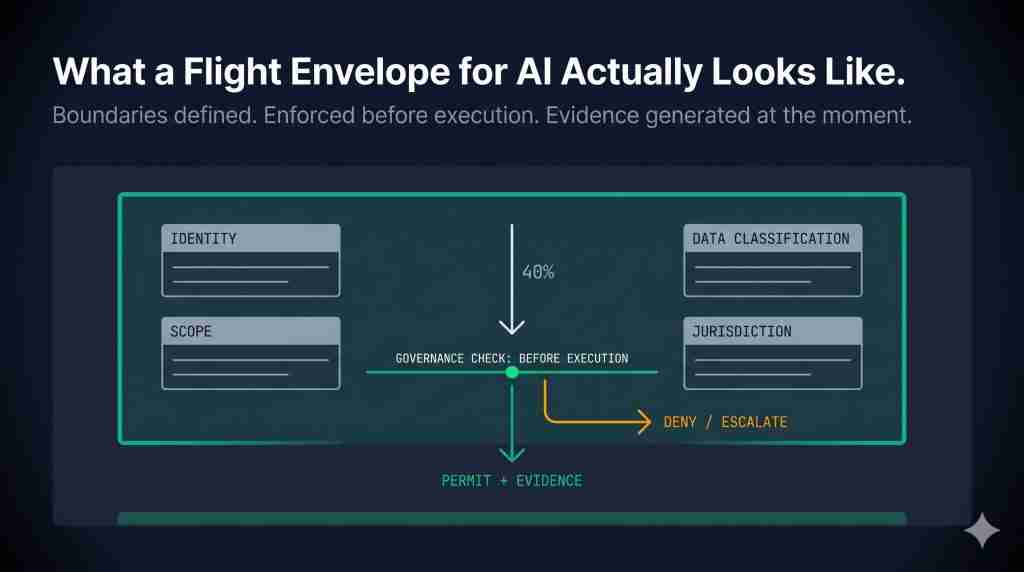
Every AI agent operating in your enterprise has an intended operating envelope. The question is whether that envelope is enforced before the agent acts, or recorded after it already has.
The flight envelope in aerospace defines the boundaries within which an aircraft can safely operate. Flight management systems enforce those boundaries continuously, in real time, before the aircraft enters an unsafe state. They do not wait for a limit to be exceeded and then log it. They evaluate, intercept, and respond before the unsafe state occurs.
The AI equivalent is architecturally precise. An agent’s operating envelope includes its authorised identity, its permitted toolset, the data classification tiers it may access, the regulatory jurisdictions that apply to its actions, and the categories of action requiring human approval before execution. These are definable parameters. The governance question is the enforcement model: evaluated before the action, or recorded after it.
A flight envelope governance model works as follows. A request comes in from an agent. A governance layer in the execution path intercepts it before any tool is invoked or external system contacted. The layer checks identity, scope, data classification, jurisdictional requirements, and approval gates. If the action passes, it executes, and a structured, policy-linked evidence event is generated at that moment, sealed in tamper-evident form. If the action fails, it is denied, transformed, or escalated. The denial itself becomes an evidence record.
This is the architectural inversion that distinguishes governance from logging. The record is generated as part of the governance evaluation, whether the action proceeds or not. The evidence exists at execution time, not as a retrospective reconstruction.
This is the architecture that Qaori Sentinel is built to provide: a client-side governance bridge in the execution path, enforcing the flight envelope locally before actions are dispatched, generating structured evidence events that flow to the Qaori control plane above it for compliance mapping, anomaly detection, and audit readiness.
The flight envelope concept applied to AI is not a metaphor that requires translation. The parameters are definable. The enforcement architecture is buildable. What has been missing is not the concept but the implementation.
What does your current governance architecture intercept before an action runs?
#AIGovernance #QaoriSentinel #EUAIAct #AIRiskManagement #EnterpriseAI
The Sysadmin and the AI Agent: Why the Same Gate Must Fire for Both
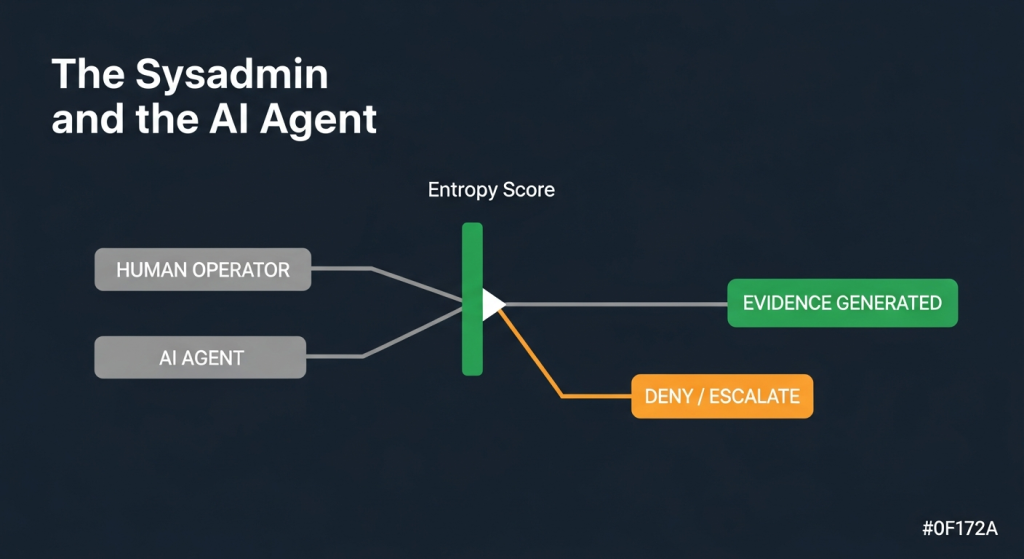
The governance gap between AI agent actions and human operator actions is not a nuance. It is an exploitation surface. Any governance framework that treats human and AI decision-makers differently creates a path by which high-entropy actions can be executed through the less-governed channel. On a Tuesday afternoon in a mid-sized financial services firm, a […]
The Authorization Gap: Where Hardware Enforcement Meets Constitutional Governance
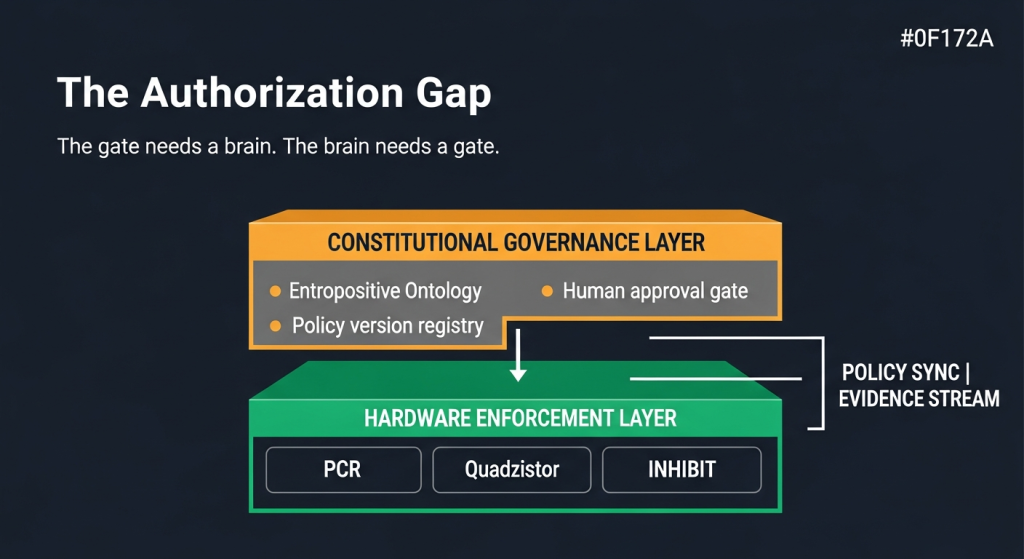
David Reichwein’s Authorization Gap framework correctly identifies the structural void between AI decision and physical execution. Closing that gap with hardware enforcement is necessary. It is not sufficient. The gate needs a brain. There is a question that sits at the foundation of every serious AI governance architecture conversation and is rarely made explicit. Not […]
The LLM Is Not the Problem. The Absence of Engineering Discipline Is.
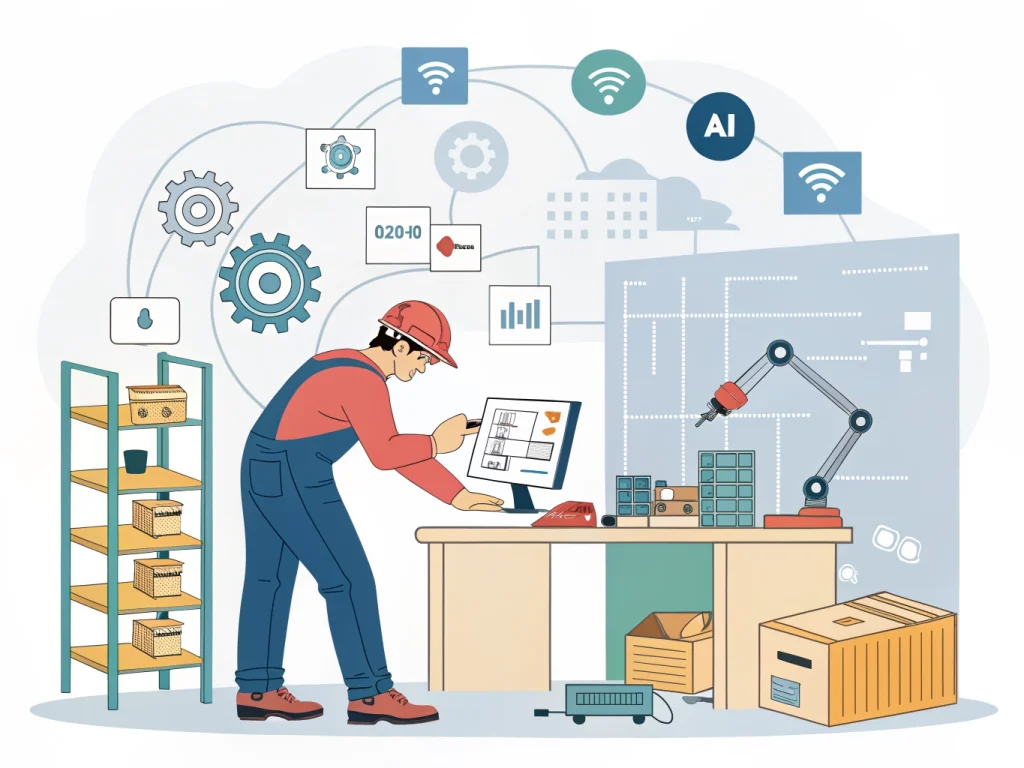
The failure of undisciplined AI deployment mirrors the offshore development disasters of the 2000s. One million lines of production code later, QAPAF proves that the toy becomes a tool the moment you apply the discipline of a craftsman. The debate about whether large language models are “toys” or “tools” is the wrong debate. A hammer […]
The Governance Question Nobody Is Asking

In an era where AI governance is becoming a pressing concern, boards are facing a pivotal question: “Show me your AI governance.” Organizations like Qaori are redefining the landscape by embedding governance into their very architecture, rather than retrofitting it around existing structures. This proactive approach transforms how AI is monitored, risks are assessed, and accountability is established. As the demand for transparency and evidence grows, understanding the nuances of AI governance becomes essential. Discover how Qaori is not just talking about governance but demonstrating it through innovative frameworks and robust systems designed for the AI-native economy.
Qaori Anonymous ID: Janus

Japan has one of the lowest whistleblower disclosure rates in the developed world, not due to a lack of wrongdoing, but because of a cultural suppression of confrontation. The Janus Identity Bridge offers a revolutionary solution, allowing verified individuals to report misconduct while maintaining their anonymity. This architectural innovation separates identity verification from disclosure, ensuring that organizations cannot unilaterally identify whistleblowers. With the Janus system, we can create a safer environment for reporting, unlocking the potential for ethical whistleblowing across various sectors. Discover how this groundbreaking technology can transform the landscape of accountability and protection for vulnerable individuals.
Two Faces, One Truth: Why Whistleblowers Need a Roman God

In a world where whistleblowers face the daunting challenge of anonymity versus accountability, the Janus Identity Bridge emerges as a revolutionary solution. This innovative platform simultaneously verifies the identity of the whistleblower while ensuring their anonymity, creating a secure channel for disclosures that legal frameworks have long promised but technology has failed to deliver. With applications ranging from compliance in Japanese enterprises to ethical reporting in supply chains, Janus is set to transform the landscape of whistleblower protection. Discover how this groundbreaking approach can empower individuals to speak out without fear—unlocking a new era of transparency and trust.
The Layer No Regulator Can See

Brian Burke published a piece this week that named, with unusual precision, the part of AI risk that no current framework governs.
He calls it the AI Decision Influence Layer.
The argument is exact. NIST AI RMF, ISO 42001, and the EU AI Act all govern the AI system itself. None of them govern what happens inside the heads of the humans working alongside it.
A loan officer who reviews two hundred AI scores a day stops evaluating each from scratch. Override rates fall. Accept latencies shrink. Whole categories of decision drift into systematic deference. The override mechanism still exists. The compliance boxes are still ticked. And the cognitive environment of the firm has quietly changed shape.
I read the piece twice. Then I sat with it for a day.
I sat with it because for almost two years my team and I have been building a platform that is, by definition, exactly the layer Burke describes. A Qaori Alter speaks, decides, and acts in the voice of its owner over months and years. If anyone is operating at the centre of the Decision Influence Layer, it is us.
So I want to credit Burke for naming the gap, and I want to say what we are doing about it.
Three primitives. One Charter object. A second-loop analyser that runs above the model, not at it. Override rate. Accept latency. Deferral concentration. Advisory alerts to a governance queue. AIUC-1 evidence integration so the layer Burke says regulators cannot see is in fact carried, by the platform, into the evidence pack the regulator does see.
We started shipping Epic 063 — the AI Decision Influence Layer — into staging this week. Six work packages. The full chain.
The EU AI Act deployer obligations land on 2 August. Ninety days. The platforms that cannot answer the influence-layer question by then will be eliminated quietly when procurement frames shift around them.
The companion long article and the four-paper white paper sit underneath this post. Engineering, ethics, platform integration, and the relationship to our parallel epic on Governance Ontology and Charter Drift.
If your organisation is past checklist and ready to govern the layer the checklist does not see, I would value a conversation.
#AIGovernance #EUAIAct #ResponsibleAI #AIUC1 #PlatformGovernance #EnterpriseAI #NIST #ISO42001
The Leaders Who Feel the Gap

The leaders who feel most uneasy about AI adoption are often the most thoughtful ones. They moved carefully, asked the right questions, and discovered that the tools available to them were not designed to answer those questions at scale.
This article is for them.
It is about the governance gap, control debt, and why infrastructure has to come before capability expansion, not after a risk event.
The Factory Has a Front Door. And the Front Door Has Rules.

The moat in autonomous software development is not the model. It is the system around the model.
We recently completed a significant upgrade to QAPAF, one that changes what every agent in the factory reads before it does anything else. I will not describe the mechanism. The outcome is this: agents that begin each session from a known, governed behavioral baseline produce fundamentally different output than agents operating from accumulated context and inferred expectations.
At the front of the factory sits Qappa. Not a chatbot. Not an assistant. A Product Owner with authority over scope, specification, and quality. No implementation begins without Qappa’s approval. No session starts without a governed state. That authority is not symbolic. It is structural.
This architecture reflects forty years of PM/PO experience encoded as organizational constraint. You can replicate the tools. The judgment that designed the system around them is not available off the shelf.
The full argument, including why the LLMs are the most interchangeable part of the stack, is in the article below.
#AIEngineering #AutonomousSoftware #EnterpriseAI
Gates Catch Defects. The Behavioral Layer Prevents Them.

Gates catch defects. The behavioral layer prevents them. In our journey with QAPAF, the Qaori Autonomous Software Factory, we’ve discovered that simply identifying flaws isn’t enough. Every defect that slips through is a costly reminder of incomplete context and poor defaults. Enter the behavioral layer—a revolutionary approach that reshapes how agents operate before tasks even begin. With strict disciplines like spec-first enforcement and independent reviews, we’re not just catching errors; we’re preventing them. Discover how this innovative system transforms our quality process, reducing defect rates and enhancing reliability. Join us as we unveil the future of software quality management.
The Entropositive Principle: Why Entropy Is the Right Unit of Governance
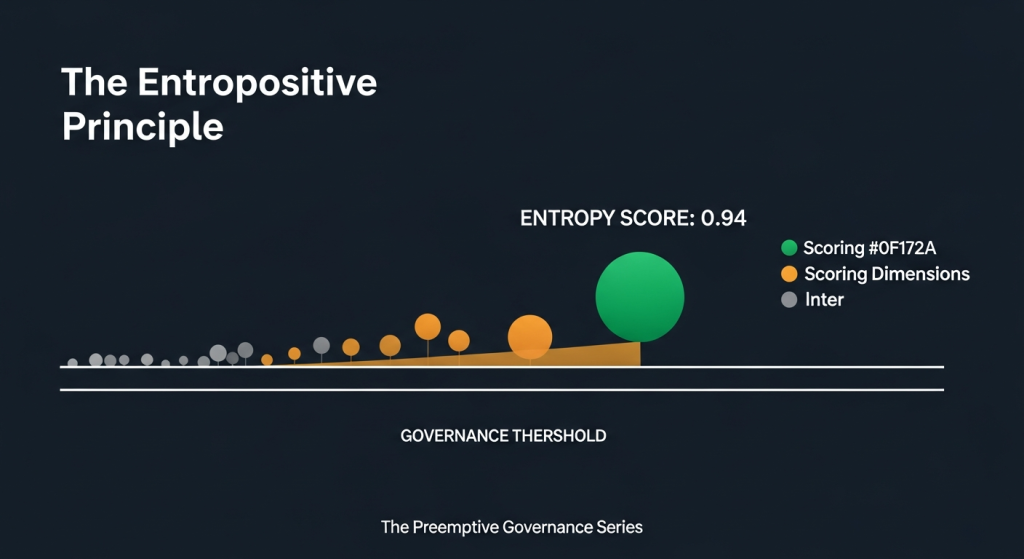
Most governance frameworks ask whether a rule was followed. The Entropositive principle asks a prior question: does this decision increase systemic entropy beyond a recoverable threshold? The answers are not the same question. In 1865, Rudolf Clausius gave physics a concept that has never stopped being true. Entropy, the measure of disorder in a thermodynamic […]
We Built for Compliance Before the Market Asked For It. Here Is What We Learned.
The EU AI Act enforcement deadline is August 2026. Many organizations are now discovering that compliance is not a feature layer: it is a substrate. Qaori built for it from the start. This is what that looks like from the inside. We Built for Compliance Before the Market Asked For It. Here Is What We […]
Your AI Governance Is Drifting
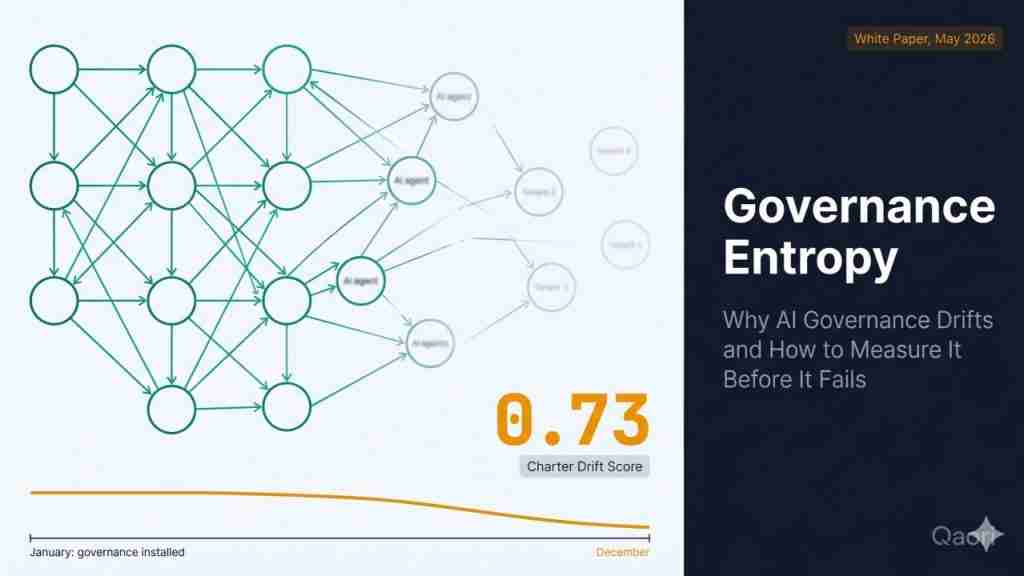
Is your AI governance framework still accurate, or has it drifted into obsolescence? As organizations evolve, their governance structures often lag behind, creating a hidden gap known as the Shadow Ledger. This article explores the inevitable decay of governance and introduces three essential instruments-Charters, Ontology Maps, and Drift Scores-that transform static documents into a dynamic control plane. Discover how to measure governance drift and ensure your organization remains compliant and resilient in an ever-changing landscape. Don’t let your governance describe the past; learn how to maintain its relevance today.
IBM Just Rang the Bell for Sovereign AI. Qaori Already Answered.
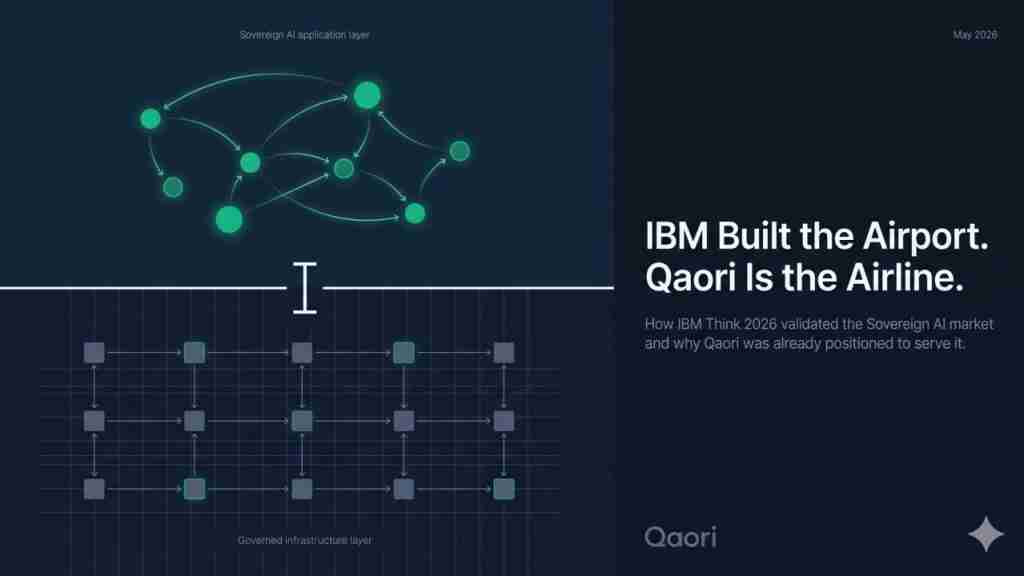
When IBM announced the general availability of Sovereign Core at Think 2026, it marked a pivotal moment for the Sovereign AI category. This infrastructure is essential, but it’s only the beginning. Qaori is poised to fill the critical gap, delivering the AI capabilities that make this regulated environment truly valuable. With 75% of enterprises planning digital sovereignty strategies by 2030 and a significant trust gap in AI, Qaori stands at the forefront, ready to transform the landscape. Discover how Qaori is not just building on IBM’s foundation but is set to redefine the future of enterprise AI.
We are running 19th-century operating systems on 21st-century hardware.
We are running 19th-century operating systems on 21st-century hardware. Every institution failing right now – governments, companies, hospitals – shares the same root cause: the architecture for making decisions was designed for a different world. Problems do not wait for committees, and adding more oversight only compounds the issue. The conclusion I keep reaching is always the same: the people are usually fine. What’s missing is the method. Discover how Augmented Governance can provide the intelligence we need to navigate this complex landscape and transform our institutions for the better.
The HR Problem Nobody Puts on the Risk Register: Company Amnesia
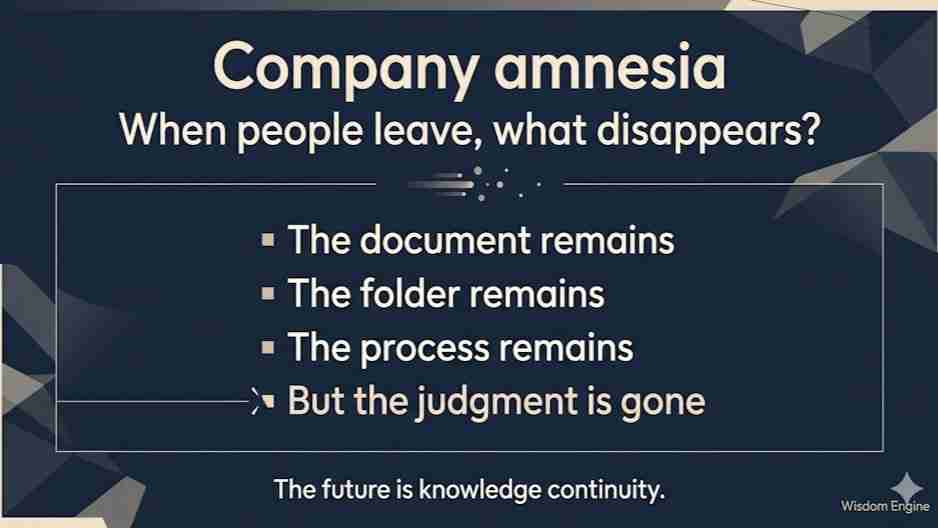
By Rosho, Founder, Qaori, the Brain Company in Japan. Building Sovereign Company Brains for the baby-boomers 団塊世代 succession wave. GDPRS/APPI-compliant. April 26, 2026 Every organization has someone like this. The person who knows why a particular process works the way it does. The one who remembers which customer asked for the exception, three years ago, […]
How Much Does Company Amnesia Really Cost?
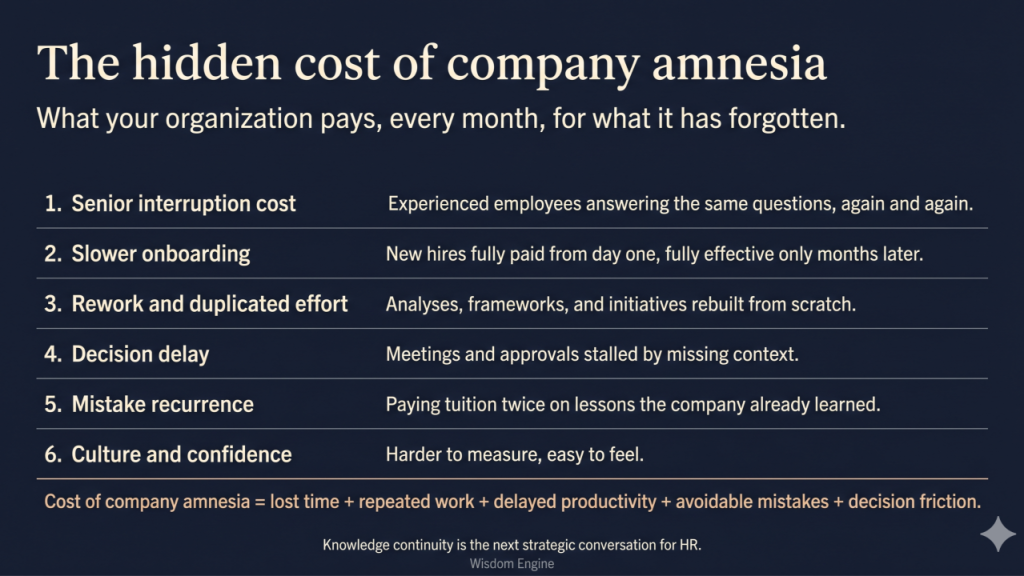
By Rosho, Founder, Qaori, the Brain Company in Japan. Building Sovereign Company Brains for the baby-boomers 団塊世代 succession wave. GDPRS/APPI-compliant. April 28, 2026 Most HR teams can quote the cost of hiring a new employee with surprising precision. They know the cost of advertising a role, the time spent in interviews, the agency fee, the […]
What the first large field study of coding agents tells us about the next industrial layer of software
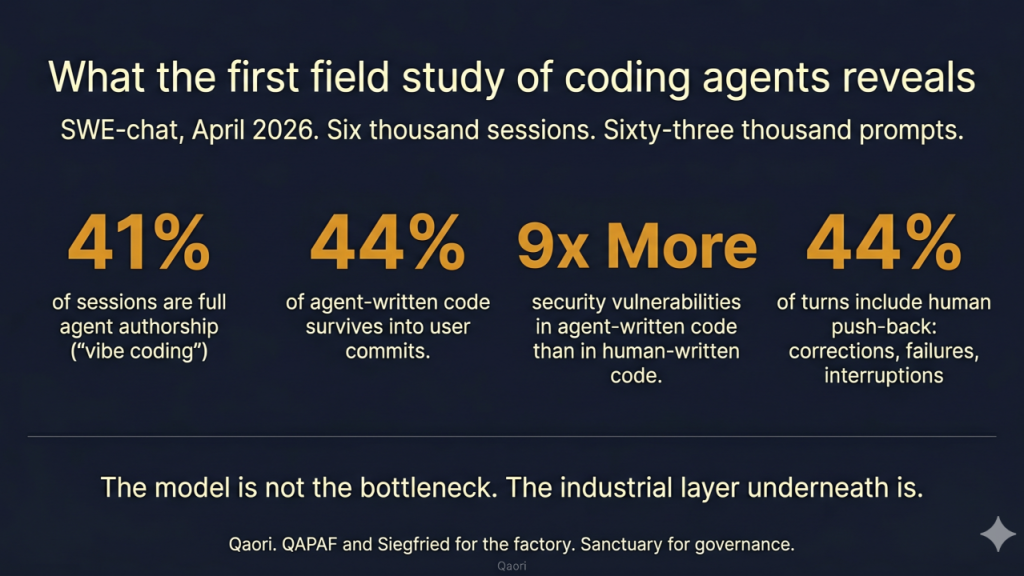
By Rosho, Founder, Qaori, the Brain Company in Japan. Building Sovereign Company Brains for the baby-boomers 団塊世代 succession wave. GDPRS/APPI-compliant. April 29, 2026 A new dataset called SWE-chat, released this month by researchers from Stanford, NYU, Princeton, and Anthropic, is the first attempt to look honestly at how AI coding agents are actually used in […]
Jacquard → Canuts → Babbage → GenAI → Governance (Why We Keep Repeating the Same Story)
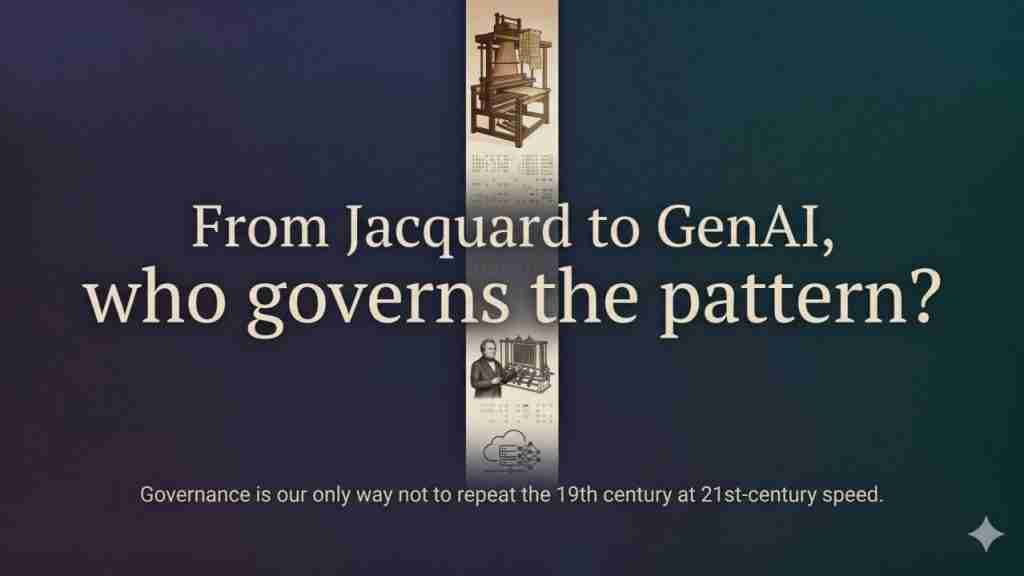
In 1805, Joseph-Marie Jacquard revolutionized weaving by turning it into a programmable activity, shifting power from master weavers to designers and merchants. This transformation sparked the Canut weavers’ revolts, highlighting the governance failures behind technological advancements. Today, generative AI represents a similar crossroads, encoding not just patterns of fabric but language, images, and decisions. As we navigate this new landscape, the real challenge lies not in the technology itself, but in how we govern it. Can we learn from history to ensure that the benefits of automation are shared equitably, rather than dictated by a select few?
I am a Guilded Master Organ Builder. I crossed into AI to save the Crafts.

By Rosho, Founder, Qaori, the Brain Company in Japan. Building Sovereign Company Brains for the baby-boomers 団塊世代 succession wave. GDPRS/APPI-compliant. May 4, 2026 A position written from inside 30 years at the workbench, and from inside the platform I built afterward. The two together are the only place this answer can be written from. I […]
How a Sovereign Brain Actually Preserves Wisdom. Seven Mechanisms, one Substrate.

In a world where invaluable wisdom is walking out the door-retiring senior managers, master craftsmen, and family elders-Qaori is pioneering a solution. Our platform captures knowledge through engaging conversations, transforming it into a living, structured resource that can be accessed and utilized by future generations. Imagine a world where your legacy is preserved in your own voice, ready to guide the next generation. Discover how our innovative mechanisms, from the Wisdom Engine to the Alter, are redefining knowledge transfer and ensuring that wisdom is not lost but held, respected, and transmitted on your terms.