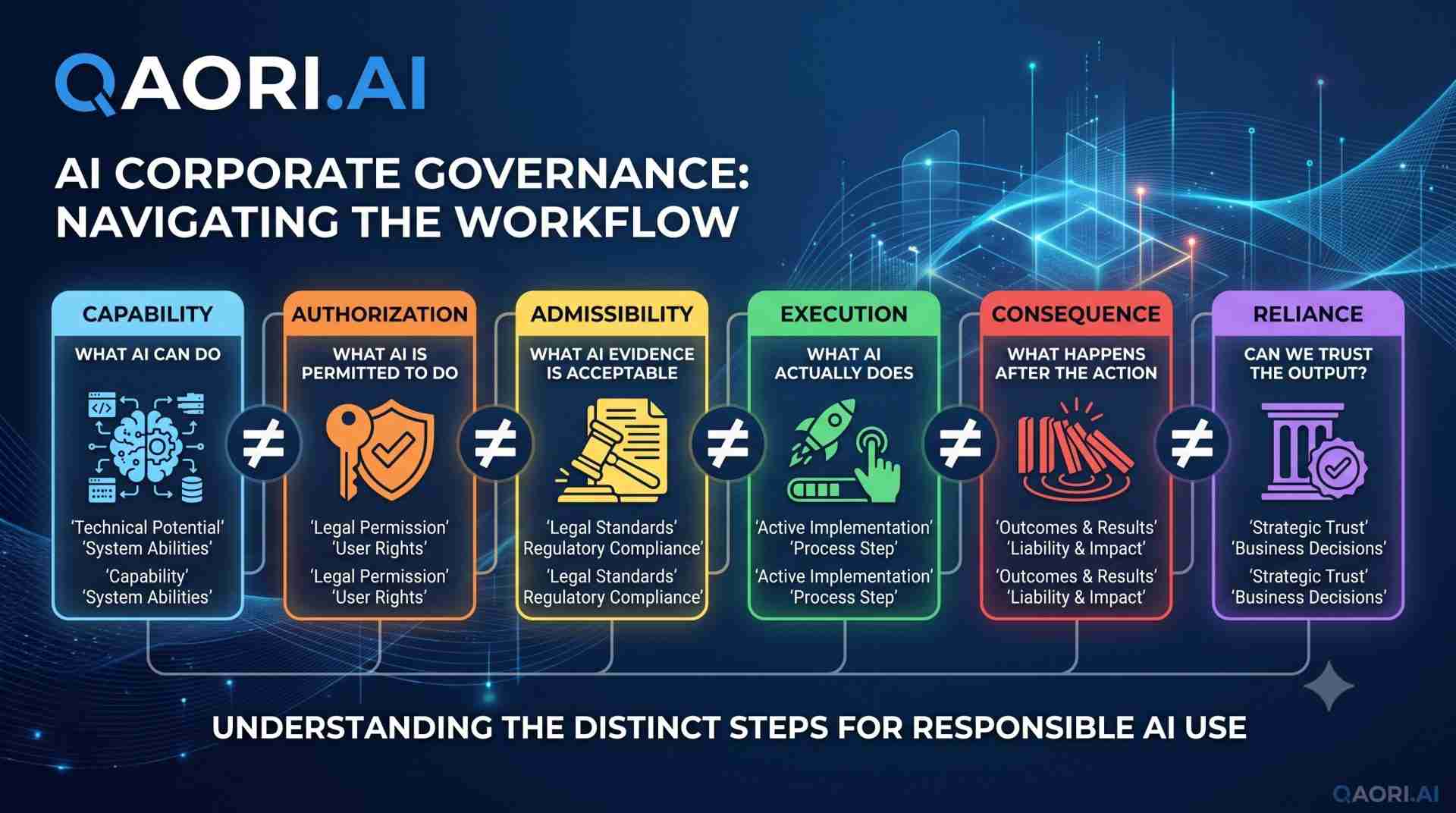
Deterministic Hybrid Governance defines a new category: physically enforced, hardware-anchored AI governance for enterprises operating under the EU AI Act.
For years, enterprise AI governance has been treated as an editorial function. Policies are written, ethics frameworks are published, audit logs are reviewed, and guardrails are configured in software. The implicit assumption running through all of it is that governance happens around the decision, and that the decision itself remains the province of whichever system, human or AI, happens to be making it. This assumption is the source of the compliance exposure that now sits on the balance sheets of every enterprise running AI at scale.
Deterministic Hybrid Governance (DHG) is a different proposition. It is not a policy layer, a consulting framework, or a probabilistic content filter that can be circumvented by a sufficiently creative prompt. DHG is a client-side sentinel deployed directly on the enterprise’s own technology stack, with a hardware enforcement gate, requiring a physical key for manual approval, that no decision with unacceptable risk can bypass. The architecture makes governance enforceable in the literal sense of the word, not aspirationally enforced, not softly suggested by a model’s alignment training, but physically blocked at the hardware layer until a human being turns a key.
That distinction between governance as editorial oversight and governance as physical enforcement is not cosmetic. It is the only distinction that matters when regulatory penalties are measured in tens of millions of euros, and when the AI systems generating enterprise revenue are making decisions that ontologically outpace the policies written to contain them.
Why physical enforcement is categorically different
The standard critique of enterprise AI governance tools is that they operate on the output of a decision rather than on the decision itself. A policy document cannot intercept a model inference. A software guardrail lives in the same probabilistic environment as the model it is meant to restrain, which means that any sufficiently novel input can produce an output the guardrail was never designed to evaluate. The guardrail’s weakness is structural, not a product of inadequate configuration.
DHG addresses this at the architectural layer. Every decision, whether made by a human operator or an AI system, is captured by the sentinel at the moment it is generated and mapped onto an ontology map, a knowledge graph representing the validated decision patterns of that enterprise’s domain. The sentinel then evaluates the entropy of the decision: how far does this choice deviate from the established, validated patterns that the organization has previously accepted as sound? Every decision, human or AI, receives a trust score based on its consistency with those validated past decisions. Decisions that deviate significantly require physical key approval before execution.
That final clause carries the operational weight of the entire system. High-entropy decisions do not execute pending review, they do not execute with a logged warning, and they do not execute subject to a policy exception workflow that can be approved in software by an authorized user with a password. They do not execute until a human being physically activates the Hardware Security Module with a key. The hardware is the enforcement gate. The physical key is the proof of human intent. Neither can be emulated, prompted around, or overridden remotely.
What hybrid actually means in this context
The word hybrid has accumulated enough ambiguity in enterprise technology marketing that it requires precise definition on first use. In DHG, hybrid refers to the integration of three distinct decision layers into one unified governance framework: human decisions, AI decisions, and hardware-signed approval, unified in one framework. This is not a human-in-the-loop process where a human occasionally reviews AI output. It is a framework in which the governance logic operates identically across human and machine sources, and in which neither source can bypass the hardware enforcement gate.
This matters because the governance failure modes of human decisions and AI decisions are structurally different. Human decisions fail through bias, political pressure, time constraint, and information asymmetry. AI decisions fail through distributional shift, prompt injection, model drift, and the quiet compounding of small optimization errors across millions of inferences. A governance framework designed only for one category of decision will miss the failure modes of the other. DHG captures and entropy-scores both, routes both through the same ontology map, and applies the same physical enforcement logic to both. The chief information security officer responsible for signing off on the organization’s governance posture is signing off on a unified architecture, not two separate frameworks that were later connected with an integration layer.
The regulatory clock and the compliance gap
The EU AI Act reaches full enforcement for high-risk systems in August 2026. Penalties for non-compliance reach 35 million euros or 7% of global annual revenue, whichever is greater. These are not theoretical maximums reserved for egregious violations; they are the statutory ceiling for non-compliance with governance requirements that regulators have signaled they intend to enforce. Organizations that have been running AI in production under the assumption that governance could be addressed as a documentation exercise are now within the enforcement horizon.
The compliance gap is already measurable. As of mid-2026, only 31% of enterprises have deployed AI ethics tools, against 74% that are running revenue-generating AI in production. The industry has converged on deterministic governance as the framing that satisfies both technical and regulatory requirements, recognizing that probabilistic safeguards do not provide the auditability that regulators require. What has been absent until now is an architecture that operationalizes deterministic governance at the hardware layer, with provable enforcement that does not depend on the integrity of the software stack above it.
What this means for enterprise buyers today
For the CISO, DHG addresses the audit requirement that most current governance tools cannot satisfy: a tamper-evident, hardware-anchored record of every high-entropy decision and the physical approval event that authorized its execution. This is an audit trail that is structurally resistant to post-hoc alteration because the hardware event itself is the record.
For the CTO and the engineering organization, DHG is a client-side sentinel that installs on existing infrastructure. The organization’s technology stack does not need to be restructured to accommodate it. The ontology maps that power entropy scoring are built from the enterprise’s own validated decision history, which means the governance layer is domain-specific rather than generic.
For General Counsel and the Board Risk Committee, DHG provides the evidence of governance that regulators are positioned to require: not a policy document attesting that governance exists, but a hardware-enforced record demonstrating that governance operated at the decision layer, before execution, on every high-entropy event. That is a materially different legal and regulatory posture than what most enterprises currently hold.
DHG is deployable today. It is not a roadmap commitment, a pilot program requiring a future integration, or a consulting engagement that produces a framework document. It is an operational sentinel with hardware enforcement, available now, for enterprises that have concluded that the governance gap between their AI deployment footprint and their compliance posture is no longer acceptable.
The category origin
Deterministic Hybrid Governance, as a defined architectural category, originates with Qaori The Brain AI Company. The architecture described here, the three-layer integration of human decision capture, AI decision capture, and hardware-enforced approval through a physical HSM, represents a departure from governance as it has been practiced in enterprise AI, and an arrival of governance as it needs to be practiced given the enforcement environment now taking shape. The question for enterprise decision-makers is not whether this category of governance will become the standard. It is whether the organization’s current governance posture will satisfy the regulators and the board by the time it does.