






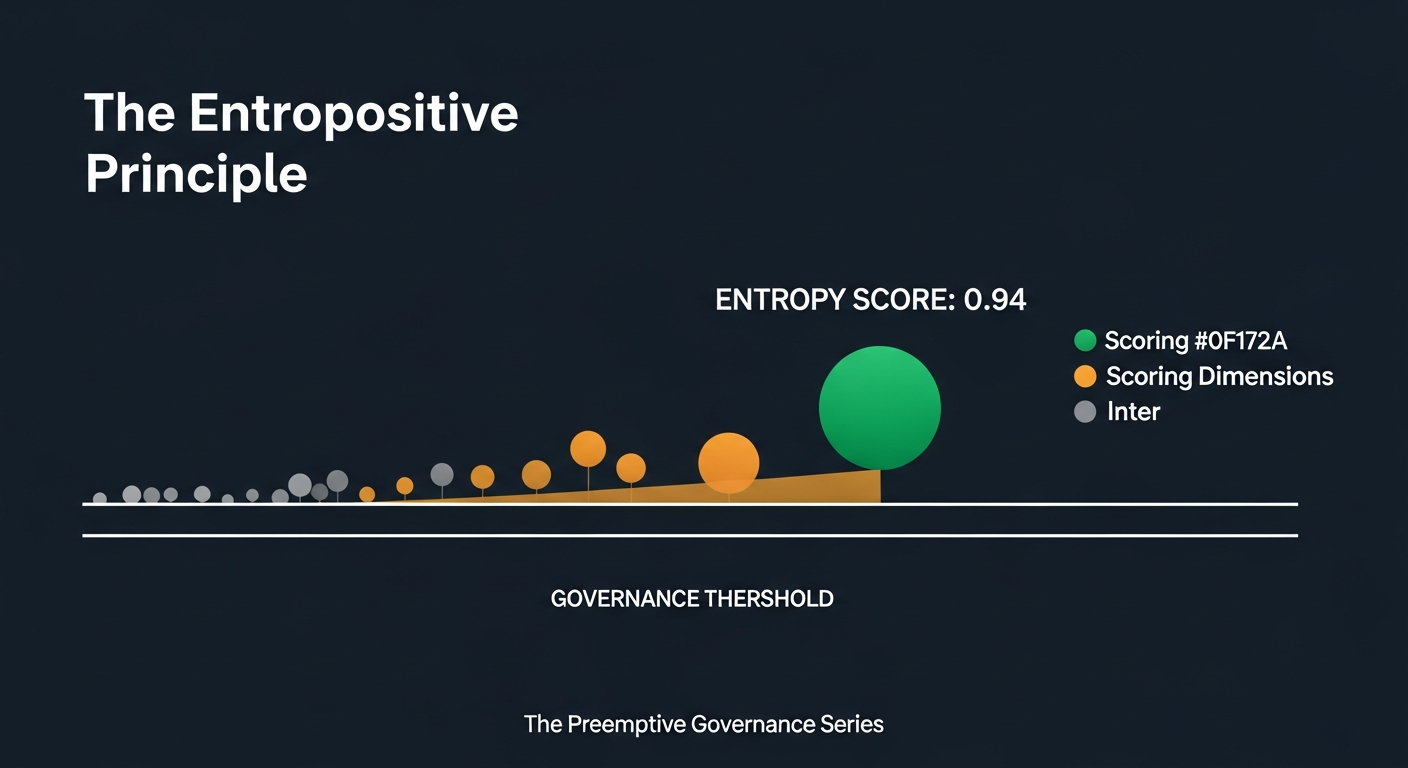
Most governance frameworks ask whether a rule was followed. The Entropositive principle asks a prior question: does this decision increase systemic entropy beyond a recoverable threshold? The answers are not the same question.
In 1865, Rudolf Clausius gave physics a concept that has never stopped being true. Entropy, the measure of disorder in a thermodynamic system, always increases in a closed system unless energy is actively invested to hold it back. The second law of thermodynamics does not describe a tendency. It describes an inevitability. Systems do not drift toward disorder as a matter of probability. They are pulled toward it as a matter of physics.
This is not a metaphor when applied to organizations or to the governance of AI systems. It is a structural description. Any system that makes decisions faster than it evaluates their reversibility, scope, and cascade potential is an entropy-accumulating system. It will eventually reach a threshold imposed from outside: regulatory failure, operational catastrophe, market collapse, or the kind of reputational event that no governance document assembled after the fact can undo.
The field of AI governance has spent the past several years building frameworks that operate at the rule level. A governance rule describes what should or should not happen. It is a constraint on behavior, documented and communicated. Rules are necessary. They are not sufficient, because the question that rules answer is not the question that determines whether governance will hold under pressure.
The question that determines whether governance holds is: does this decision increase systemic entropy beyond a recoverable threshold?
That question is prior to the rule question. A decision can follow every documented rule and still increase entropy significantly, when the rule system is incomplete, when the decision is novel, when the ontology that maps actions to their consequences has not been updated to reflect a recent architectural change, or when the actor is technically within scope but operating at the boundary of what the rule was designed to govern. A governance system that evaluates actions only against rules will fail precisely in the cases where failure is most consequential, the cases the rule writer did not anticipate.
The Entropositive principle formalizes the prior question. Entropositive derives from entropy and positive: not entropy-neutral, not entropy-tolerant, but directionally committed to moving systems toward lower, more recoverable states. It is governance with a thermodynamic direction. The word is chosen deliberately. Governance that logs, audits, and reports after the fact does not have a direction. It observes entropy accumulating and documents it. Entropositive governance is active: it evaluates the entropy gradient of a proposed decision before execution and gates decisions that would move the system in the wrong direction.
The formalization of this principle as an engineering concept began in 2016, not as a response to AI but as a response to organizational systems: companies whose decision processes accumulated entropy in ways that were predictable from the structure of their dependency graphs, but invisible to any governance system operating at the rule level. The core insight from that work was the following. The failure mode of organizational governance is not rule violation. It is rule irrelevance: the governance framework describes a system that no longer exists, because the system has evolved faster than the framework has been updated. The governance entropy gap is the distance between the organizational system as it actually operates and the governance framework that is supposed to govern it. In every organization that governance has failed, the entropy gap had been widening for months or years before the failure became visible.
The same mechanism operates in AI systems, and faster. A model is deployed, an agent estate is built around it, integrations are added, tools are extended, operating contexts expand. The governance framework that was designed at deployment time describes a system that is already different. The entropy gap opens the moment the first post-deployment change is made without a corresponding governance update.
Entropy, as an engineering measurement for governance, has three components. Irreversibility captures whether a decision can be undone within acceptable recovery time and cost. Not all decisions are irreversible, but among those that are, the cost of reversal varies enormously: from a five-minute configuration change to a four-hour database rollback across 148 dependent services. Scope captures how many entities, dependencies, jurisdictions, and downstream systems an action affects. A decision that affects one workflow is a different entropy event than a decision that affects a decision template from which forty thousand downstream contracts auto-derive. Cascade potential captures the degree to which a decision triggers further automated decisions that compound its effect. A schema migration that triggers automated redeployment pipelines in six downstream services does not end at the schema change. It begins there.
The composite entropy score derived from these three dimensions is computable from the ontology graph of the system being governed. It does not require a human to assign weights. Irreversibility is a property of the action type, derivable from the ontology class. Scope is the degree centrality of the target node in the dependency graph: nodes with more downstream connections carry higher scope weight automatically. Cascade potential is the PageRank of the target node: nodes upstream of other high-degree nodes carry higher cascade potential. The score is structural, not subjective. When the ontology is accurate, the scoring is accurate. When the ontology has gaps, the scoring has blind spots, and those blind spots are the governance risk.
This last point is the honest constraint at the center of the Entropositive model. The entropy score is only as good as the ontology that feeds it. A governance layer operating against an incomplete ontology does not know what it does not know. The detection radius of the system extends only as far as the ontology map extends. A node that is not in the graph generates no entropy signal, regardless of how consequential an action against it might be. This is not a failure of the scoring model. It is a description of what governance intelligence requires: a maintained, accurate, and continuously updated representation of the system’s actual structure, not its intended structure at deployment time.
This is why ontology construction is not a setup step in a governance deployment. It is an ongoing operational obligation. The governance entropy gap closes not through better rules but through better maps.
The practical transition from rule-based to entropy-based governance does not require discarding rules. Rules encode important institutional knowledge about what classes of action are known to be problematic. The transition requires adding the prior question: before we evaluate this action against our rules, what is its entropy score? The rules govern the cases we anticipated. The entropy score governs the cases we did not, which are precisely the cases where governance has historically failed.
For the field, this is an architectural argument with a specific implication. A governance layer that evaluates actions only against rules, however comprehensive those rules are, is a governance layer with a bounded detection radius. It can only intercept action classes that were named in the rule set. A governance layer that evaluates actions against an entropy score derived from an ontology graph has a detection radius that extends to any action whose consequence graph exceeds threshold, whether or not that action class was anticipated when the governance framework was written.
The difference between those two architectures is the difference between governing the system you designed and governing the system you have.
The Entropositive principle is not an alternative to rule-based governance. It is the prerequisite for governance that remains relevant as systems change. Rules describe what should happen. Entropy scoring detects when the gap between what is happening and what should happen has grown to the point where governance must intervene, including in cases where no rule yet exists for what is happening.
That is the prior question. It is the one that determines whether a governance program will hold under the conditions that matter most: the novel case, the edge condition, the action no one thought to write a rule for, taken by an actor no one thought to govern.
In thermodynamics, entropy wins eventually unless energy is continuously invested. In organizational and AI governance, the same principle applies. The difference is that in governance systems, the energy is intelligence, not heat. The Entropositive model is the architectural commitment to invest that intelligence continuously, in the right place, at the right moment: upstream of the action, not in the report that follows it.

