






The Funding Machine Is Financing the Wrong Future

$83 billion in AI funding in six months.
95% of corporate AI projects producing no measurable profit.
This is not a technology wave. It is a fashion cycle with better branding.
The conventional diagnosis is time horizon. More patient capital. But the problem is deeper than patience.
The funding machine is organized around a theory of what intelligence is for. The theory is that intelligence optimizes: it makes things faster, cheaper, more scalable. Close the loop in eighteen months.
What that theory cannot see is a different question.
What if the purpose of intelligence is not to optimize what already exists, but to transmit what must not be lost?
UNESCO has documented thousands of knowledge traditions at risk of disappearing within a generation. The knowledge exists in living practitioners. There is no database. There is no backup. When a master retires without transmitting what they know, that knowledge is gone.
Not stored. Gone.
The funding machine has the wrong theory of intelligence. It is financing optimization. The civilization problem is transmission.
This is the first piece in a seven-part series called The Unbroken Thread.
Each article explores one dimension of the same question: what would it mean to build knowledge infrastructure that the next fifty years actually need?
The series is not a complaint about AI. It is a proposition about what AI, built correctly, could do for the generations that come next.
Full article in the first comment.
KnowledgeTransmission IntangibleCulturalHeritage AI VentureCapital LongTermThinking Qaori
They Don’t Read Because Reading Isn’t the Problem
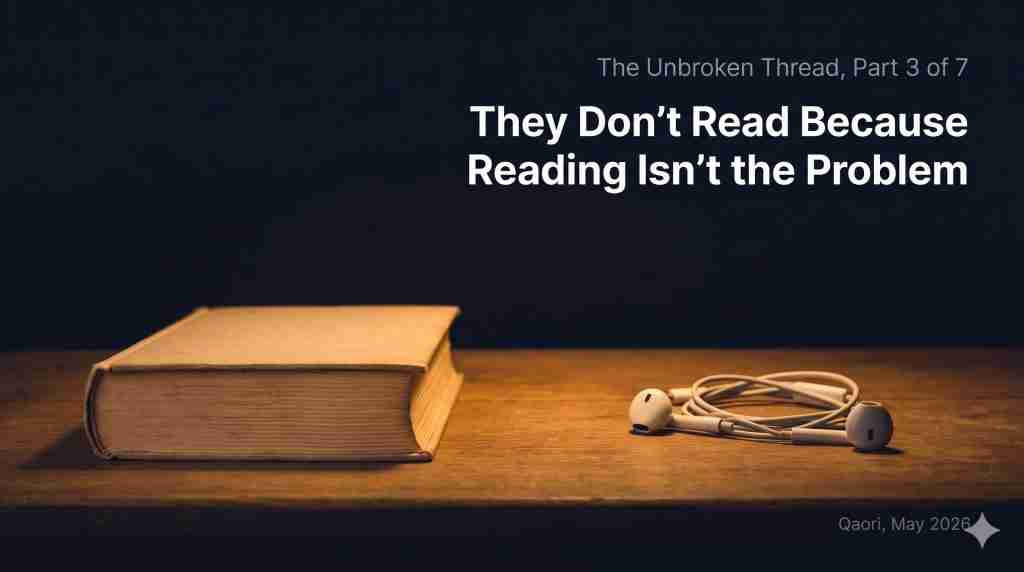
The fifteen-year-old who watches three-hour YouTube essays but can’t finish two paragraphs of text is not broken.
The format is.
She has watched three hours of close argument on a complex historical subject. Primary sources. Counter-arguments. A sustained analytical framework. Voluntarily. On a Saturday afternoon. Without being asked.
The problem is not her attention.
The book is a five-hundred-year-old tool. It solved a real problem brilliantly: how to transmit knowledge at scale without requiring the physical presence of the person who holds it.
But the book has one characteristic we have never named as a characteristic, because we mistook it for a feature of knowledge itself.
The book does not watch you.
It cannot tell whether you understood. It cannot adjust when the argument would benefit from a different angle. It delivers its content the same way to the eight-year-old and the professor.
For five centuries, that was the best available option.
The teenager chose the video over the article because the video has a voice, a rhythm, a person who clearly cares about the subject, pacing that responds to complexity. The essayist anticipated her reactions and built them into the structure. The paragraph offered none of this.
She correctly identified that one format contains something closer to the actual experience of learning from a person.
She is not wrong. The format is wrong.
We have responded by treating this as a moral failure in the young. More discipline. More friction. More insistence on the old container. As if the difficulty of the format is the point.
We do not apply this logic anywhere else. We do not tell surgeons to refuse anesthesia because the difficulty of the operation is what makes the surgeon serious.
The job of a knowledge format is to transmit knowledge. If a format fails at that job, the question is not what is wrong with the learners.
Full article in the first comment.
Education LearningFormats KnowledgeTransmission DigitalLearning IntangibleCulturalHeritage Qaori
What a Flight Envelope for AI Actually Looks Like
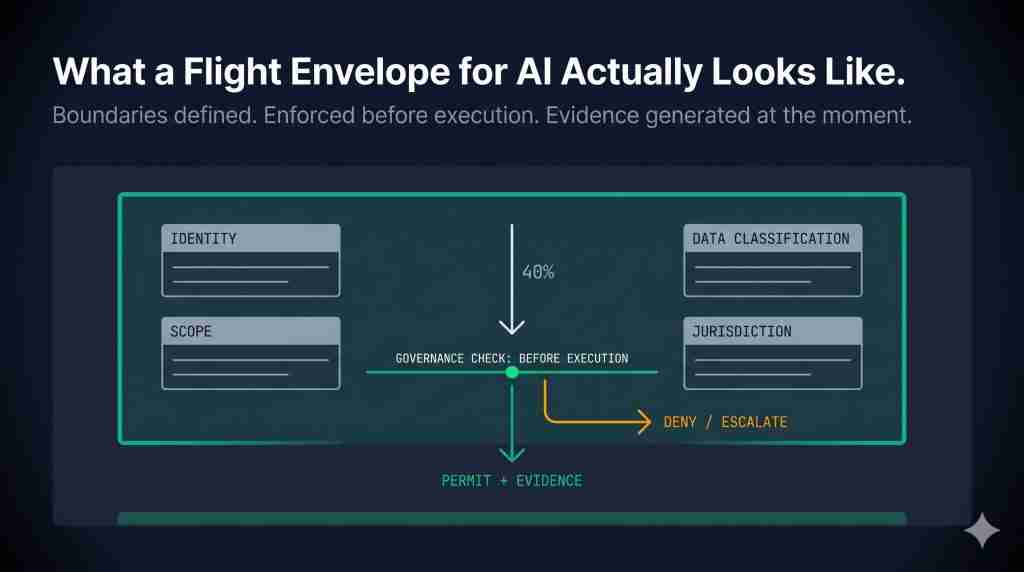
Every AI agent operating in your enterprise has an intended operating envelope. The question is whether that envelope is enforced before the agent acts, or recorded after it already has.
The flight envelope in aerospace defines the boundaries within which an aircraft can safely operate. Flight management systems enforce those boundaries continuously, in real time, before the aircraft enters an unsafe state. They do not wait for a limit to be exceeded and then log it. They evaluate, intercept, and respond before the unsafe state occurs.
The AI equivalent is architecturally precise. An agent’s operating envelope includes its authorised identity, its permitted toolset, the data classification tiers it may access, the regulatory jurisdictions that apply to its actions, and the categories of action requiring human approval before execution. These are definable parameters. The governance question is the enforcement model: evaluated before the action, or recorded after it.
A flight envelope governance model works as follows. A request comes in from an agent. A governance layer in the execution path intercepts it before any tool is invoked or external system contacted. The layer checks identity, scope, data classification, jurisdictional requirements, and approval gates. If the action passes, it executes, and a structured, policy-linked evidence event is generated at that moment, sealed in tamper-evident form. If the action fails, it is denied, transformed, or escalated. The denial itself becomes an evidence record.
This is the architectural inversion that distinguishes governance from logging. The record is generated as part of the governance evaluation, whether the action proceeds or not. The evidence exists at execution time, not as a retrospective reconstruction.
This is the architecture that Qaori Sentinel is built to provide: a client-side governance bridge in the execution path, enforcing the flight envelope locally before actions are dispatched, generating structured evidence events that flow to the Qaori control plane above it for compliance mapping, anomaly detection, and audit readiness.
The flight envelope concept applied to AI is not a metaphor that requires translation. The parameters are definable. The enforcement architecture is buildable. What has been missing is not the concept but the implementation.
What does your current governance architecture intercept before an action runs?
#AIGovernance #QaoriSentinel #EUAIAct #AIRiskManagement #EnterpriseAI
The Sysadmin and the AI Agent: Why the Same Gate Must Fire for Both
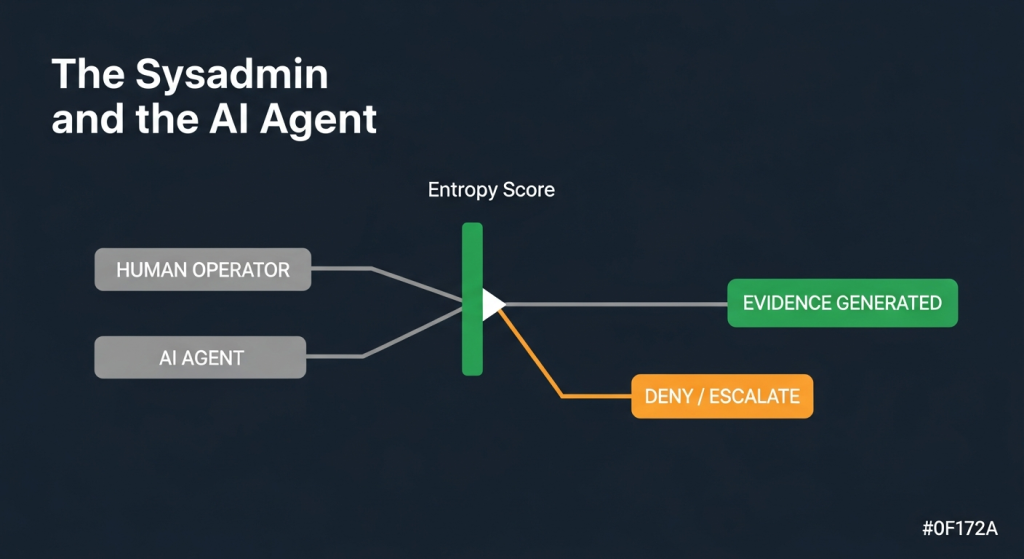
The governance gap between AI agent actions and human operator actions is not a nuance. It is an exploitation surface. Any governance framework that treats human and AI decision-makers differently creates a path by which high-entropy actions can be executed through the less-governed channel. On a Tuesday afternoon in a mid-sized financial services firm, a […]
The Authorization Gap: Where Hardware Enforcement Meets Constitutional Governance
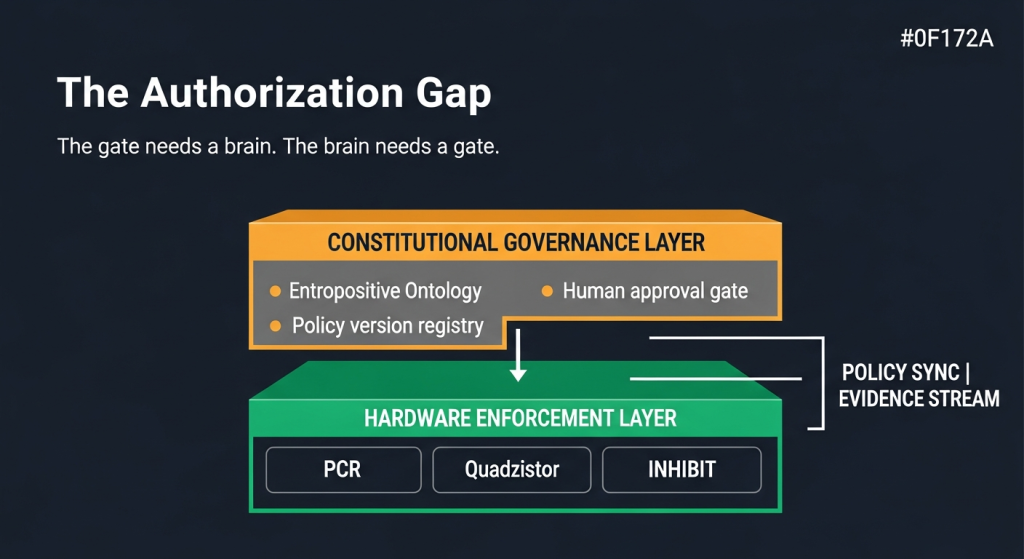
David Reichwein’s Authorization Gap framework correctly identifies the structural void between AI decision and physical execution. Closing that gap with hardware enforcement is necessary. It is not sufficient. The gate needs a brain. There is a question that sits at the foundation of every serious AI governance architecture conversation and is rarely made explicit. Not […]
The LLM Is Not the Problem. The Absence of Engineering Discipline Is.
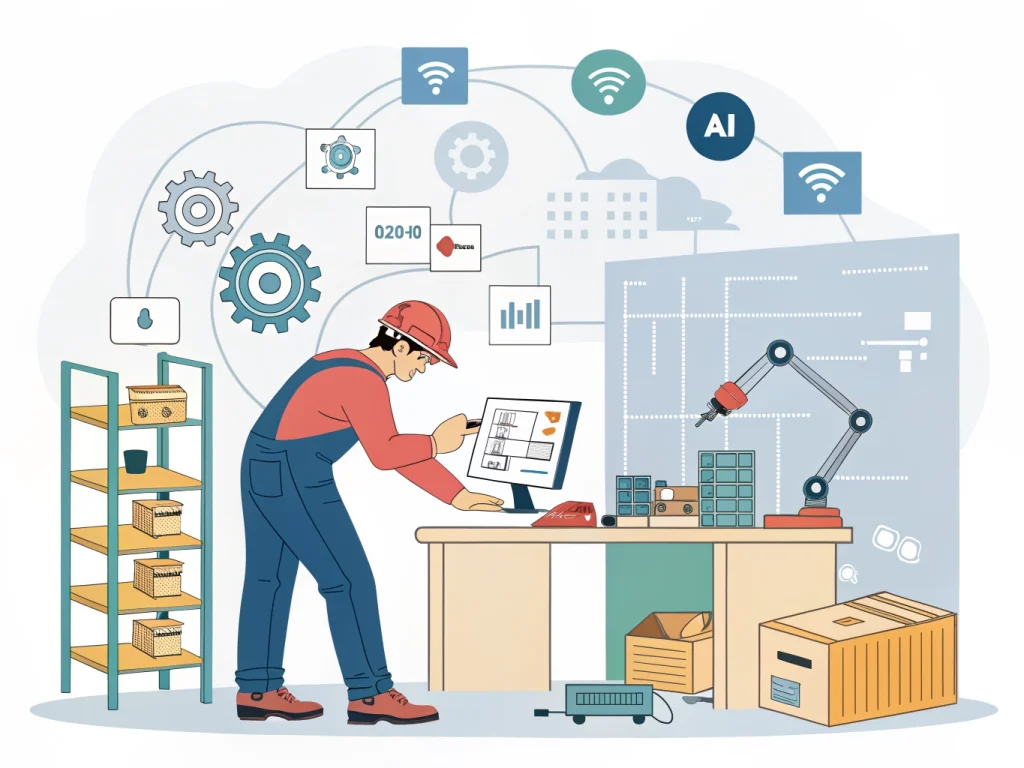
The failure of undisciplined AI deployment mirrors the offshore development disasters of the 2000s. One million lines of production code later, QAPAF proves that the toy becomes a tool the moment you apply the discipline of a craftsman. The debate about whether large language models are “toys” or “tools” is the wrong debate. A hammer […]
The Funding Machine Is Financing the Wrong Future
$83 billion in AI funding in six months.
95% of corporate AI projects producing no measurable profit.
This is not a technology wave. It is a fashion cycle with better branding.
The conventional diagnosis is time horizon. More patient capital. But the problem is deeper than patience.
The funding machine is organized around a theory of what intelligence is for. The theory is that intelligence optimizes: it makes things faster, cheaper, more scalable. Close the loop in eighteen months.
What that theory cannot see is a different question.
What if the purpose of intelligence is not to optimize what already exists, but to transmit what must not be lost?
UNESCO has documented thousands of knowledge traditions at risk of disappearing within a generation. The knowledge exists in living practitioners. There is no database. There is no backup. When a master retires without transmitting what they know, that knowledge is gone.
Not stored. Gone.
The funding machine has the wrong theory of intelligence. It is financing optimization. The civilization problem is transmission.
This is the first piece in a seven-part series called The Unbroken Thread.
Each article explores one dimension of the same question: what would it mean to build knowledge infrastructure that the next fifty years actually need?
The series is not a complaint about AI. It is a proposition about what AI, built correctly, could do for the generations that come next.
Full article in the first comment.
#KnowledgeTransmission #IntangibleCulturalHeritage #AI #VentureCapital #LongTermThinking #Qaori
The Governance Question Nobody Is Asking

In an era where AI governance is becoming a pressing concern, boards are facing a pivotal question: “Show me your AI governance.” Organizations like Qaori are redefining the landscape by embedding governance into their very architecture, rather than retrofitting it around existing structures. This proactive approach transforms how AI is monitored, risks are assessed, and accountability is established. As the demand for transparency and evidence grows, understanding the nuances of AI governance becomes essential. Discover how Qaori is not just talking about governance but demonstrating it through innovative frameworks and robust systems designed for the AI-native economy.
Qaori Anonymous ID: Janus

Japan has one of the lowest whistleblower disclosure rates in the developed world, not due to a lack of wrongdoing, but because of a cultural suppression of confrontation. The Janus Identity Bridge offers a revolutionary solution, allowing verified individuals to report misconduct while maintaining their anonymity. This architectural innovation separates identity verification from disclosure, ensuring that organizations cannot unilaterally identify whistleblowers. With the Janus system, we can create a safer environment for reporting, unlocking the potential for ethical whistleblowing across various sectors. Discover how this groundbreaking technology can transform the landscape of accountability and protection for vulnerable individuals.
Two Faces, One Truth: Why Whistleblowers Need a Roman God

In a world where whistleblowers face the daunting challenge of anonymity versus accountability, the Janus Identity Bridge emerges as a revolutionary solution. This innovative platform simultaneously verifies the identity of the whistleblower while ensuring their anonymity, creating a secure channel for disclosures that legal frameworks have long promised but technology has failed to deliver. With applications ranging from compliance in Japanese enterprises to ethical reporting in supply chains, Janus is set to transform the landscape of whistleblower protection. Discover how this groundbreaking approach can empower individuals to speak out without fear—unlocking a new era of transparency and trust.
The Layer No Regulator Can See

Brian Burke published a piece this week that named, with unusual precision, the part of AI risk that no current framework governs.
He calls it the AI Decision Influence Layer.
The argument is exact. NIST AI RMF, ISO 42001, and the EU AI Act all govern the AI system itself. None of them govern what happens inside the heads of the humans working alongside it.
A loan officer who reviews two hundred AI scores a day stops evaluating each from scratch. Override rates fall. Accept latencies shrink. Whole categories of decision drift into systematic deference. The override mechanism still exists. The compliance boxes are still ticked. And the cognitive environment of the firm has quietly changed shape.
I read the piece twice. Then I sat with it for a day.
I sat with it because for almost two years my team and I have been building a platform that is, by definition, exactly the layer Burke describes. A Qaori Alter speaks, decides, and acts in the voice of its owner over months and years. If anyone is operating at the centre of the Decision Influence Layer, it is us.
So I want to credit Burke for naming the gap, and I want to say what we are doing about it.
Three primitives. One Charter object. A second-loop analyser that runs above the model, not at it. Override rate. Accept latency. Deferral concentration. Advisory alerts to a governance queue. AIUC-1 evidence integration so the layer Burke says regulators cannot see is in fact carried, by the platform, into the evidence pack the regulator does see.
We started shipping Epic 063 — the AI Decision Influence Layer — into staging this week. Six work packages. The full chain.
The EU AI Act deployer obligations land on 2 August. Ninety days. The platforms that cannot answer the influence-layer question by then will be eliminated quietly when procurement frames shift around them.
The companion long article and the four-paper white paper sit underneath this post. Engineering, ethics, platform integration, and the relationship to our parallel epic on Governance Ontology and Charter Drift.
If your organisation is past checklist and ready to govern the layer the checklist does not see, I would value a conversation.
#AIGovernance #EUAIAct #ResponsibleAI #AIUC1 #PlatformGovernance #EnterpriseAI #NIST #ISO42001
We are the Brain Company.
Last week, Y Combinator named “Company Brain” one of their number one categories for their 2026 cohort. Their thesis: every company in the world will need a primitive that turns its own artifacts, Slack threads, support tickets, email, databases, code, into an executable knowledge layer for AI agents. They are right about the category. They are 10 years late on the substrate.
Qaori has been building it since 2017.
I want to make this simple, because the founders, operators, and investors I respect do not have time for ambiguity:
**Qaori is the Brain Company.**
We build sovereign brains for organisations, creators, and individuals. Captured by conversation. Mapped end-to-end. Narrated by AI Alters. Hosted in regional sanctuaries under the law of your jurisdiction.
That is the product. That is the company. That is what we are now.
—
### Why “brain”
Every other category name people are trying to put on this, AI assistant, knowledge base, copilot, AI agent, productivity tool, is a feature framing. None of them describe what is actually happening.
What is happening is this: a finite amount of wisdom exists inside an organisation, an expert, or an individual. That wisdom is leaking out. Senior people retire and take their decision history with them. Consultants and coaches fill their calendars before their method can scale. Knowledge workers spread their thinking across forty SaaS tools none of them own.
A *brain* is the right word because a brain is what the wisdom needs to live in. Not a search index. Not a vector store. Not a chatbot. A brain that remembers, reasons, narrates, and survives the people who built it.
Every other category name is a thing the brain *uses*. The brain itself is the unit.
—
### Why “sovereign”
This is the differentiator no other player can claim.
Every brain we build lives in a regional sanctuary: Japan, Europe, the United States, Asia, or Africa. Your brain is processed and stored under the law of your jurisdiction, on infrastructure in your region. It does not cross borders for storage, inference, or billing. The regional infrastructure is the architecture, not a setting you can override.
For European buyers post-GDPR and post-AI-Act, this is procurement-grade compliance baked into the platform. For Japanese buyers, it is APPI compliance and 適格請求書 issuance from a Tokyo data center, with Japanese-language Alters speaking in the register their senior staff actually use. For American buyers, it is a US jurisdiction node under applicable US data law. For African and Asian buyers, it is regional sovereignty by infrastructure, not by promise.
Every other player is asking buyers to trust that their data will not leave a vendor’s cloud. We removed the question. The cloud is yours. The law is yours. The brain is yours.
—
### Three brains. One platform.
We build three.
**Sovereign Company Brain.** For organisations capturing what their senior people know before it walks out the door. For SMEs and corporates running succession plans, scaling teams, or absorbing acquisitions. The brain ingests documents, decisions, processes, and the conversations of your knowledge holders. It produces Alters bound to regions of the brain: onboarding for new hires, policy explanations for the team, specialised personas per department.
**Sovereign Creator Brain.** For coaches, consultants, course creators, and solo experts who hit the ceiling of their own calendar. The brain packages your method, your library, your reasoning into a deployable companion. Sell access. License your reasoning. Let your expertise outlast your inbox.
**Sovereign Personal Brain.** For professionals and lifelong learners who want a thinking partner they actually own. Same substrate. Smaller scale. Sovereign from day one.
Plus Qammy, protected AI for learners. Deliberately not a brain. We do not call it Sprout Brain or Guided Brain or anything else. Children, students, and supported communities deserve a product shaped around their wellbeing, not framed by a category we are claiming for adults. Honesty is the position.
—
### What is under the hood
The question I get most from technical evaluators is what the substrate actually is. The answer:
**The Wisdom Engine** is the single internal API every brain calls. It grounds answers in your sources, your frameworks, and your profile. CAG over your stable knowledge graphs. RAG over your private corpus. Six intent modes: question, decision, reflection, summary, knowledge book, coach. Every response evidence-cited.
**The Knowledge Map**, launching soon, is the visualisation surface that makes a brain visible. Documents to decisions to processes to people, rendered as a navigable graph. See gaps. See collisions. Promote what is canonical. Retire what is stale. Bind an Alter to any region of the map.
**Alters** are the narration layer. Headless AI personas, one per region of the brain, evidence-citing, drop-in deployable as a UI surface inside any product. We ship N personas per tenant, not one chatbot.
**QAPAF Siegfried**, our autonomous factory, turns brain regions into deployable software, content, and workflows. Your brain does not just answer. It ships.
**Sanctuary** is the regional sovereign infrastructure layer. Five regions, day one. Same substrate, different jurisdictions, no cross-border data flow.
I will write deeper technical posts on each of these. For today the point is: the substrate is built. The category just got named. We are ready.
—
### What this means
For organisations: there is a way to capture what your senior people know before they leave, and to keep that knowledge alive in a brain you own. We are a real conversation away from your team’s first Sovereign Company Brain.
For creators: there is a way to scale yourself without becoming someone you are not. Your method, your library, your reasoning, packaged into a brain that works while your calendar runs.
For individuals: there is finally a thinking partner where the relationship runs in the right direction. You own the brain. The brain learns from you. The vendor does not own either.
For investors and accelerator partners: we are now actively raising and actively partnering. Yokohama-based, multi-sanctuary, cooperatively governed. If you are building a portfolio for the next decade rather than the next quarter, we should talk.
—
### A note on timing
I have been working on this problem since 2016. The earliest version was a project called Entropositive, a governance-focused attempt to map how a company actually works, ten years before the tooling existed to deliver it. No genAI. No grounded retrieval. No way to narrate from a knowledge graph in natural language. Entropositive was the right idea, ten years too early.
Qaori is what that thinking becomes when the substrate finally arrives. The Sanctuary model, the Wisdom Engine, the Alters, the cooperative governance, all of it has been taking shape steadily since 2017, accelerating sharply once large language models could carry their share of the work.
The Brain Company position is what ties ten years of conviction into one sentence.
The timing is not coincidence. The category is forming around a substrate that has been quietly building for a decade. The only thing I am doing today is naming what we are.
Qaori, The Brain Company. Sovereign by design.
If any of this resonates, the door is open at qaori.ai/start. Or message me directly. I read everything.
The Leaders Who Feel the Gap

The leaders who feel most uneasy about AI adoption are often the most thoughtful ones. They moved carefully, asked the right questions, and discovered that the tools available to them were not designed to answer those questions at scale.
This article is for them.
It is about the governance gap, control debt, and why infrastructure has to come before capability expansion, not after a risk event.
The Factory Has a Front Door. And the Front Door Has Rules.

The moat in autonomous software development is not the model. It is the system around the model.
We recently completed a significant upgrade to QAPAF, one that changes what every agent in the factory reads before it does anything else. I will not describe the mechanism. The outcome is this: agents that begin each session from a known, governed behavioral baseline produce fundamentally different output than agents operating from accumulated context and inferred expectations.
At the front of the factory sits Qappa. Not a chatbot. Not an assistant. A Product Owner with authority over scope, specification, and quality. No implementation begins without Qappa’s approval. No session starts without a governed state. That authority is not symbolic. It is structural.
This architecture reflects forty years of PM/PO experience encoded as organizational constraint. You can replicate the tools. The judgment that designed the system around them is not available off the shelf.
The full argument, including why the LLMs are the most interchangeable part of the stack, is in the article below.
#AIEngineering #AutonomousSoftware #EnterpriseAI
Gates Catch Defects. The Behavioral Layer Prevents Them.

Gates catch defects. The behavioral layer prevents them. In our journey with QAPAF, the Qaori Autonomous Software Factory, we’ve discovered that simply identifying flaws isn’t enough. Every defect that slips through is a costly reminder of incomplete context and poor defaults. Enter the behavioral layer—a revolutionary approach that reshapes how agents operate before tasks even begin. With strict disciplines like spec-first enforcement and independent reviews, we’re not just catching errors; we’re preventing them. Discover how this innovative system transforms our quality process, reducing defect rates and enhancing reliability. Join us as we unveil the future of software quality management.
The Entropositive Principle: Why Entropy Is the Right Unit of Governance
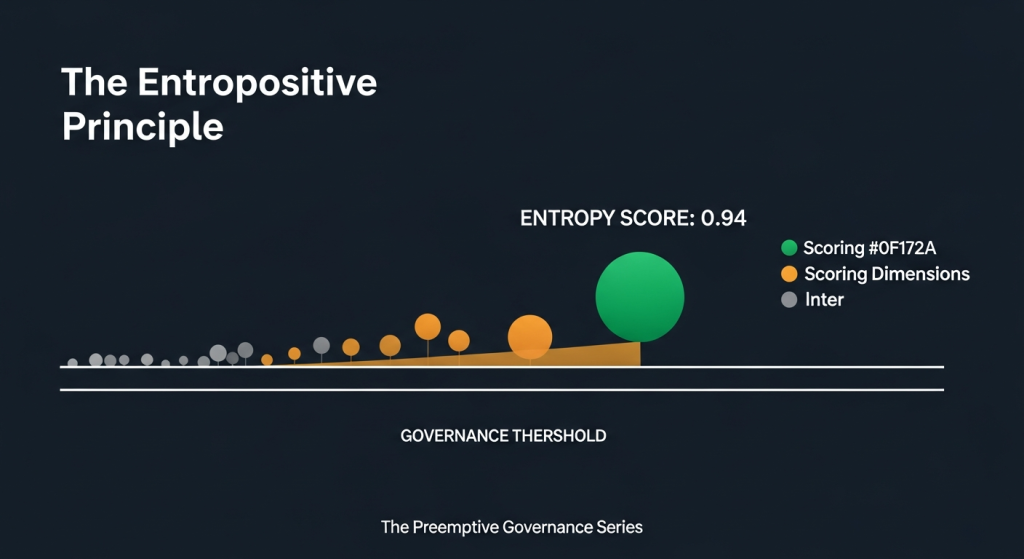
Most governance frameworks ask whether a rule was followed. The Entropositive principle asks a prior question: does this decision increase systemic entropy beyond a recoverable threshold? The answers are not the same question. In 1865, Rudolf Clausius gave physics a concept that has never stopped being true. Entropy, the measure of disorder in a thermodynamic […]