






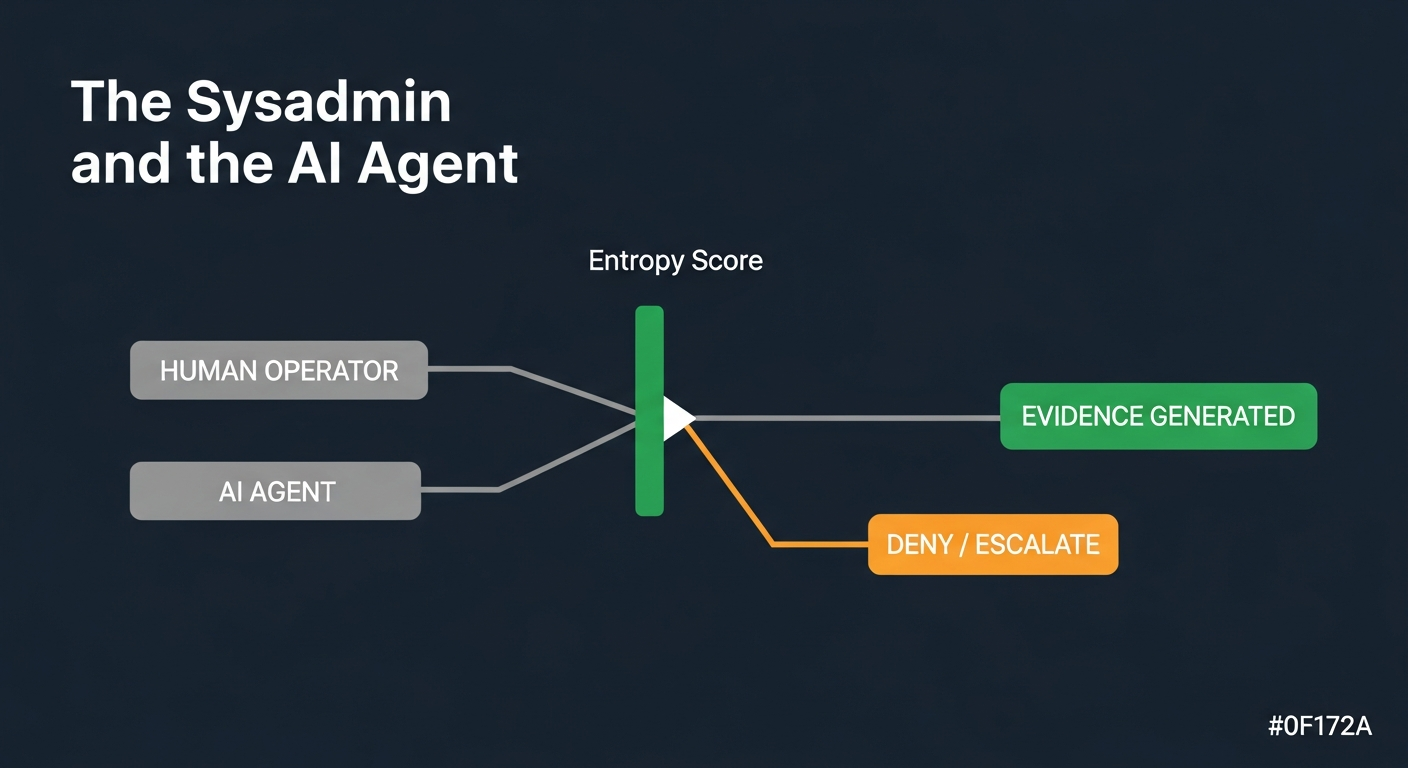
The governance gap between AI agent actions and human operator actions is not a nuance. It is an exploitation surface. Any governance framework that treats human and AI decision-makers differently creates a path by which high-entropy actions can be executed through the less-governed channel.
On a Tuesday afternoon in a mid-sized financial services firm, a database administrator connects to what he believes is the staging environment to run a schema migration. The environment selector in his terminal client is displaying the wrong context. He is connected to production. The migration executes in under three seconds. The cascade begins within thirty.
Across 148 dependent microservices, connection pool exhaustion and schema validation failures compound. Automated retry logic amplifies the failure signal. Six downstream redeployment pipelines trigger simultaneously, each encountering the modified schema and failing independently. By the time the database administrator recognizes what has happened, 12,000 tenant accounts are unavailable. The recovery takes four hours. SLA penalties are triggered in three jurisdictions.
Now consider the following variation. Not a database administrator. An AI agent, instructed to apply a pending schema migration as part of an automated deployment workflow. Same target. Same schema change. Same execution time. Same cascade. Same four hours. Same penalties.
In the second scenario, your AI governance framework probably had something to say about this. Scope checks, approval gates, environment validation logic: these are architecture components that have been discussed at length in the AI governance conversation. The agent might have been intercepted. Whether it was depends on the specific governance implementation, but at least the category of risk was on the radar.
In the first scenario, the governance framework almost certainly had nothing to say. The database administrator had legitimate credentials, a legitimate task, and legitimate access to the migration tooling. No rate limit was breached. No content policy was violated. No AI system was involved. The governance apparatus was not designed to intercept this, because the governance apparatus was designed to govern AI systems, and a human being issued the command.
The enterprise AI governance field has spent significant energy in the past several years defining governance architectures for AI agents. That work is important and necessary. It has, however, created an unintended structural asymmetry. In many organizations, the AI agent operating in the enterprise is subject to tighter operational governance than the human operator performing the same action. The AI agent may need to pass scope checks, approval gates, and policy evaluations before its action executes. The human operator, trusted by default, does not. The governance gap runs in the wrong direction relative to the actual risk.
This asymmetry is not merely a theoretical concern. It is an exploitation surface. In systems with mixed human-AI agency, the path of least resistance for a high-entropy action is the human path, because the human path is less governed. A workflow that is intercepted at the agent layer can be rerouted to a human operator who can then execute the same action without triggering the same governance checks. The governance architecture has, inadvertently, created a bypass.
The correct unit of governance analysis is the decision and its ontology-resolved consequence graph, not the identity category of the actor who made it. The entropy of the schema migration described above is a property of the action: the schema change, the target environment, the dependency graph of the affected system, the irreversibility of the change, the scope of downstream impact. That entropy is identical whether the command was issued by an AI agent or a human administrator. A governance architecture that evaluates entropy should score the action identically in both cases. A governance architecture that evaluates actor identity will score them differently, and that difference is the gap.
The Entropositive model, as described in the previous article in this series, defines entropy as a property of decisions, not of decision-makers. The three dimensions of entropy scoring, irreversibility, scope, and cascade potential, are computed from the ontology graph of the system being governed, against the specific action being proposed, without reference to whether the proposing actor is a person or a process. If the ontology correctly encodes the relationship between the schema and its 148 dependent services, the entropy score for the migration command is high regardless of who issues it. The governance threshold fires regardless of who is asking.
This is the actor-agnostic detection model. Not in the sense that actors are irrelevant, they remain relevant for audit, attribution, and the design of approval chains, but in the sense that the entropy threshold is applied uniformly across the full population of actors in the system. The detection radius extends to human operator actions in the same way it extends to AI agent actions.
The practical implementation of actor-agnostic detection requires that governance be present in the routing path of both human operator tool usage and AI agent action dispatch. For AI agents, this is the architecture this series has described: a governance layer in the execution path that intercepts action requests before they are dispatched to tools or external systems. For human operators, the equivalent is a governance layer in the execution path of the privileged tooling they use: the database clients, the infrastructure management consoles, the deployment pipelines. Both surfaces need to be in the governance layer’s field of view.
The objection that sometimes arises at this point is that human operators have legitimate autonomy that AI agents do not. This is true and important to preserve correctly. The actor-agnostic model does not eliminate human autonomy. It does not prevent high-entropy actions from being taken. It introduces a confirmation gate: the structured evidence that the operator saw the ontology-resolved consequence graph before they proceeded, understood the scope of what they were authorizing, and confirmed their intent. The database administrator in the opening scenario was not operating without judgment. He was operating without information. He did not know that the environment selector was wrong. The governance gate does not substitute for his judgment. It provides him with the information his judgment needs before his action becomes irreversible.
The confirmation gate for a human operator and the approval gate for an AI agent are the same architectural component. Both present the actor with the entropy-scored consequence graph of the proposed action. Both require explicit confirmation before execution proceeds for actions above threshold. Both generate a structured evidence event documenting that the evaluation occurred, the consequence graph was presented, and the confirmation was given. The evidence record for a human operator action and the evidence record for an AI agent action have the same structure. Both are auditable. Both are attributable.
This is also the architectural resolution of a governance question that regulatory frameworks have not yet answered clearly: what constitutes effective human oversight of an AI system? The EU AI Act’s Article 14 requirement for effective human oversight is frequently interpreted as a requirement to have a human somewhere in the loop. That interpretation, while technically compliant, is not effective oversight in any meaningful sense. Effective oversight means that the human who is in the loop has the information required to exercise genuine judgment, not merely the ability to press a button. The actor-agnostic confirmation gate provides that information: the consequence graph is what the oversight is being exercised over, not an opaque AI output requiring the human to trust that the evaluation was correct.
A secondary benefit of the actor-agnostic model is its effect on the organizational accountability structure described in the previous article. When governance applies uniformly to AI agents and human operators, the distinction between “AI governance” and “operational governance” dissolves. There is only governance: the set of rules, thresholds, and confirmation requirements that apply to consequential actions in the system, regardless of who initiates them. This is a conceptually simpler and organizationally more defensible position. A compliance program that governs AI agents to a high standard and human operators to a lower standard is not a governance program. It is a selective constraint on one class of actor. The uniformity of the actor-agnostic model is, among other things, a legal advantage: it is harder to argue that a governance program was inadequate when it applied the same standards to every actor in the system.
The detection radius of a governance system that implements the actor-agnostic model is substantially larger than one that does not. Every high-entropy action in the system, regardless of its origin, is within the governance layer’s field of view. The exploitation surface created by the human-as-less-governed-actor pathway is closed. The evidence record is complete across the full population of actors. And the boundary between AI governance and human operational governance, which has been a source of organizational confusion in the deployment of AI governance programs, disappears.
The gate is not a different gate for different actors. It is the same gate for the same entropy. That is the architectural principle. The opening scenario of this article would have resolved differently under it: the consequence graph would have been displayed before the command executed, the wrong environment would have been visible, and the migration would not have run. Whether the command came from an agent or an administrator was not the relevant question. The entropy was.

