






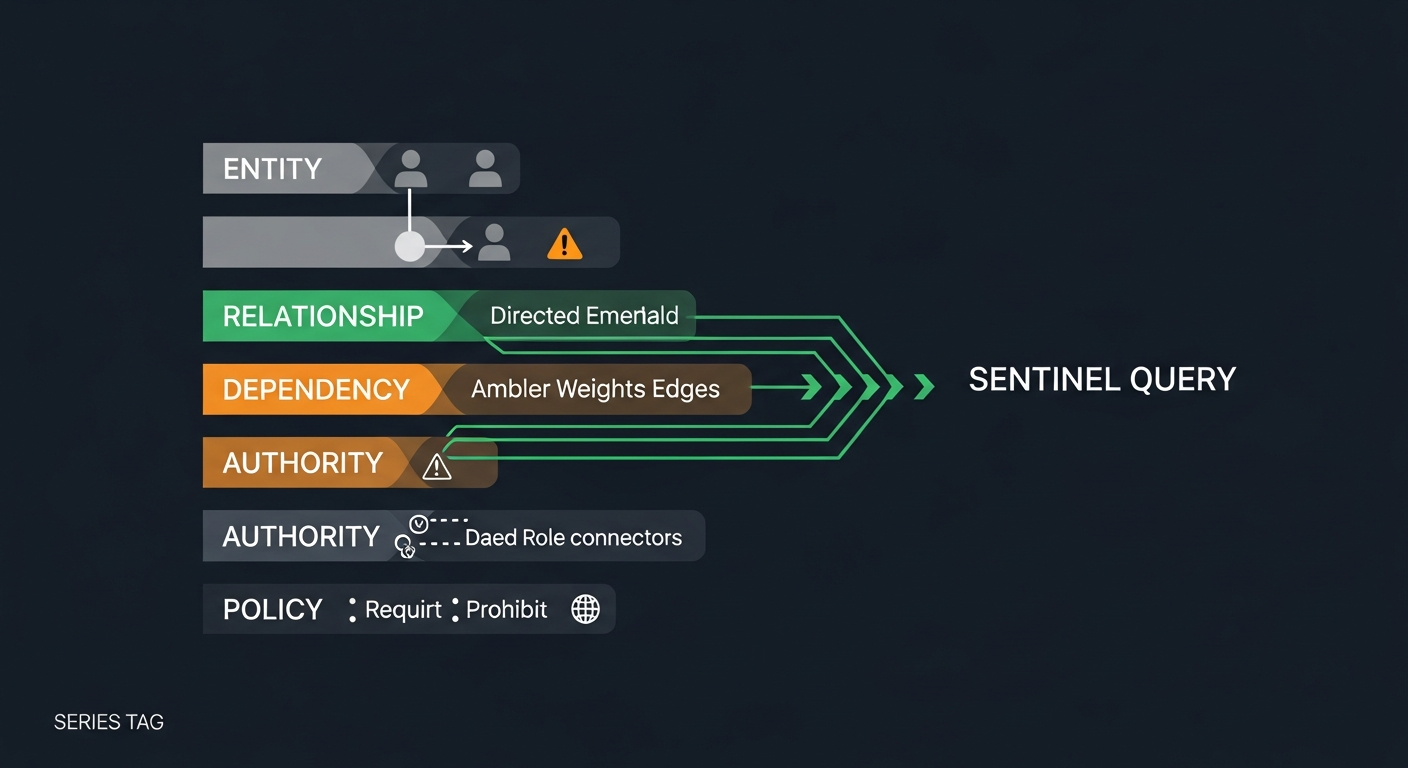
The ontology that makes entropy-based governance work is not built to be read by humans. It is built to be queried by Sentinel at decision time.
There is a persistent misunderstanding about what an organizational ontology is for. Most engineering teams, when they encounter the word, think of documentation. A taxonomy. A data dictionary. A reference architecture diagram stored on a wiki page that someone updates when the mood strikes. That framing produces a useful artifact for human orientation. It produces a useless artifact for governance.
The Entropositive Ontology is neither a taxonomy nor a document. It is a query infrastructure. Its primary consumer is Sentinel, the interception and evaluation layer that governs AI agent actions at decision time. It is built to answer specific questions in milliseconds, under production load, with the accuracy that governance decisions require. Human-readable documentation is a secondary artifact that can be derived from it. The primary artifact is a live graph database with a real-time query interface.
This distinction is not cosmetic. An ontology built for human readability is organized around clarity and comprehensibility. It is structured to explain. An ontology built for Sentinel to query is organized around traversal performance, centrality computation, and dependency resolution. It is structured to answer. These are different design constraints, and conflating them produces systems that serve neither purpose well.
What the Ontology Represents
The Entropositive Ontology is a map of decision topology, not existence topology. This is the first and most important thing to understand about how it differs from a standard knowledge graph.
A knowledge graph answers the question: what exists and how are things related? An entity has attributes. Relationships between entities are named and directed. The graph is a structured description of a domain. This is valuable for many purposes. It is insufficient for governance.
The Entropositive Ontology answers different questions: what decisions are possible, who has the authority to make them, and what do those decisions cascade to? It is not a static description of a domain. It is a dynamic representation of the decision space that governance must cover. The nodes are not just objects. They are objects with governance weight. The edges are not just relationships. They are dependency paths with propagation semantics. The ontology is the machine-readable form of organizational authority and consequence.
It is organized into five layers, each serving a specific purpose in the governance query that Sentinel executes when it intercepts an action.
The Five Layers
The Entity Layer is the foundation. It contains every governed object in the organization’s AI-managed scope: services, schemas, data stores, pipelines, contract templates, workflows, configurations, and credentials. Each entity is a node with a classification: its type, its domain, its operational status, and the governance tier that applies to it by default. The Entity Layer is the address book. Sentinel queries it first to determine what the intercepted action targets.
The Relationship Layer maps how entities connect to one another. An API service depends on a data schema. A pipeline reads from a data store and writes to another. A workflow triggers a series of downstream services in a defined sequence. The edges in the Relationship Layer carry direction and type. They distinguish among dependency (B fails if A changes), consumption (B reads from A), and authorization (B can proceed only with A’s confirmation). These distinctions matter because they determine how entropy propagates through the graph. Sentinel queries the Relationship Layer to enumerate the structural connections of the target entity.
The Dependency Layer is where cascade semantics live. Not all relationships propagate consequences at the same rate or in the same direction. The Dependency Layer annotates the relationship graph with cascade weights: how strongly a change to node A flows through to node B, and whether that flow is immediate, deferred, or conditional. A schema migration in a foundational data store may cascade to a downstream service immediately upon deployment, or only when the downstream service next initializes. These timing semantics are governance-relevant because they affect the blast radius calculation. Sentinel queries the Dependency Layer to compute cascade potential, the third dimension of the Entropy Quotient.
The Authority Layer encodes who decides what. Every entity in the graph has an ownership assignment: the team, role, or individual that holds governance authority over that entity. Every relationship between entities has an approval structure: who must authorize a change that crosses the boundary of that relationship. The Authority Layer is what allows Sentinel to answer the question “who must approve this action?” without consulting a spreadsheet or routing through a ticketing system. The approval chain is a structural property of the ontology, not a procedural lookup. When Sentinel determines that an action requires human authorization, the Authority Layer provides the specific authority: not “someone in management” but the named role or team that holds governance rights over the target entity and its dependencies.
The Policy Layer contains the machine-readable rules that apply to each entity, relationship, and authority path in the graph. Permissions define what actions are allowed on an entity without additional approval. Requirements define what preconditions must be met before an action can proceed. Prohibitions define what cannot happen regardless of who requests it or who approves it. The Policy Layer is the organizational constitution expressed as a graph. Sentinel queries it last, after resolving what the action targets, what it cascades to, and who has authority, to determine what the policy says about the proposed action.
The Query That Happens at Decision Time
When Sentinel intercepts an action, it executes a structured query against the ontology. The sequence is deterministic and occurs before any execution takes place.
The query begins by resolving the target entity in the Entity Layer. What is the object this action intends to affect? If the entity is not in the ontology, the action is held rather than allowed through. An entity that governance does not know about does not get a free pass. It gets escalated to the team responsible for ontology coverage.
With the target entity resolved, Sentinel computes two scores from the Relationship and Dependency layers. The first is degree centrality: the number of direct downstream dependencies this entity has, expressed as a normalized scope score. The second is cascade potential: the PageRank-weighted influence of this entity in the dependency graph, reflecting not just how many downstream nodes it touches but also how many of those downstream nodes are themselves high-centrality nodes. These two scores, combined with the irreversibility of the proposed action type, produce the Entropy Quotient.
With the Entropy Quotient computed, Sentinel queries the Authority Layer to resolve the approval structure. If the EQ places the action in a tier that requires human authorization, who specifically is the authorizing party? The Authority Layer produces a named authority, not a category. The approval request is routed to a specific individual or role, not to a general escalation queue.
Finally, Sentinel queries the Policy Layer for the target entity, action type, and resolved authority. Is this action permitted at all? Is there a requirement that must be satisfied before it proceeds, independent of the EQ? Is there a prohibition that applies regardless of the EQ or the authorization status?
The output of this query sequence is a governance finding: the EQ score, the gate decision derived from the EQ and the policy, the authorization requirement, if applicable, and the evidence record to be committed to the Authorization Evidence Pack. This entire sequence runs in the hot path of action evaluation. It must be fast enough not to materially slow down governed operations.
VEIP and the Authorization Evidence Pack
The governance finding produced by the ontology query does not exist solely to gate the action. It must also produce a verifiable record that the action was correctly evaluated, that the governance framework at the time of evaluation produced a specific finding, and that the finding was applied.
This is the function of VEIP, the Veraxis Execution Integrity Protocol. VEIP defines how the ontology’s findings are cryptographically committed to the Authorization Evidence Pack. Before an action proceeds, the AEP records the computed EQ, the ontology snapshot at the time of evaluation (specifically the centrality and cascade values for the target entity), the gate decision, the authorization chain if approval was required, and the timestamp of the evaluation. The AEP is signed using a key held independently of the operational system. After-the-fact tampering with the AEP is detectable.
The AEP is not a log. A log is a record of what happened after execution. The AEP is a precondition for execution. No AEP means no execution. The AEP is the artifact that makes governance decisions auditable in the precise sense that regulators and risk committees require: not “we have logs,” but “every governed action carries a cryptographically verified record of the governance evaluation that preceded it.”
This structure also means that the quality of the governance record is a direct function of the quality of the ontology query. If the ontology is incomplete, the AEP records the incomplete finding rather than the one a complete ontology would have produced. This is transparent. It is also the correct design. A governance record that accurately describes what the governance system knew and did, including its coverage gaps, is more defensible than one that elides uncertainty. The AEP is an evidence pack, not a certificate of perfect coverage.
Building the Ontology: The Operational Reality
The practical question is how the Entropositive Ontology gets built and maintained in a real enterprise environment.
The starting point is almost never a clean slate. Organizations have existing documentation: service catalogs, architecture diagrams, RACI matrices, access control lists, and data flow documentation. Some of this is current. More of it is stale. None of it is in a form that Sentinel can query. The first phase of ontology construction is ingestion and formalization: taking what the organization already knows about its systems, normalizing it into the five-layer structure, and loading it into the graph database.
This process typically achieves 50 to 70 percent coverage of the governed estate. The remainder, the systems, relationships, and authority structures that are not documented anywhere, must be inferred. Behavioral inference works here: access log analysis reveals which services communicate with which, even when that communication is not documented. Network topology provides relationship evidence. Audit trails show who makes decisions about what, which is a proxy for the Authority Layer, even when no formal authority assignment exists.
The ontology does not need to be complete before governance can begin. The articles earlier in this series made this point about entropy scoring in general, and it applies with particular force to ontology construction. Sixty percent coverage means that sixty percent of governed actions are evaluated against an accurate consequence graph. That is substantially better than zero percent, which is what rule-based governance typically achieves for novel action classes. The governance imperative is to deploy at partial coverage and expand continuously, not to wait for completeness.
The maintenance obligation is real and ongoing. Every new service added to the estate requires a corresponding entity in the Entity Layer, with its relationships, dependencies, authority assignments, and applicable policies. This is not optional infrastructure work. It is the operational commitment that keeps the governance layer accurate. An ontology built once and not maintained is a governance system that degrades in real time.
The tooling for ontology maintenance should be part of the development and deployment pipeline, not a separate administrative process. When a team deploys a new service, the deployment process should include ontology registration as a required step. When a schema changes, the dependency layer should update automatically. When an ownership transfer occurs, the Authority Layer should reflect it within the governance SLA window. The ontology is a live system. It must be treated as one.
Why This Is Different from Documentation
The reason I have spent this article insisting on the distinction between the Entropositive Ontology and documentation is that organizations that treat them as the same thing end up with the wrong system and bad operational habits.
Documentation is produced by humans for humans. It is written in prose or structured formats that prioritize readability. It is updated when someone has the time and motivation. It exists in version control or a content management system. It is consulted when a human needs orientation. None of these properties is useful for Sentinel.
The Entropositive Ontology is a graph database. It is continuously updated through automated ingestion, behavioral inference, and the required registration steps in deployment pipelines. It is queried by Sentinel in milliseconds. It produces structured outputs that feed entropy scoring, gate selection, authorization routing, and AEP generation. It is a piece of operational infrastructure with requirements for availability, latency, and accuracy. It is not consulted. It is queried.
The human-readable documentation of the organizational structure can be generated from the ontology. This is a useful secondary capability. The strategy team can generate a current-state architecture view. The compliance function can generate a policy coverage report. The risk committee can generate an authority mapping. All of these are derivable from the same graph that Sentinel queries. But they are secondary. The graph comes first. The documentation follows from it.
This inversion, documentation as a derivative of infrastructure rather than infrastructure as an implementation of documentation, is the architectural shift that makes the Entropositive Ontology work as a governance foundation. The source of truth is the graph. Everything else is a projection of it.
The next article in this series covers the production deployment path: how organizations move from framework to live governance, what the first ninety days should achieve, and why the sequence in which governance is activated matters as much as the architecture itself.

