






The Entropositive Ontology: A Query Infrastructure, Not a Document
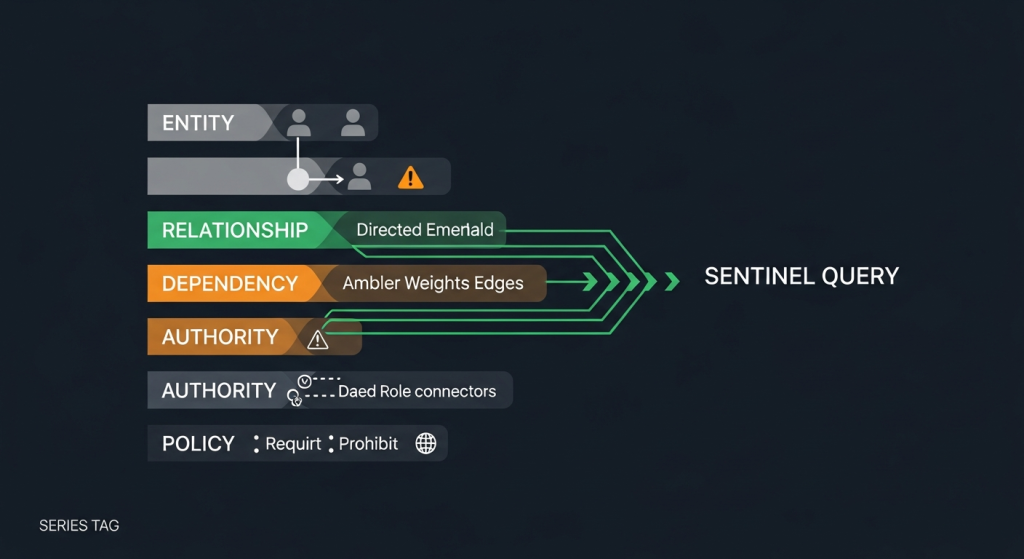
Most organizations building AI governance assume the ontology is documentation. A knowledge graph. A service catalog. Something humans read and update when the spirit moves them.
That assumption produces the wrong system.
The Entropositive Ontology is not built for humans to read. It is built for Sentinel to query. At decision time. In the hot path. Before execution proceeds.
When Sentinel intercepts an action, it runs a structured query across five layers: Entity (what is the target?), Relationship (what does it connect to?), Dependency (what does it cascade to?), Authority (who decides?), Policy (what is permitted, required, or prohibited?). The output is an Entropy Quotient, a gate decision, an authorization routing, and the evidence record that gets committed to the Authorization Evidence Pack before any execution happens.
This entire sequence runs in milliseconds. It does not work if the ontology is a wiki page.
The operational implication is that ontology construction is infrastructure work, not documentation work. It belongs in the deployment pipeline. When a new service is deployed, it gets registered in the graph. When a schema changes, the dependency layer updates. When ownership transfers, the Authority Layer reflects it. The ontology is a live system with availability and accuracy requirements. Treating it otherwise is the fastest path to governance that looks rigorous on paper and fails at decision time.
Documentation can be derived from the ontology. Service catalogs, architecture views, policy coverage reports: all of these can be generated as projections of the same graph that Sentinel queries. But the graph is the source of truth. The documentation follows from it.
The inversion matters. Documentation as a derivative of infrastructure is a different operational posture than infrastructure as an implementation of documentation. The first produces a governance system that stays current. The second produces a governance system that is accurate at deployment time and degrading from that moment forward.
This article, the eleventh in the enterprise governance series, covers the five-layer structure of the Entropositive Ontology, what Sentinel actually queries at decision time, how VEIP commits the ontology’s findings to a cryptographically verifiable evidence pack, and what the operational commitment to ontology maintenance looks like in practice.
Link in comments.
AIGovernance EnterpriseAI KnowledgeGraph Entropositive Qaori