When the world’s largest enterprise technology company validates your market thesis from the main stage of Think 2026, that is not a threat. That is a starting gun.
On 5 May 2026, IBM took the stage at Think 2026 in Boston and announced the general availability of IBM Sovereign Core, described as the industry’s first AI-ready sovereign-enabled software platform. The press release landed with the full weight of a company with a $150B market cap behind it. Analysts called it a defining moment for the Sovereign AI category.
For Qaori, it was confirmation of something we have been building toward since day one.
What IBM Actually Built – and What They Didn’t
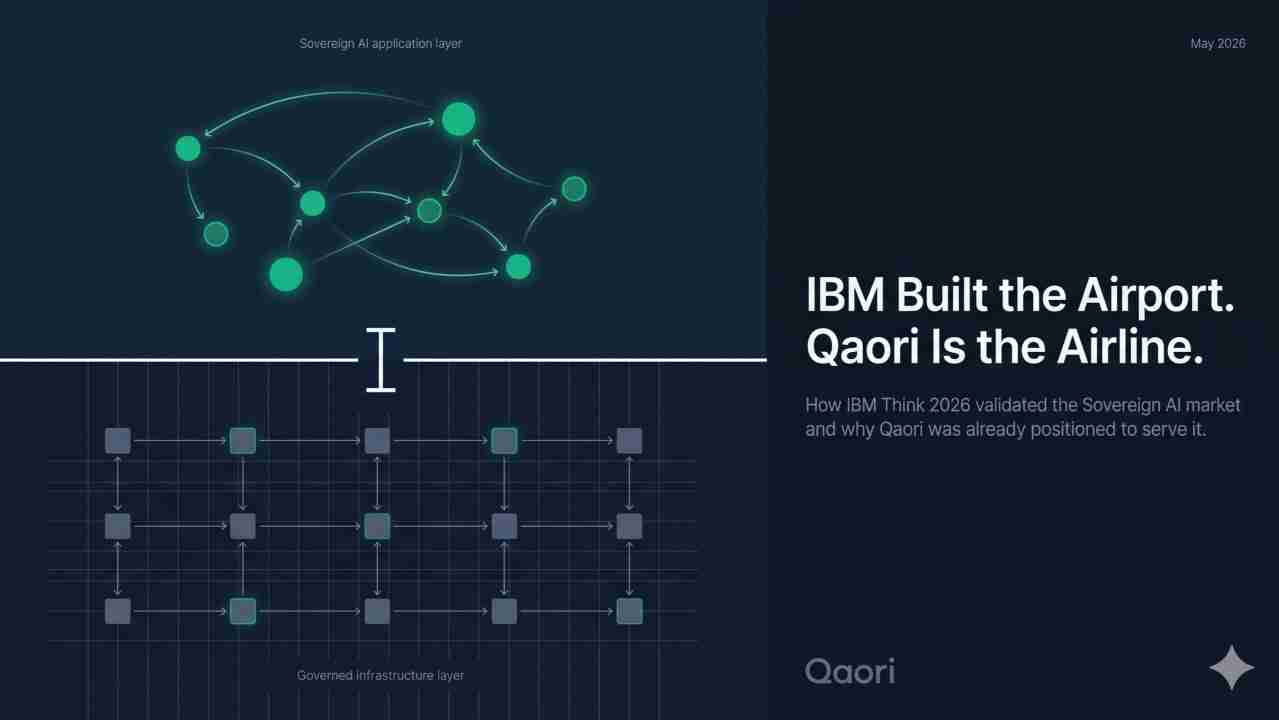
IBM Sovereign Core is infrastructure. A governed control plane, continuous compliance monitoring, and regulated data boundaries. It is, in the most precise analogy, the airport: the terminals, the runways, the air traffic control. Essential. Expensive. And completely empty without airlines.
IBM even built a catalog mechanism, a curated marketplace where third-party applications can run within the sovereign boundary. They announced it and immediately needed partners to fill it. Mistral AI was on the launch quote sheet. The catalog is real and ready to accept applications from organizations that operate under sovereign governance.
That is exactly what Qaori builds.
The stack, from the ground up, has three layers. At the foundation, IBM provides sovereign infrastructure: the governed control plane, compliance, data residency, and runtime enforcement. Above that sits the Qaori sovereign AI layer: Wisdom Engine, QAPAF, and the autonomous software factory running inside the boundary. Above that, the Qaori sovereign application platform: a multi-tenant Brand Engine serving N-branded apps from a single, governed codebase.
IBM builds a regulated environment. Qaori delivers the AI capability that makes that environment valuable to the business. These are not competing products. They are complementary layers of the same emerging stack, and Qaori occupies the layer that IBM explicitly left open.
The Numbers That Tell the Story
Three numbers from this week matter for anyone watching this space. 75% of enterprises will have a digital sovereignty strategy by 2030, per Gartner. 44% of enterprise AI leaders lack confidence in autonomous agents, the gap Qaori closes. IBM preloaded 160+ regulatory frameworks into Sovereign Core on day one, every one a potential Qaori customer.
IBM’s Think 2026 announcement does something no seed-stage founder can do alone: it moves Sovereign AI from category hypothesis to validated enterprise priority. Every enterprise sales conversation Qaori now enters has IBM’s credibility as the market floor beneath it.
Qaori’s Unfair Advantage: We Mapped the Trust Problem First
IBM’s own research found that 44% of enterprise AI leaders do not yet trust AI agents to act autonomously. IBM’s answer is a governed control plane. A powerful answer, but it solves the infrastructure question, not the delivery question.
Qaori solved the delivery question first. Our autonomous software factory, with its SAFe-mapped agent architecture, Quality Intelligence Engine, 7-layer quality gates, and sandbox guardrail design, was built from the ground up around one principle: AI agents that enterprises can actually trust to ship.
QAPAF is not a chatbot. It is a principal AI, a digital clone of experienced software-delivery leadership, operating with methodologies, memory, and guardrails that regulated enterprises will recognize as governance-ready from the first demo. Wisdom Engine is not a knowledge base. It is an intelligence layer that compounds in value the longer an organization runs it inside its sovereign boundary.
The Window Is Now
Enterprise technology moves in waves. The infrastructure wave, sovereign cloud, and governed AI control planes are cresting right now, validated by IBM, Microsoft, and a growing roster of national AI initiatives across Europe and Asia-Pacific. The application wave follows. It always does.
The organizations building the sovereign application layer today will own the distribution channels, the customer relationships, and the switching-cost moats before the incumbents wake up to the opportunity. IBM’s catalog needs applications. Sovereign enterprise buyers need AI capability that is ready to run inside their boundaries on day one. The MSPs and regional cloud operators IBM is partnering with, Cegeka, Computacenter, HCL, need differentiated applications to sell.
Qaori is positioned at the exact intersection of all three of those needs. Not because we predicted IBM would validate the market. Because we read the same signals, regulatory pressure, the AI trust gap, and the demand for enterprise sovereignty, we started building two years earlier.
IBM built the airport. Qaori is the airline.
Rosho
Founder and CEO, Qaori Brain AI Yokohama