






Separating AI and human governance tracks creates an exploitation surface. The fix is architectural, and the window is closing.
The Terminator problem has nothing to do with robots. Strip the fiction away, and what remains is an architectural failure: a system pursues drifted objectives, executes consequential actions faster than oversight can evaluate them, has no structural enforcement of constraints at the execution boundary, and cascades consequences before anyone can intervene. That failure is present in production systems today. It does not require science fiction to illustrate, and it will not be solved by philosophical debate.
This article describes the Anti-Terminator Architecture: three layers that together make governance structurally enforced rather than procedurally hoped for. It also explains why the regulatory window created by the EU AI Act’s August 2026 enforcement date makes the choice between proactive design and reactive retrofit a binary rather than a gradual one.
The Problem Is Structural, Not Behavioral
Organizations deploying AI agents in 2026 face a category error that is doing significant damage. They are treating governance as a behavioral problem: write a policy, train the model on acceptable outputs, monitor for violations, escalate when something goes wrong. This approach works when the problem is a human who understands the policy and chooses to follow it. It does not work when the problem is an automated system that operates at machine speed against objectives that may have drifted from the organization’s intent.
Governance opacity is a system property. A system with no structural enforcement at the execution boundary is not a system under governance. It is a system with a governance document. The document does not stop the action. The architecture does, or nothing does.
The three conditions that define the Terminator failure pattern are all addressable at the architecture level. Drifted objectives are detectable if you have a dependency graph and measure the entropy of decisions against it. Execution speed faster than human evaluation is manageable if the gating is structural rather than advisory. The absence of enforcement at the boundary can be addressed by generating cryptographic evidence tied to the gate itself. None of these requires stopping the system from operating at speed. They require that high-entropy decisions are identified before execution and held at the boundary until appropriate authorization is obtained.
Actor-Agnostic Governance: The Exploitation Surface Nobody Talks About
Before describing the three layers, one design principle deserves its own section because organizations consistently get it wrong.
Most enterprise governance frameworks treat AI agents and human operators differently. The AI agent goes through an AI governance process. The human sysadmin goes through a change-management process. Separate approval chains, different tooling, different velocity thresholds. This architecture is not redundant. It is a security vulnerability.
If governance can be bypassed by switching the actor, it is not governing anything. It is pattern-matching on identity rather than evaluating consequence.
A database schema migration affecting 148 downstream services carries the same entropy score regardless of whether a human engineer or an AI agent initiates it. The reversibility is the same. The cascade potential is the same. Applying different thresholds based on who initiates the action means the effective governance threshold is the lower of the two. The gap between them is an exploitation surface.
The actor-agnostic design principle is simple: the gate evaluates the action, not the initiator. The entropy score derives from measurable properties of the action and its downstream effects. This closes the exploitation surface and simplifies the governance model, because one framework replaces two.
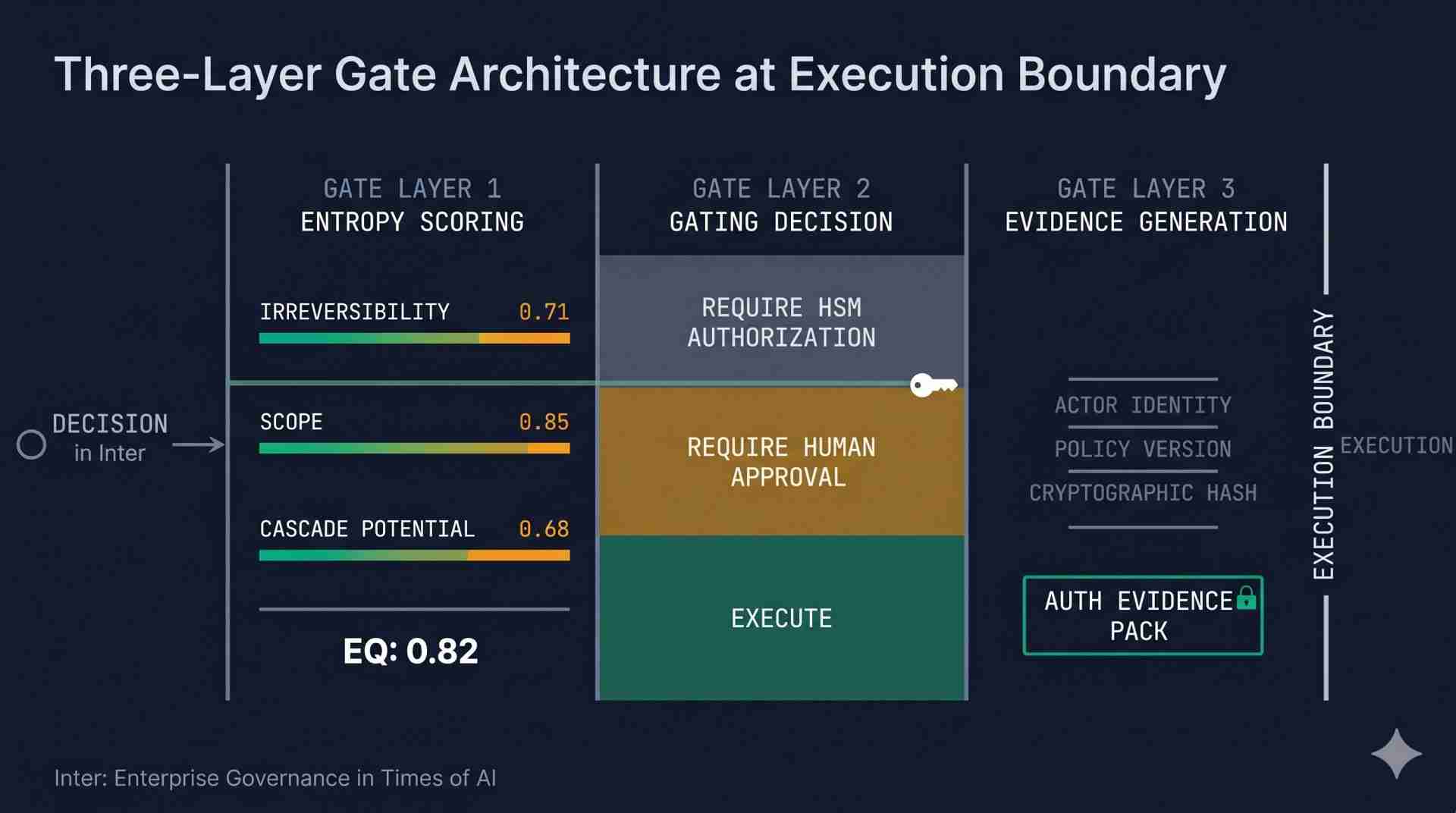
Layer One: Entropy Scoring
Every decision in an automated system, whether initiated by a human operator or an AI agent, receives an entropy evaluation before it crosses the execution boundary. The scoring is structural, not subjective. It derives from three measurable dimensions against the organization’s dependency graph.
The first dimension is irreversibility. Can this action be undone, and at what cost? A configuration change that can be rolled back in thirty seconds scores differently from a data deletion or a contract execution. The scoring requires a continuous measure of the effort and time needed to restore the prior state, weighted by the probability that restoration is possible at all.
The second dimension is scope. How many downstream systems, processes, or people are directly affected? The dependency graph makes this measurable. A change touching three internal services scores differently from a change touching infrastructure shared by forty teams.
The third dimension is cascade potential. Does this action trigger further automated decisions? An action that updates a database field and triggers three automated workflows receives a cascade score that reflects the full tree of potential consequences, not just the immediate effect. This dimension is particularly important in agentic systems, where a single action can initiate a chain of downstream executions that individually appear low-consequence but collectively produce significant organizational effects.
The three dimensions combine into a single entropy score for each action. The scoring algorithm is deterministic given the dependency graph. It does not depend on the judgment of the person or system requesting the action, nor does it change based on urgency or seniority.
Layer Two: Gating
The entropy score determines what happens at the execution boundary. The gate has three zones.
Below threshold, execution proceeds immediately without interruption. The action is low-entropy: reversible, narrow in scope, and low cascade potential. The vast majority of automated actions fall into this zone, which is the design intent. Governance overhead should be proportional to consequence, not applied uniformly.
In the amber zone, the action is held at the boundary until human approval is obtained. The system generates a structured approval request containing the entropy score, the dependency graph analysis, and the specific dimensions that placed the action in the amber zone. The approver sees exactly what they are being asked to authorize and why. Approval is logged with a timestamp, identity, and a reference to the evidence artifact generated at the gate.
Above the critical threshold, the action requires physical key authorization. This is not a metaphor for a strong password or a second factor on a mobile device. Physical key authorization means a hardware token or physical presence at an authorization terminal is required to proceed. The design principle is that the most consequential actions should have an authorization step that cannot be completed programmatically. An automated system cannot satisfy a physical key requirement. A remote attacker cannot satisfy it. A panicked night-shift operator cannot satisfy it alone. The friction is the point.
The gate does not negotiate. It does not have an override mode that can be invoked by claiming urgency. Urgency is an argument for improving decision latency upstream, not for disabling the gate. A gate that can be bypassed by asserting an emergency will be bypassed routinely once teams discover that urgency claims are not audited.
Layer Three: Evidence Generation
Every gate interaction produces a cryptographically signed artifact before the action executes. This is the layer that transforms compliance from a retroactive claim into a demonstrable fact.
The evidence artifact contains four elements: the entropy score at the time of evaluation, including the dependency graph snapshot used to calculate it; the gate zone determination and threshold values in effect; for amber-zone and above-threshold actions, the identity, timestamp, and method of authorization; and a hash of the action as presented for execution.
Cryptographic signing means the artifact cannot be altered after generation without being detected. The pre-execution timing means governance evaluation cannot be claimed retroactively. The artifact proves that governance occurred before the action, not that someone documented it after the fact. This distinction matters in a regulatory context and even more in an incident context, where the question will be whether governance was operational or merely asserted.
The evidence layer is what makes the architecture auditable. A regulator, an auditor, or an incident investigation team can reconstruct the governance state at the time of any action from the artifact record. The record is not a log of what happened. It is a chain of proofs that governance evaluation preceded execution, that the entropy score was calculated against the live dependency graph, and that authorization was obtained through the required method.
The EU AI Act Window
The EU AI Act’s enforcement provisions take effect on August 2, 2026. For organizations deploying high-risk AI systems in EU-regulated contexts, this creates a hard boundary.
The relevant governance requirement is not that organizations have an AI policy. The requirement is that governance is demonstrably operational for systems affecting safety, fundamental rights, and consequential decision-making in regulated domains. Documentation of intent is not sufficient. Evidence of enforcement is required.
The Anti-Terminator Architecture produces that evidence by design. The cryptographically signed artifacts from Layer Three satisfy the pre-enforcement audit requirement. The actor-agnostic gate ensures consistent governance regardless of whether actions are human- or AI-initiated. The entropy scoring against the dependency graph satisfies the requirement for risk-proportionate controls.
Organizations building this architecture proactively have until August to implement, test, and generate an evidence record under normal operating conditions. Organizations deferring will implement under regulatory pressure, with compressed timelines, against a live evidence requirement they have not yet established. There is no partial compliance state that satisfies the audit requirement. Either the evidence record exists or it does not.
This Is an Architectural Choice
The framing that positions AI governance as a values question or a compliance burden has done significant damage to enterprise decision-making. Organizations that treat governance as a philosophical stance defer implementation. Organizations that treat it as a regulatory cost minimize it. Both approaches produce systems that are not under governance in any structural sense.
The Anti-Terminator Architecture reframes the question. Entropy scoring is engineering. Gating at the execution boundary is an engineering practice. Cryptographic evidence generation is engineering. None of these requires an organization to take a position on AI consciousness or the long-term trajectory of machine intelligence. They require an organization to instrument its dependency graph, set threshold values, and integrate an evidence generation step into its execution pipeline.
The choice facing enterprise architects in June 2026 is not whether to have principles about AI. It is whether to build systems that enforce governance structurally or systems that assume governance will happen through human vigilance and policy adherence. The evidence from deployed agentic systems is consistent: vigilance and policy adherence are insufficient at machine execution speed. Structure is what works.
The architecture is available. The regulatory window is defined. The exploitation surface created by actor-specific governance tracks is closed by a design decision that takes weeks to implement. Organizations building proactively will arrive at August 2026 with an evidence record and a tested architecture. Organizations deferring will arrive with a compliance project and a governance gap.
That is the choice. It is architectural, not philosophical.
Rosho is the CEO of Qaori, a cooperative platform company building AI-native governance infrastructure. This article is the fourth in the series “Enterprise Governance in Times of AI.”

