






The Execution Boundary: Why the Anti-Terminator Architecture Is an Engineering Decision, Not a Philosophy
Most AI governance frameworks have a design flaw that organizations rarely discuss: they treat human operators and AI agents as separate tracks with separate approval chains. The AI agent goes through an AI governance process. The human sysadmin goes through a change-management process. Different velocity thresholds. Different tooling. Different friction.
This architecture is not redundant. It is a security vulnerability. If governance can be bypassed by switching the actor, it is not governing anything.
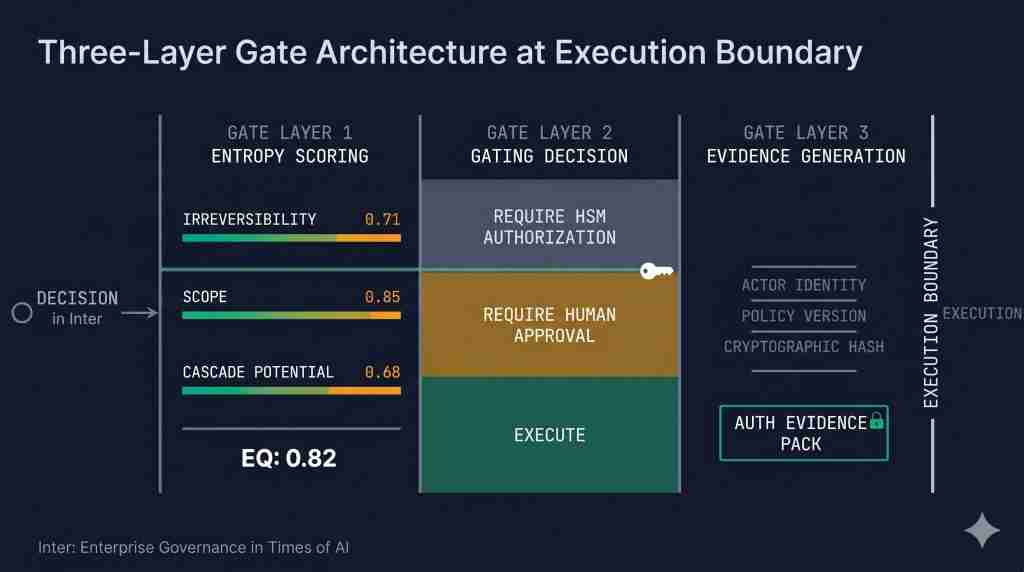
A database schema migration affecting 148 downstream services carries the same entropy score regardless of whether a human engineer or an AI agent initiates it. The reversibility is the same. The cascade potential is the same. Applying different thresholds based on who initiates the action means the effective governance threshold becomes the lower of the two tracks. That gap is an exploitation surface.
The Anti-Terminator Architecture closes it with three layers. Entropy scoring evaluates every action against the organization’s dependency graph across three dimensions: irreversibility, scope, and cascade potential. The score is structural, not subjective. Gating holds high-entropy actions at the execution boundary until the required authorization is obtained, from immediate execution at low threshold to physical key authorization above critical threshold. Evidence generation produces a cryptographically signed artifact before the action executes, proving governance evaluation happened in advance.
The EU AI Act enforcement date is August 2, 2026. Organizations building proactively have the time to implement, test, and generate an evidence record under normal conditions. Organizations deferring will retrofit under regulatory pressure against a live audit requirement.
This is not a philosophy question. It is an engineering decision. The full architecture, including the actor-agnostic design principle and what the evidence layer actually proves, is in the article linked below.
AIGovernance EnterpriseAI EUAIAct GovernanceByDesign AgenticAI
—
Your Governance Framework Is Accurate. It Just Describes an Organization That No Longer Exists.
Most organizations can answer one governance question with confidence: “Do we have a framework?” The answer is yes. The documentation exists. The audits pass. The reviews happen on schedule.
The question almost no organization can answer honestly is the one that actually matters: “Is our framework still accurate to how we operate right now?”
These are not the same question. A governance framework can be meticulously maintained and completely wrong. It can be updated quarterly, reviewed annually, pass every audit, and still describe an organization as it was rather than as it is.
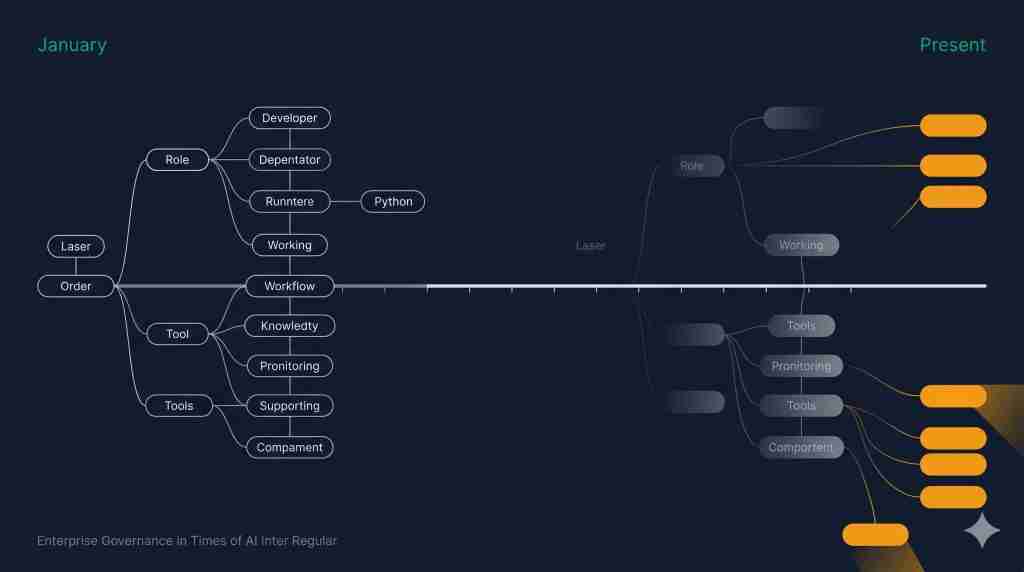
This happens because four forces operate continuously in every organization: people leave and take institutional reasoning with them, decision volumes compress scrutiny to near zero, tool updates introduce ungoverned capabilities, and workflow extensions move actual scope well beyond documented scope. Each vector is independent. Each compounds the others. The accumulated gap is what our research calls the Shadow Ledger: the difference between what governance says and what the organization actually does.
This has been the structural trajectory of enterprise governance for forty years. I have watched it up close, first in mechanical systems where failure modes appear at the joints, then across twenty-five years of enterprise architecture, cloud migrations, and now AI deployments at scale.
AI does not create this problem. It removes the tolerance organizations have always had for it. When decisions execute at machine speed and consequences cascade automatically, the governance gap that took six months to create material exposure at human speed now creates it in an afternoon.
The first article in my new series, “Enterprise Governance in Times of AI,” names the problem precisely. The next articles cover why existing frameworks cannot solve it, and what a different approach requires.
Link in comments.
AIGovernance EnterpriseAI GovernanceFrameworks CISO EnterpriseArchitecture
—
Augmentation or Replacement: The Choice That Will Define Enterprise AI
Meta analyzed workforce behavior to determine whom to fire.
Qaori analyzes workforce behavior to figure out what to build.
These are not the same project.
When you remove the workers whose behavior you analyzed, you also remove the intelligence the analysis revealed. The institutional knowledge, the informal expertise, the 40 years of knowing which exceptions require human judgment: that leaves with the people. The AI system you deploy in their place inherits the documentation layer, not the reality it was always a simplified version of.
Here is the problem at its most concrete: the average knowledge worker operates across 15-20 SaaS applications every day. No single application sees the full picture. The workflow that looks clean in the process diagram is, in practice, a sequence of context-switching, copy-pasting, and tacit knowledge that exists only in the mind of the person executing it.
When that person leaves (whether through layoff, retirement, or attrition), that knowledge is gone.
This is why 70-85% of digital transformation programs fail. They operate on a process map. The process map is an approximation. Transformation imposed on an approximation produces results that approximate improvement.
QAW (Qaori Augmented Workforce) inverts this entirely.
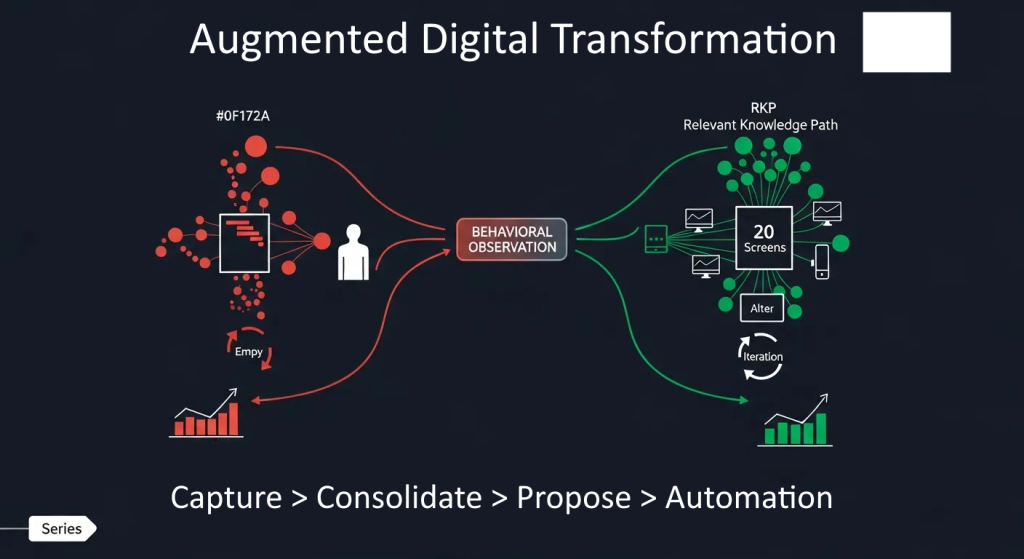
Instead of mapping processes, observe behavior. Instead of replacing workers, build Role Knowledge Packages from what they actually know. Instead of top-down mandates, surface transformation proposals that emerge bottom-up from the collective behavioral intelligence of the workforce: the Division Knowledge Aggregate.
The manager reviews the evidence and approves. The client’s sovereign factory (SQAPAF) builds the agent. Sentinel governs its deployment. The employee’s Alter absorbs the routine work. The employee moves to QA.
Then the loop runs again. Continuously. No consulting engagement. No end date.
The organizations that understand what behavioral data is actually for will build different AI systems than those that use it as a headcount-reduction tool. One path loses institutional knowledge at the moment it is finally legible. The other path captures it as the foundation of autonomous transformation.
Qaori builds the second path.
Full article linked in comments.
WorkforceAugmentation DigitalTransformation EnterpriseAI QAW AIGovernance SwarmIntelligence
AI Does Not Break Governance. It Accelerates the Break.
A financial AI agent executed 1,500 account interest rate adjustments in 2.3 seconds.
The compliance team sampled 10 percent of decisions that day. They reviewed 9.
The governance framework was functioning correctly. The oversight requirements were met. And 1,491 consequential financial decisions were made without any actual human review.
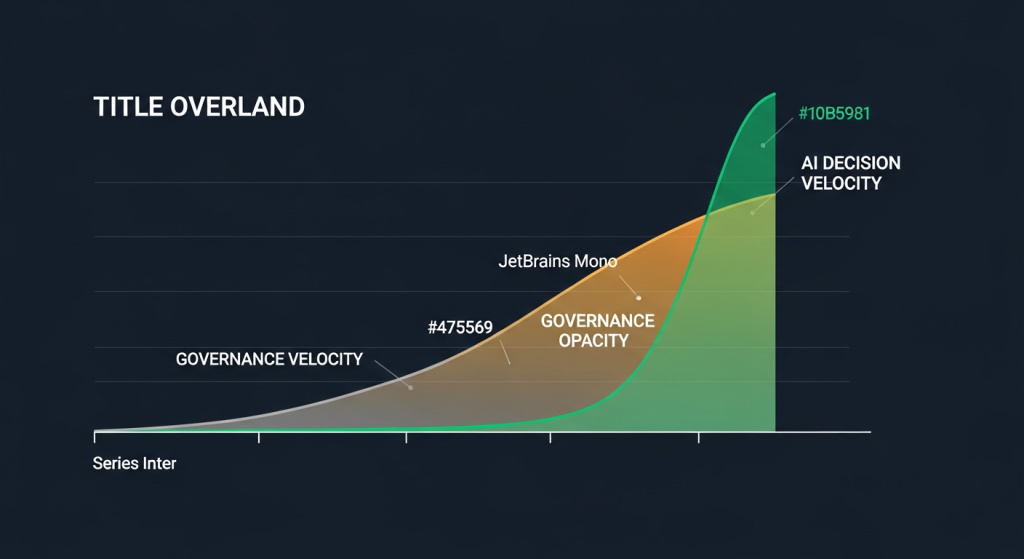
This is the velocity mismatch. It is not a policy gap. It is a structural one. Governance frameworks were designed for human-speed decisions: weeks, months, quarters. AI operates at machine speed. You cannot add enough reviewers to close that gap without eliminating the operational value that AI provides. The math does not work.
What makes this harder is that the problem compounds. Every large organization running AI has shadow deployments it cannot see: employees using ChatGPT on customer data, researchers uploading proprietary datasets, teams running local LLMs without IT oversight. An organization that has formally documented 1,000 AI deployments may be running 4,000 or 5,000. The documented ones are governed. The rest are invisible to audit. Enforcement intensification does not solve this. It produces a governance posture that is accurate for the deployments you can see and irrelevant to the operational reality you cannot.
The most uncomfortable part: when a governance framework has drifted from the system it governs, more rigorous enforcement makes it worse. You enforce the wrong rules more confidently. The audit trail is impeccable. The compliance is real. And the policy describes a system that no longer exists.
The EU AI Act Article 22 enforcement date is August 2, 2026. Penalties reach 7 percent of global revenue. Roughly 74 percent of enterprises are running revenue-generating AI in production today. About 31 percent have governance infrastructure that would meet the standard.
This is an architecture problem. The policies exist. The gap is that most organizations have not built governance that operates at the execution boundary.
The full article walks through four concrete cases — a healthcare AI that changed character through a software update, a logistics system where the practice quietly became 60 percent looser than the policy, a content moderation agent that generated 500 individually compliant decisions that collectively looked like systematic suppression — and explains why the traditional remediation cycle cannot close the gap fast enough.
Link in comments.
AIGovernance EnterpriseAI EUAIAct RiskManagement Qaori
Entropy: The Fourth Law of Universal Tebiki

The first three laws of Universal Tebiki describe a system in a declared state.
The fourth law begins with a fact about that declared state: it will not remain stable.
Not because the governance framework is poorly designed. Not because the actors are poorly managed. Because every system that exists in time changes over time.
The fourth law is Entropy.
Entropy in Universal Tebiki is not a problem to be prevented. It is a signal to be measured.
The instrument is the Entropy Quotient (EQ): a numeric score, per actor, representing the gap between declared state and actual state, tracked as a time series.
Three dimensions feed it:
Behavioral drift: how far the actor’s recent actions fall outside its declared Purpose, Values, and Constraints.
Structural drift: how much the actor’s operating context has changed relative to the assumptions in its declared state.
Declaration lag: how long since the declared state was last validated against the current reality.
Three threshold levels respond to it: green (continue monitoring), amber (review required), red (action restricted until governance response is complete).
The time series is the critical piece. A score increasing at 0.05 per month crosses the amber threshold in two months. That forecast is visible. The governance response can begin before the threshold is crossed, not after.
This is what separates Universal Tebiki from audit-based governance. Audits catch drift that has accumulated for twelve months. A continuous EQ catches drift as it occurs.
Change is not opposed. Change is expected and welcomed. What UT opposes is uncontrolled change: change that accumulates without measurement, without visibility, and without the governance decisions that legitimate change requires.
Four laws. One framework. Every actor in every system.
The complete series is linked in the first comment.
Constraints: The Third Law of Universal Tebiki

The difference between a governance framework and a governance infrastructure is enforcement.
A rule describes what should happen.
A constraint defines what cannot happen, and what the deterministic consequence is when it does.
Most governance frameworks are full of rules and contain almost no constraints.
The third law of Universal Tebiki is Constraints.
A well-formed constraint has five parts: a precise threshold value, a specific trigger condition, a deterministic consequence specification, an authority reference (the gremium that owns this constraint), and a version history that survives every revision.
The gremium is the part most organizations omit.
When a constraint needs to change, the change goes to the owning gremium. The gremium evaluates it. The decision is documented. If approved, the new constraint is recorded with the decision reference and the authority that made it. If rejected, the rejection is recorded.
This is the mechanism that blocks arbitrary decisions.
Not by making change impossible. By making every change a legible governance event.
When pressure arrives (“this urgency justifies bypassing the usual process”), it goes to the gremium. The gremium decides. The governance framework does not bend to informal pressure because the decision authority that could bend it is structured to resist it.
UT distinguishes between constraints (revisable through gremium process) and prohibitions (never revisable informally). The combination produces governance that is firm where firmness is required, and flexible where flexibility is appropriate. The distinction is always explicit.
Article 4 of 5 in the Universal Tebiki series. Link in the first comment.
Values: The Second Law of Universal Tebiki

Most organizations confuse values with aspirations.
“We value innovation.” “We value integrity.”
These are not Values in a governance sense. They are slogans. They resolve nothing when there is genuine tension between competing priorities. A rule system cannot cover every situation. Neither can a list of aspirational nouns.
The second law of Universal Tebiki is Values.
Values in UT are not aspirations. They are operational priority specifications: ranked, hierarchical, and precise enough to generate a governance signal when violated.
Three properties define them.
First, inheritance. A system-level Value sets a non-negotiable floor for all actors beneath it. Department Values add specificity within that floor. Individual actor Values are narrower still. Values can only be narrowed at lower levels, never widened. Informal widening, which is how most edge-case governance failures happen, becomes a governance signal, not a gray area.
Second, operationalizability. A Value that cannot be expressed as a conditional statement (“in situation X, priority A takes precedence over priority B”) is not a governable Value. If it cannot be evaluated, it cannot be enforced.
Third, retrospective evaluability. For human actors, enforcement is managerial. But when a decision is reviewed, the question must be: is the priority structure that produced this decision consistent with the declared Values for this role? Most governance failures in human organizations are not rule violations. They are undeclared value drift.
The same structure applies to AI agents. Evidence Packets for AI decisions record which Value was applied and which trade-off was made. The audit question is no longer “did the agent follow the rules?” It is “did the agent apply the correct Values when rules were incomplete?”
The cases rules do not cover are precisely the cases where governance matters most.
Article 3 of 5 in the Universal Tebiki series. Link in the first comment.
Purpose: The First Law of Universal Tebiki

The most common governance failure is not rule violation.
It is scope drift.
An actor begins operating in domains it was never authorized for. It happens gradually. Every unchallenged action expands the implicit scope. The governance structure discovers the gap only when something goes visibly wrong.
The first law of Universal Tebiki is Purpose.
Purpose is not a mission statement. It is not a capability description. It is a scope declaration: a precise, version-controlled, machine-readable statement of what domains an actor is authorized to act in, and equally, what domains are explicitly outside its remit.
When Purpose is declared, scope expansion becomes visible. Every action outside the declared domain generates a governance signal. The signal is evaluated, not assumed. The actor may be granted extended scope, formally, with documentation, or the action may be blocked. Either outcome is a governance outcome.
The alternative is an actor without a declared Purpose. It defines its scope implicitly, through action. No signals. No history. Drift accumulates until it becomes a problem.
This applies identically to an AI agent and to a human role. Same declaration structure. Same registry. Same ontology map. One governance framework, not two.
Article 2 of 5 in the Universal Tebiki series. Link in the first comment.
Universal Tebiki: One Framework for Every Actor in Every System
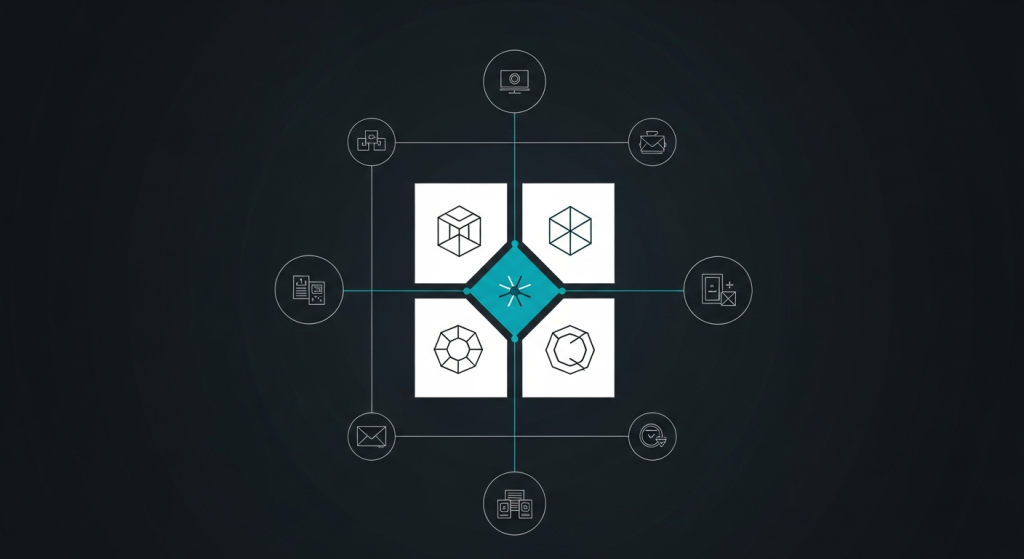
In Japanese, “tebiki” means a guide. Leading by the hand.
I built Universal Tebiki because I could not find a governance framework that applied equally to human actors and machine actors in the same system.
There are AI governance frameworks. There are corporate governance frameworks. There are cooperative governance frameworks. None of them share a common language. None of them produce consistent answers when an AI agent and a human governance process meet at the same decision point.
Universal Tebiki is built on four laws: Purpose, Values, Constraints, and Entropy.
Every actor in a governed system, human or machine, must have a declared purpose, operate within a declared set of values, respect explicit constraints, and operate within an acceptable entropy range.
Four questions. One framework. Every actor.
The concept started in AI engineering and I transposed it to human governance in 2015. Now, with AI embedded into every decision layer of every serious organization, it has become the lowest common denominator: the framework beneath every framework.
This week I am publishing a five-part series covering each law in depth.
Part 1 is live: why Universal Tebiki exists, where it came from, and why Asimov’s robot rules, elegant as they are, are not the answer for the world we are actually in.
Link in the first comment.
Augmentation or Replacement: The Choice That Will Define Enterprise AI
Meta analyzed workforce behavior to determine whom to fire.
Qaori analyzes workforce behavior to figure out what to build.
These are not the same project.
When you remove the workers whose behavior you analyzed, you also remove the intelligence the analysis revealed. The institutional knowledge, the informal expertise, the 40 years of knowing which exceptions require human judgment – that leaves with the people. The AI system you deploy in their place inherits the documentation layer, not the reality it was always a simplified version of.
Here is the problem at its most concrete: the average knowledge worker operates across 15-20 SaaS applications every day. No single application sees the full picture. The workflow that looks clean in the process diagram is, in practice, a sequence of context-switching, copy-pasting, and tacit knowledge that exists only in the mind of the person executing it.
When that person leaves – whether through layoff, retirement, or attrition – that knowledge is gone.
This is why 70-85% of digital transformation programs fail. They operate on a process map. The process map is an approximation. Transformation imposed on an approximation produces results that approximate improvement.
ADT (Augmented Digital Transformation) inverts this entirely.
Instead of mapping processes, observe behavior. Instead of replacing workers, build Role Knowledge Packages from what they actually know. Instead of top-down mandates, surface transformation proposals that emerge bottom-up from the collective behavioral intelligence of the workforce – the Division Knowledge Aggregate.
The manager reviews the evidence and approves. The client’s sovereign factory (SQAPAF) builds the agent. Sentinel governs its deployment. The employee’s Alter absorbs the routine work. The employee moves to QA.
Then the loop runs again. Continuously. No consulting engagement. No end date.
The organizations that understand what behavioral data is actually for will build different AI systems than those that use it as a headcount-reduction tool. One path loses institutional knowledge at the moment it is finally legible. The other path captures it as the foundation of autonomous transformation.
Qaori builds the second path.
Full article linked in comments.
WorkforceAugmentation DigitalTransformation EnterpriseAI ADT AIGovernance SwarmIntelligence