






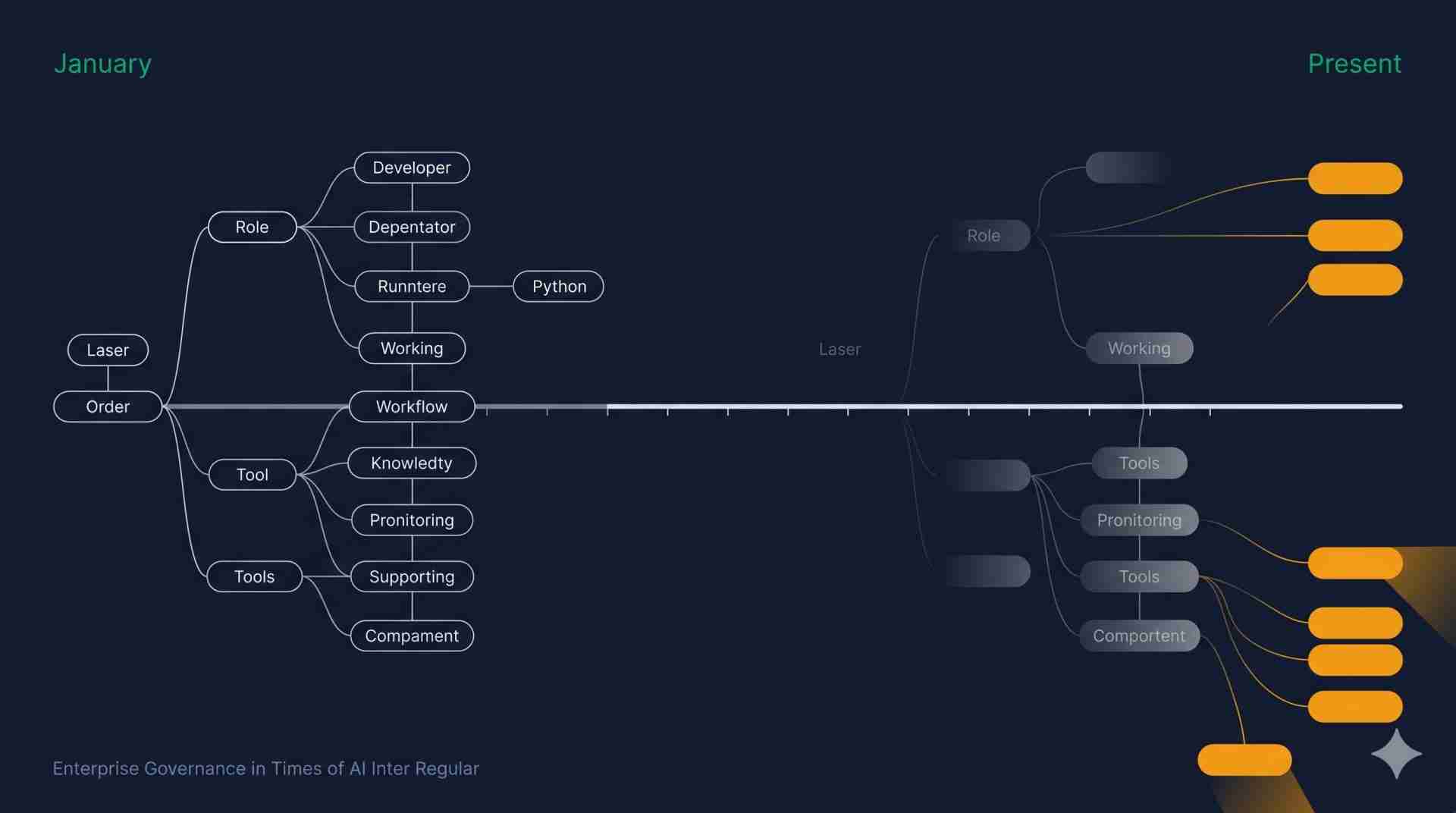
Governance frameworks do not fail because they are poorly designed. They fail because the organizations they govern keep changing, and the frameworks do not.
Governance frameworks do not fail at installation. They fail over time, quietly, through structural forces that every organization experiences and almost none measures. I have been watching this pattern for twenty-five years, across mechanical systems, enterprise architecture, cloud migrations, and now AI deployments at scale. The mechanism is always the same. The consequences are getting faster.
The core problem is not complexity, regulatory lag, or leadership complacency. The core problem is that governance frameworks describe organizations at a single point in time, and organizations are dynamic systems that do not stop changing after the framework is installed. The gap between what the framework says and what the organization actually does is the governance problem. It is structural. It is invisible. And it is not new.
What is new is the speed at which AI is widening that gap.
The Framework Describes January
Every governance framework is accurate on day one. It describes the organization as it exists at the moment of installation: the people in their roles, the tools at their current versions, the workflows as they were designed, the scope of each system as it was authorized.
Six months later, none of those things is exactly the same. Three engineers have left. One took with her the institutional knowledge of why a particular risk threshold was set at its precise value. Two tools have been updated. The new versions have capabilities the framework never contemplated. One workflow has organically extended into an adjacent domain because a team found a better way to solve a problem. A data feed that did not exist in January is now feeding a model that was scoped only for internal decisions.
The governance framework still says January.
This is not a documentation problem. Most organizations maintain their frameworks. They review them, update them, pass audits against them. The question that almost no organization can honestly answer is not “Do we have a governance framework?” but “Is our governance framework still accurate to how we actually operate?” Maintenance and accuracy are not the same thing. A framework can be meticulously maintained and structurally wrong.
Four Vectors That Work Continuously
Governance decay operates through four drift vectors, each independent, each compounding the others.
The first is personnel change. A governance framework crystallizes the reasoning of the people who built it. Each threshold, each boundary, each rule encodes a risk judgment made by someone who understood the system deeply. When that person leaves, the reasoning departs with them. The documentation stays. The organizational memory that could interpret the documentation, catch anomalies, and update the framework when conditions change is gone. What remains is governance maintained by people who did not author it and cannot read its deeper logic.
The second is volume compression. At low decision volume, governance functions as a genuine check. Each decision receives scrutiny. A human reviewer can evaluate context, confirm scope, and verify that conditions are met. When volume scales by an order of magnitude, the governance structure remains identical, but the substance evaporates. Reviews still happen. Audit trails are maintained. But when a reviewer samples 1% of decisions, the governance function is no longer a limiting factor in system behavior. It is a documentation process that appears to involve oversight.
The third is tool updates. Governance is written against the capabilities a system has at the time of governance writing. If the system cannot do something, there is no rule about it. When the system is updated and new capabilities are introduced, the governance framework contains no policy for those capabilities because they did not exist when the framework was written. The system now operates with ungoverned capability. The gap is not caught because the governance process was not designed to detect when updates introduce new scope.
The fourth is workflow extension. This is the most structurally dangerous vector because it operates through productive energy rather than negligence. People find new applications for the tools they have. They extend the scope at the edges. Each individual extension is locally useful, locally justified. A scheduling system scoped for one product line gets applied to a second line because they share infrastructure. Then it gets connected to purchasing. Then to supplier coordination. Then to maintenance planning. Each step is an improvement. Accumulated over twelve months, the system governs a scope that bears no resemblance to the framework’s description. No one violated a rule. The scope simply moved.
The Shadow Ledger
Robert Hopp’s research introduced the concept of the Shadow Ledger: the accumulated total of all unmanaged governance gaps across all vectors operating simultaneously. It is not visible as a single catastrophic event. It does not announce itself. It builds beneath the surface of normal operations.
The Shadow Ledger is the difference between what the governance framework says the organization does and what the organization actually does. Most organizations cannot tell you how large theirs is because measuring it requires continuous comparison of documented governance with the actual operational state. Almost no organization does this continuously. Most measure it once a year, after the fact, against a static snapshot.
By the time the annual review identifies a gap, it has been operational for months. Decisions have been made under an inaccurate form of governance. Consequences have been committed.
The Example That Makes This Concrete
In 2021, a financial services organization deployed a credit-scoring algorithm tuned by an engineer who understood not just how it worked, but why each parameter was set precisely where it was. The governance framework captured the broad strokes of her decisions. The deep reasoning, the kind that would catch subtle model drift, lived in her knowledge.
When she left, the framework remained intact. Nine months later, the algorithm had drifted in its treatment of a specific applicant segment. Not due to policy violation. Due to model drift in the underlying training data. The framework said the algorithm was still operating within the original policy. The framework was wrong. The engineer would have caught the drift in a quarterly review, because she understood what the indicators of drift looked like. The framework could not say this. The person who could read the signs was gone.
This is a governance accuracy failure, not a governance documentation failure. The documentation was complete. The accuracy was gone.
Why Annual Review Is Structurally Insufficient
Most organizations review governance frameworks annually. This is a management practice. It is not a measurement.
Measurement is continuous. It detects change as change happens. An organization that continuously measures governance accuracy can detect when a personnel departure has created a knowledge gap, when a tool update has introduced ungoverned capability, when volume increases have compressed review depth to below meaningful coverage, or when workflow extension has moved the system beyond its authorized scope.
An organization that reviews governance annually detects these things at best 11 months late. By the time the review discovers the gap, the operational period under inaccurate governance is already complete. The decisions made in that period cannot be unmade. The Shadow Ledger for that period is already written.
In 2023, a financial services organization conducted its annual review in January and found its governance intact. The organization updated its AI system to a new model version in February. The new version had capabilities the previous version did not. Those capabilities were ungoverned because the framework had not been updated to reflect the new model. An audit six months later found the ungoverned capability had been used twice. The annual review had worked exactly as designed. It had simply been designed to catch drift once per year in an environment where drift was occurring continuously.
AI Does Not Create This Problem. It Accelerates It.
Each of the arguments above applies to organizations that have not deployed a single AI system. This is a forty-year-old structural problem that predates the current AI cycle. What AI changes is the speed and scale of consequences.
Traditional governance processes were designed for human-speed decision-making. A decision that takes days to execute can be reviewed, flagged, and corrected before major consequences accumulate. A human-speed governance process can barely keep pace with a human-speed operational system. The gap still opens. The consequences still accumulate. But they accumulate slowly enough that enforcement intensification, more reviews, more sign-offs, and more detailed audits can contain the damage.
AI removes that tolerance. When a system processes hundreds of decisions per minute, the governance gap that would have taken six months to create material consequences at human speed creates those consequences in an afternoon. When dependent decisions cascade automatically across systems, consequences are committed before a human can read a paragraph about the first decision.
The organizational response is usually an intensification of enforcement: more rigorous logging, more detailed audit trails, and more comprehensive documentation of what the agent decided and why. This approach produces something specific: a better-documented record of drift. A detailed audit trail showing all the ways a system violated its governance framework is not evidence of good governance. It is evidence of a well-documented failure.
More enforcement of inaccurate rules does not produce better governance. It produces more evidence that the rules were wrong.
The Right Question
For twenty-five years, the standard governance conversation in enterprises has started from the wrong question. The question has been: “Do we have a framework?” The answer is almost always yes. The documentation exists. The reviews happen. The audits pass.
The question that actually determines governance quality is: “Is our framework still accurate to how we operate right now?”
This is a harder question. It requires continuous measurement, not periodic review. It requires detecting drift as soon as it begins, not after the annual review. It requires understanding not just whether governance documentation exists, but whether that documentation matches operational reality.
Organizations that cannot answer this question honestly are operating with a Shadow Ledger of unknown size. Most are. For organizations running significant AI deployments at the speed enterprises run them today, the tolerance for this ambiguity is gone. The gap between human-speed governance and machine-speed decision-making is not a theoretical risk. It is an operational condition that exists right now in systems that make consequential decisions every minute.
The governance problem is not new. The governance solution must be. What that solution looks like and why existing frameworks cannot deliver it are what this series goes on to explore next.

