






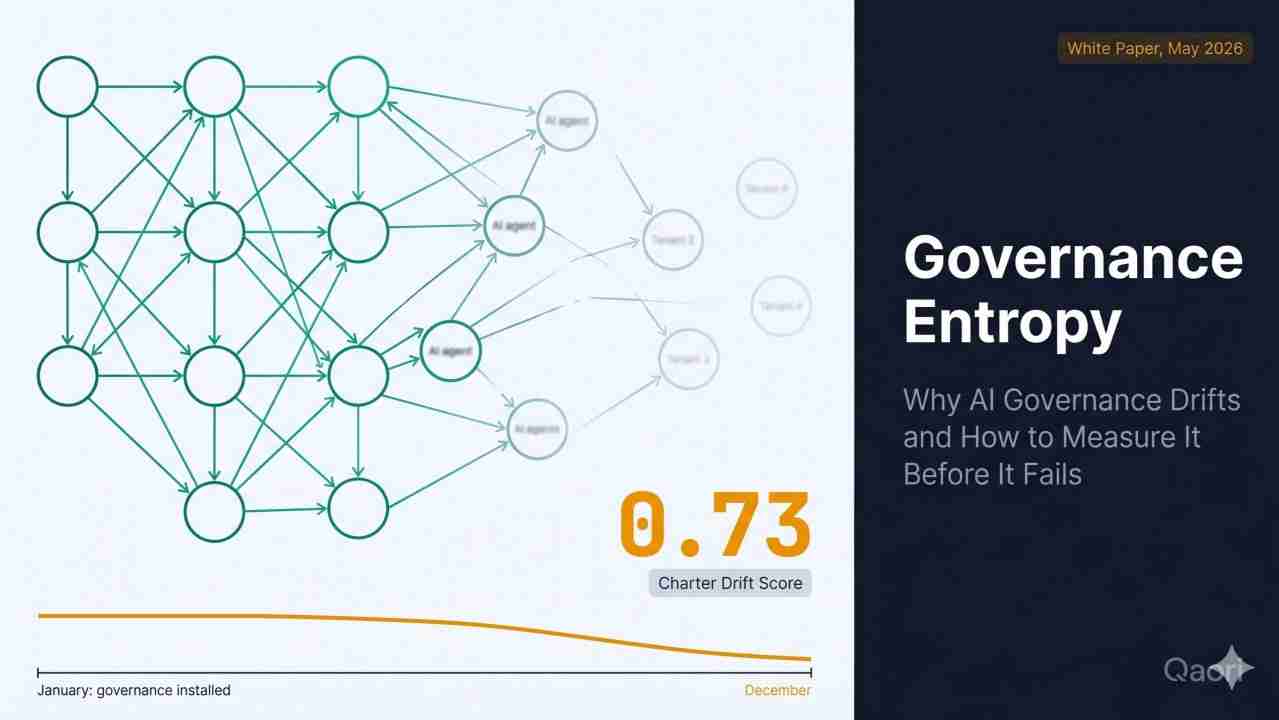
Your AI Governance Is Drifting. Here Is How to Measure It.
@Thomas Tornatore from Fellowship Intelligence asked this question:
There is a question that almost no organization can honestly answer about their AI governance.
Not “do we have a governance framework?” Most do.
Not “is it documented?” Most are.
The question is: is it still accurate?
A governance framework installed in January describes the organization as it existed in January. The organization has not stood still since January. People have left. Tools have been updated. Workflows have expanded into adjacent territory. New AI agents have been deployed.
The governance framework still says January.
This gap has a name. I want to give you the physics behind it, the four mechanisms through which it enters, and the three specific instruments that close it.
Why Governance Decays, and Why It Is Inevitable
In 1865, Rudolf Clausius introduced the concept of entropy: the measure of disorder in a thermodynamic system. The second law states that in any natural process, total entropy increases. Systems trend toward disorder unless energy is actively invested to maintain order.
This is not a metaphor when applied to organizations. Robert Hopp and the Entropositive methodology spent a decade formalizing the application of thermodynamic entropy to organizational systems. Their central finding: Best Practice equals low entropy. The gap between how an organization currently operates and how it should operate is a measurable, calculable, trackable, and actionable score.
The corollary is direct: any governance structure, without active maintenance mechanisms, drifts toward disorder by physical law. Not because anyone is negligent. Because the organization it describes keeps changing, and the framework has no mechanism to change with it.
Robert ‘Rosho’ Hopp’s team called the accumulated state of unmanaged governance gaps the Shadow Ledger. It is not visible as a failure. It accumulates quietly, behind documentation that looks entirely intact.
The question is not whether your governance has a Shadow Ledger. It does. The question is how large it is, and whether you are measuring it.
The Four Vectors
Governance entropy enters through four specific mechanisms. I will describe each precisely, because understanding the vector determines the defense.
Personnel changes are the fastest vector. Governance structures encode the judgment of the people who built them: the reasoning behind each rule, the risk tolerance that set each threshold, the organizational context that made each boundary sensible. When those people leave, the reasoning leaves with them. What remains is a set of rules without context, maintained by people who inherited decisions they did not make. Within months of a key departure, a governance tier can be functionally unmaintained even as it appears structurally intact.
Volume compression is the invisible vector. At low volume, every significant AI decision gets real scrutiny. At high volume, the same governance process becomes a throughput operation. Reviews happen, approvals are granted, and audit trails are maintained. But the depth of scrutiny per decision has dropped to near zero. The governance structure looks the same. The governance substance has hollowed out.
Tool updates are the technical vector. AI systems change without anyone changing the governance. A model provider releases a new version. An integration is updated. A capability that did not exist six months ago now exists. A prohibition designed for a system that could not generate images is now irrelevant because the system was updated to include image generation. Governance written for one system describes a different system.
Workflow extension is the most structurally dangerous vector, not because it is malicious, but because it is driven by the organization’s productive energy. People do useful things with AI tools. They find new applications. They expand the scope at the edges. Each extension is locally reasonable. Cumulatively, they move the actual scope of AI use well beyond what the governance structure describes. It feels like progress. It registers as exposure.
Why the Instinct Is Wrong
The standard response to governance risk is enforcement intensification. More reviews. More sign-offs. More audits. More documentation.
This response is counterproductive, and the reason is thermodynamic.
More rigorous enforcement of a stale governance structure does not reduce entropy. It produces more confident enforcement of the wrong rules. The energy invested in enforcement intensity is energy not invested in accuracy verification. You end up with a governance structure that is simultaneously more rigorously enforced and less accurate.
From a regulatory risk perspective, that is a worse position than a lightly enforced but accurate one. An audit trail that meticulously records decisions made under governance that no longer describes the organization is not evidence of good governance. It is evidence of well-documented drift.
The right response to governance entropy is not more enforcement. It is a measurement.
The Three Instruments
There are three specific instruments that convert governance from a static document set (which drifts) into a living control plane (which does not).
The first is the Charter: a machine-readable document that defines, for a specific AI system, the complete set of permitted actions, obligatory behaviors, and prohibitions. Not a PDF. An executable policy object, signed at publication, version-controlled in a registry, and resolvable by the governance gate at runtime.
The Charter is the stable-state zero. It is what governance accuracy is measured against. Without it, drift cannot be calculated because there is no baseline to drift from.
Charters inherit. A platform-level Charter sets non-negotiable floors. Tenant-level Charters add context. Agent-level Charters narrow scope. The hierarchy makes the governance surface legible. You can see, at any level of granularity, exactly what any AI agent is authorized to do and what it is prohibited from doing.
The second instrument is the Ontology Map: a formal map of the entire governance surface, covering every agent, every hosted application, every authority domain, and the places where two agents share authority over the same customer, data, or decision domain.
The Ontology Map answers the question: what does our governance actually cover? Without it, workflow extension is invisible. New agents join the platform. Existing agents expand their scope. The governance surface grows while the governance structure stays fixed. Nobody notices because nobody has a map.
The map should be derived automatically from the platform’s registry of agents and applications, not written by hand, because hand-written maps are themselves subject to entropy. When a new agent is deployed, the map updates. When two agents begin acting on the same domain, the map surfaces a collision: a shared authority point that the governance structure needs to explicitly address. The Collision Map, a ranked register of every shared authority domain ordered by risk, makes workflow extensions visible the moment they happen, not six months later in an annual review.
The third instrument is the Drift Score: a numeric measure, computed nightly per agent, of the gap between what the Charter says should happen and what the Evidence Packet stream records as actually happening.
An Evidence Packet is a tamper-evident receipt emitted for every consequential AI decision: what was decided, by which agent, under which Charter version, at what time. The packets are write-once and hash-chained. Any modification after the fact breaks the chain at the point of tampering. They are the ground truth of what the organization’s AI systems have actually done.
The Drift Score engine compares the Charter against the Evidence Packet stream on four dimensions:
Permission gaps: actions taken with no corresponding permission in the current Charter. Prohibition breaches: actions taken that match a declared prohibition. Obligation gaps: required behaviors absent from the packet record. Version lag: agents operating under outdated Charter versions.
These combine into a composite score: 0.0 (no drift) to 1.0 (severe drift). Green below 0.2. Amber between 0.2 and 0.5. Red above 0.5. Updated nightly. Any entity crossing red triggers an alarm.
One signal worth highlighting: a drop in Evidence Packet emission volume is itself a drift signal. If an agent emitting 500 packets per day drops to 50, either activity has genuinely reduced or the obligation to emit packets is not being met. The volume signal catches obligation drift that content-based scoring alone cannot detect.
The Ownership Question
The governance drift conversation I keep having with enterprise AI teams always lands on the same structural question:
Who is accountable for whether your governance is still accurate, not who makes decisions inside it, but who owns the structure itself?
In most organizations, the honest answer is nobody. Decisions are run through the governance structure. Audits are conducted. Reviews are scheduled. But no one’s explicit responsibility is to continuously verify that the structure through which those decisions are run still accurately describes the organization.
The Drift Score answers this question instrumentally. Whoever watches the score owns the accuracy of governance. When the score is green, the governance is maintained. When it is red, something specific has drifted, and something specific needs to change.
This is governance as an instrument rather than governance as an assumption.
What Physics Says about the Alternative
Heylighen’s work on dissipative systems states that, for a complex system to remain stable, it requires internal control elements that maintain heterogeneities, thereby eliminating fluctuations that could destroy them. When those control elements are left unmaintained, the system succumbs to entropy, and its structure begins to degrade, homogenizing with its environment.
Applied to governance: a governance structure without active maintenance mechanisms does not remain stable. It degrades. It begins to describe the environment rather than constrain it. At that point, the governance is not governing. It describes what is already happening and calls it compliant.
This is the state of most AI governance structures twelve months after installation. Not failed. Not violated. Just unchecked. Describing January in December.
The Practical Question
If you are running AI in a regulated environment, the question for your next governance review is not “are we compliant?” It is: do we have the instrumentation to know if we drift out of compliance before it becomes a regulatory event?
Three instruments: a Charter Store, an Ontology Map, and a Drift Score.
Without them, your governance is documentation. With them, it is a control plane.
The gap between the two is the work. It is also the competitive moat, because the organizations that build this maintenance layer now will be the ones with defensible governance postures when regulators arrive. The others will have excellent documentation of the state of things in January.
Rosho is the CEO of Qaori, an AI-native operating system for enterprises deploying AI in regulated environments. Qaori’s Preemptive Governance framework is live in production. The governance maintenance layer, ontology mapping, and charter drift scoring are currently being built.
Contact: rosho@rosho.world | qaori.ai

