






The Authorization Gap: Where Hardware Enforcement Meets Constitutional Governance
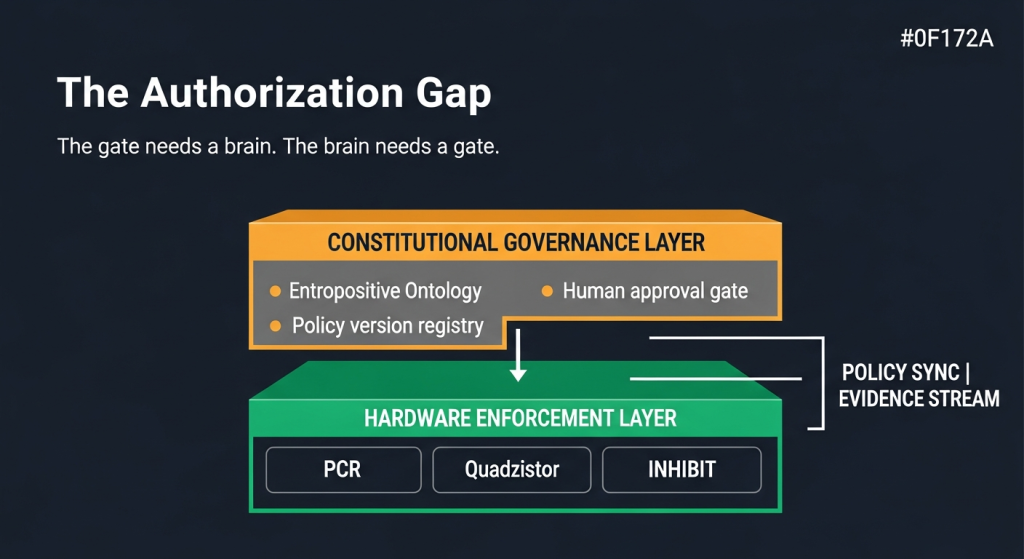
David Reichwein’s Authorization Gap framework correctly identifies the structural void between AI decision and physical execution. Closing that gap with hardware enforcement is necessary. It is not sufficient. The gate needs a brain. There is a question that sits at the foundation of every serious AI governance architecture conversation and is rarely made explicit. Not […]
The Factory Has a Front Door. And the Front Door Has Rules.

The moat in autonomous software development is not the model. It is the system around the model.
We recently completed a significant upgrade to QAPAF, one that changes what every agent in the factory reads before it does anything else. I will not describe the mechanism. The outcome is this: agents that begin each session from a known, governed behavioral baseline produce fundamentally different output than agents operating from accumulated context and inferred expectations.
At the front of the factory sits Qappa. Not a chatbot. Not an assistant. A Product Owner with authority over scope, specification, and quality. No implementation begins without Qappa’s approval. No session starts without a governed state. That authority is not symbolic. It is structural.
This architecture reflects forty years of PM/PO experience encoded as organizational constraint. You can replicate the tools. The judgment that designed the system around them is not available off the shelf.
The full argument, including why the LLMs are the most interchangeable part of the stack, is in the article below.
#AIEngineering #AutonomousSoftware #EnterpriseAI
Gates Catch Defects. The Behavioral Layer Prevents Them.

Gates catch defects. The behavioral layer prevents them. In our journey with QAPAF, the Qaori Autonomous Software Factory, we’ve discovered that simply identifying flaws isn’t enough. Every defect that slips through is a costly reminder of incomplete context and poor defaults. Enter the behavioral layer—a revolutionary approach that reshapes how agents operate before tasks even begin. With strict disciplines like spec-first enforcement and independent reviews, we’re not just catching errors; we’re preventing them. Discover how this innovative system transforms our quality process, reducing defect rates and enhancing reliability. Join us as we unveil the future of software quality management.
What the first large field study of coding agents tells us about the next industrial layer of software
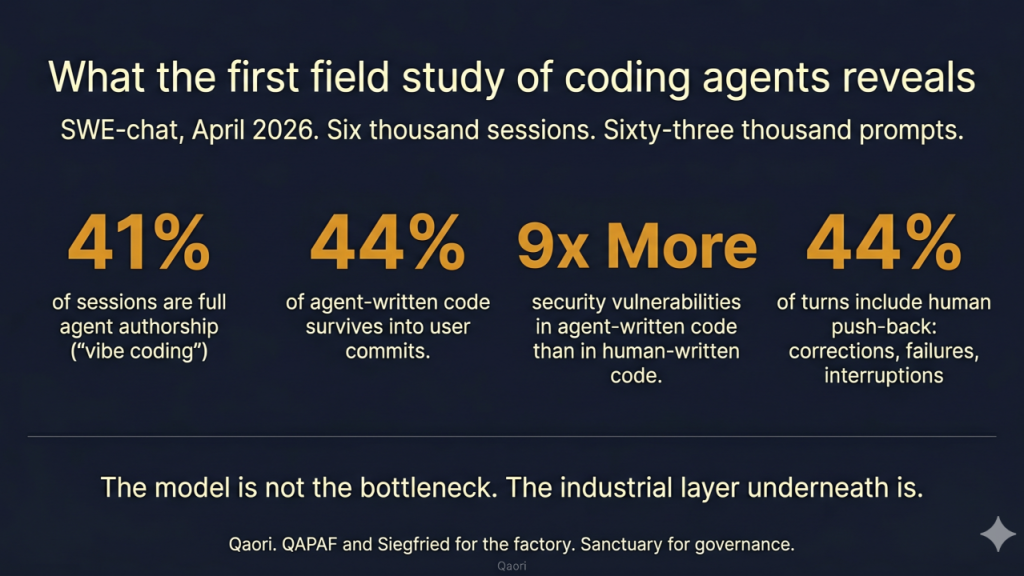
By Rosho, Founder, Qaori, the Brain Company in Japan. Building Sovereign Company Brains for the baby-boomers 団塊世代 succession wave. GDPRS/APPI-compliant. April 29, 2026 A new dataset called SWE-chat, released this month by researchers from Stanford, NYU, Princeton, and Anthropic, is the first attempt to look honestly at how AI coding agents are actually used in […]