






title: “Sanctuary Architecture, A Public Technical Brief”
audience: “Public”
version: “2.0-public”
date: “May 2026”
author: “Rosho Hopp, Founder, Qaori”
Sanctuary Architecture
A Public Technical Brief
This document describes Qaori’s Sanctuary architecture at a level intended for a general technical audience. It explains the principles, the regional structure, the multi-model design, and the sovereignty guarantees we enforce in infrastructure rather than in policy. Operational detail, internal benchmarks, and proprietary configurations are deliberately out of scope.
A note on context. Qaori is multi-cloud by design. The platform is Terraform-driven, which means the same architecture can be deployed across major cloud providers without rewrites. Where relevant, the descriptions below describe the architecture as designed, not the specifics of any single deployment.
1. The Sanctuary Principle
Qaori operates under a single architectural rule: data captured on the platform is stored, processed, and encrypted within the region where it originated. It does not cross jurisdictional boundaries. When AI processing is required, the processing comes to the data, not the data to the processing.
This is enforced at the infrastructure layer, not the policy layer. The next sections describe how.
2. Regional Architecture
The platform is structured as a mother hub with regional spokes. Each spoke is an isolated sovereignty zone provisioned from a single Terraform module set, which guarantees configuration parity across regions and auditable infrastructure changes.
Priority regional zones include the European Union, Japan, the United States, and Singapore. Once a regional hub is active, all data captured in that region is stored and processed locally. No data is replicated across zones without explicit per-tenant configuration and consent. Regional compliance, GDPR in the EU, APPI in Japan, CCPA in the US, is met at the infrastructure level rather than as a contractual addendum.
Terraform’s portability means the platform can be deployed or relocated across cloud providers and regions on a tightly controlled timeline. Sovereignty is therefore not tied to any single vendor.
3. The Multi-Model Sanctuary Pipeline
Qaori does not run a single model. The architecture is built on a cross-family consensus principle: no single model from any single vendor has unchecked authority over a generation, a moderation decision, or a code change. Different models from different organizations have different failure modes, and orchestrating them against each other catches issues no single model consistently catches.
Model selection across the platform is deliberately switchable. Our criteria for any role are speed, accuracy on the specific task, and cost, in that order of importance. Within the platform, large open-weight models are self-hosted for high-throughput conversational workloads, and frontier cloud models are reserved for narrower, higher-value reasoning tasks behind an anonymization boundary.
3.1 Cross-Model Consensus Flow
The compliance pipeline is the most distinctive architectural element of the platform. It is illustrated below.
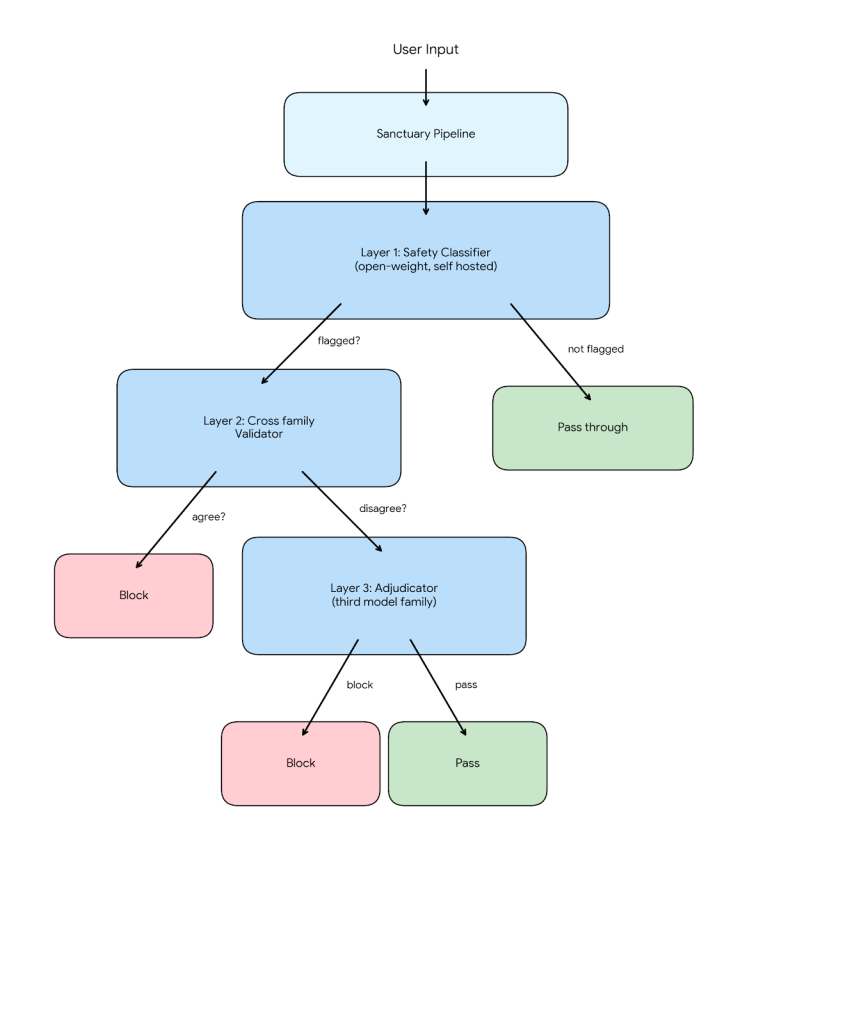
The principle: when two models from different families agree, confidence is high. When they disagree, the decision is escalated to a third family. A first-pass classifier filters, a second model from a different family validates, and a third family adjudicates edge cases. This pattern is implemented today and runs in production.3.2 Autonomous Engineering Pipeline
The platform includes an autonomous engineering pipeline that turns engineering issues into reviewed pull requests with minimal human intervention. A primary generation engine produces the proposed change. An independent reviewer from a different model family runs quality assurance on every output before it is allowed to merge. The same cross-family consensus principle that governs content moderation also governs code that ships into the platform.
4. The Anonymization Gateway
Self-hosted inference handles the majority of platform traffic. Whenever a request must be served by an external cloud model, it passes through an anonymization gateway before leaving the Sanctuary boundary. The gateway operates in multiple languages and detects named entities, contact information, identification numbers, and financial data, replacing them with placeholder tokens before transmission. On response, tokens are remapped to allow coherent output. The external model never processes identifiable user data.
This pattern handles the structured majority of personal data well. Conversational context that carries implicit identity, and domain-specific quasi-identifiers in regulated verticals, remain active areas of research across the industry, and we approach them as such.
5. Encryption And Key Management
Data at rest within the Sanctuary boundary is encrypted with AES-256, managed through the cloud provider’s key management service with regular key rotation. For tenants with high-risk requirements, tenant-specific keys are available, which means the tenant retains exclusive control over access to their own data.
Data in transit is TLS 1.3 for all service-to-service and client-to-platform connections.
6. Active Research Areas
Sovereignty-grade AI infrastructure is not a finished problem. Areas of active engineering on the platform include serving optimization for self-hosted open-weight models under sustained concurrent load, structured output reliability in long-running agentic pipelines, anonymization for implicit and contextual identifiers, and consensus orchestration as a first-class platform primitive rather than a hand-built layer. We treat these as ongoing engineering work rather than solved problems.
7. Why Sanctuary
Qaori serves regulated industries, healthcare, finance, legal, and government, where the questions asked of any platform are consistent: where does the data go, who sees it, and who is accountable. The answer Qaori gives is enforced in code rather than in policy. Real identities. Regional data sovereignty. Self-hosted inference for sensitive workloads. Cross-family consensus for decisions that affect users. Cloud fallback only behind anonymization.
The word Sanctuary is not a metaphor. It is the founding intention of the platform expressed in infrastructure.
Qaori, Yokohama, Japan. May 2026.