






Aviation learned to enforce operating boundaries before the aircraft entered an unsafe state. The equivalent architecture for AI agents is not only possible to describe precisely; it is buildable. This is what it looks like.
The flight envelope is one of the foundational concepts in aerospace engineering. It defines the complete space of conditions under which an aircraft can operate safely: the relationship between airspeed and altitude, the maximum structural load factor, the limits of angle of attack before the wing stalls, the temperature boundaries for engine operation. Every point within the flight envelope is a safe state. Every point outside it is, with varying degrees of immediacy, an unsafe one.
What makes the flight envelope significant as a governance concept is not the definition of the boundary. Defining limits is the easy part. What makes it significant is the enforcement architecture. Modern flight management systems enforce the flight envelope continuously, in real time, before the aircraft enters an unsafe state. They monitor the current operating parameters against the envelope boundaries. If a pilot command would take the aircraft outside the envelope, the system responds: it may push back against the control input, modify the command to stay within safe limits, or trigger an alert requiring pilot action. The Airbus fly-by-wire system makes it structurally very difficult to command an attitude that would overstress the airframe. The enforcement is active, anticipatory, and in the execution path. It does not wait for the aircraft to exceed a limit and then record the event.
The analogy to AI agent governance is precise and instructive. And building it out carefully resolves the architectural ambiguity that most governance discussions leave untouched.
Every AI agent operating in an enterprise environment has, whether explicitly defined or not, an intended operating envelope. It has an identity: the agent has been provisioned with specific credentials and operates on behalf of a defined principal. It has an authorised toolset: the tools it is permitted to invoke, the APIs it is permitted to call, the systems it is permitted to interact with. It has authorised data access: the classification tiers it may read, the repositories it may query, the data it may process. It has a jurisdictional operating context: the regulatory jurisdictions whose rules apply to its actions. It has action authority limits: categories of action it may take autonomously and categories that require human approval before execution. And it has a temporal operating context: it is governed by the policy version in force at the moment of action, which may differ from the policy version in force when it was provisioned.
These parameters, taken together, constitute the agent’s flight envelope. The governance question is whether those parameters are enforced before the agent acts, or whether they are recorded after the agent has already acted outside them.
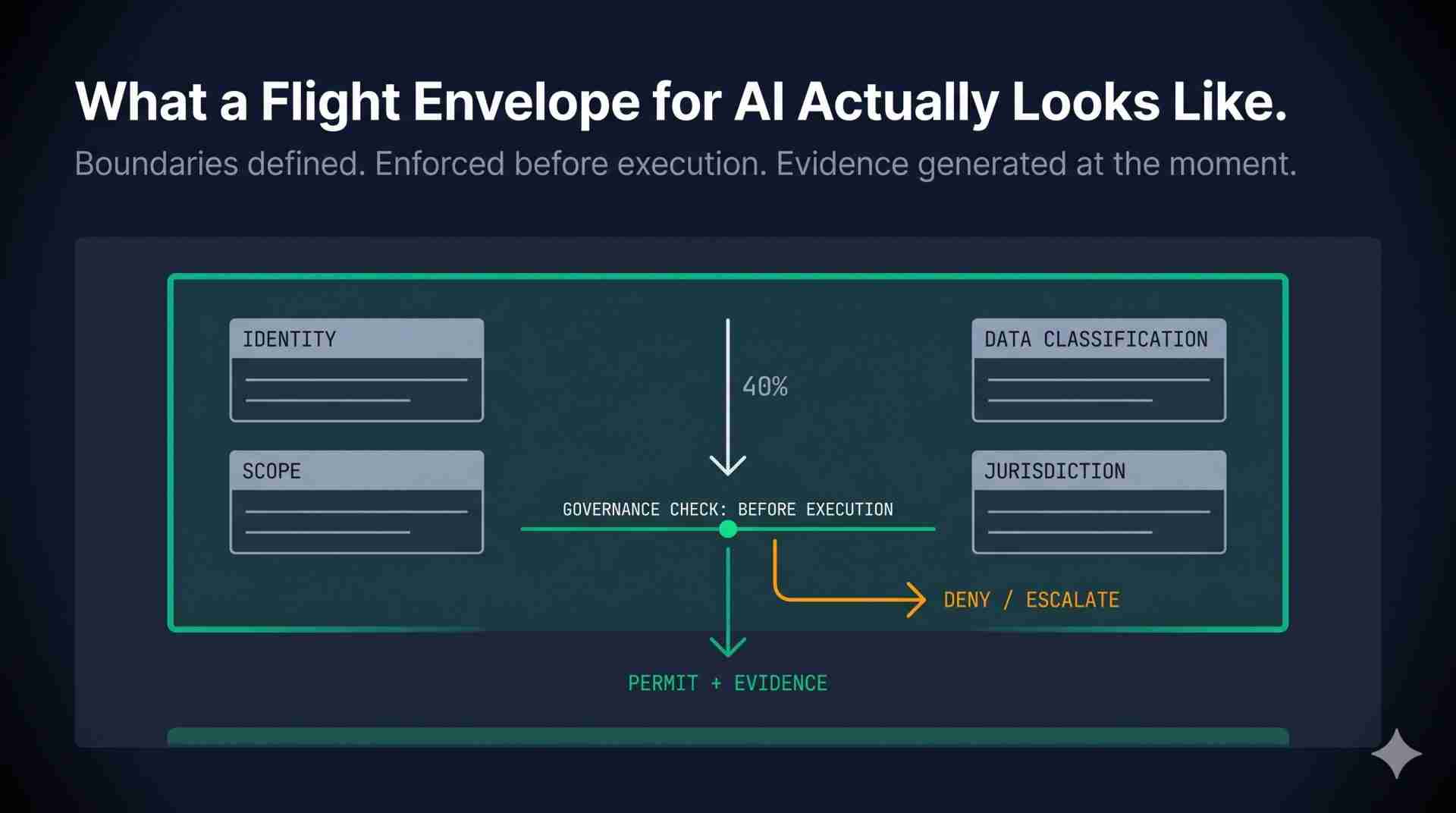
The flight envelope model applied to AI means the following. When a request comes in from an agent, a governance layer in the execution path intercepts it before the action is dispatched to any tool or external system. That governance layer performs a structured evaluation against the agent’s operating envelope. It checks identity: is this agent what it claims to be, operating on behalf of the principal it claims to represent? It checks scope: does this requested action fall within the toolset this agent is authorised to invoke? It checks data classification: does this action request access to data at a classification tier the agent is approved for? It checks jurisdictional requirements: does the data or action trigger obligations under a specific regulatory framework, and if so, are those obligations met? It checks approval requirements: does this category of action require a human to authorise it before it executes?
If the action passes all checks, it is permitted to execute. At the moment of execution, a structured evidence event is generated: not a log entry, but a structured, policy-linked record capturing the identity of the actor, the policy version evaluated, the scope determination, the data classification assessment, the jurisdictional context, any approval records, and the outcome. This evidence event is sealed in tamper-evident form at the moment it is generated.
If the action fails a check, it does not execute. Instead, the governance layer determines the appropriate response based on the nature of the failure. Some failures result in outright denial: the agent is not authorised for this action, full stop. Some result in transformation: the action is modified to fall within authorised parameters before execution. Some result in escalation: the action is held pending human review or approval. In every case, the denial or escalation itself becomes an evidence event. The governance record is complete for actions that were prevented, not only for actions that were permitted.
This is the architectural inversion that distinguishes a flight envelope governance model from a flight recorder governance model. In the recorder model, the record begins after the action. In the envelope model, the governance evaluation happens before the action, and the record is generated as part of that evaluation, whether the action proceeds or not.
This is where Qaori Sentinel enters the architecture.
Qaori Sentinel is a client-side governance bridge that sits in the execution path of AI agent systems, enforcing the flight envelope locally before actions are dispatched to tools and external systems. It is not a hosted API that receives action requests and returns verdicts. It is a component that runs in the client environment, co-located with the agents it governs, so that governance evaluation happens within the same trust boundary as the agents themselves. This matters for latency, for data sovereignty, and for the architectural integrity of the enforcement path: a governance check that can be bypassed, routed around, or that fails to intercept an action because of network conditions is not a governance check in any meaningful sense.
Qaori Sentinel enforces the flight envelope parameters described above: identity, scope, data classification, jurisdictional requirements, approval gates. It generates the structured evidence events at execution time. It handles denial, transformation, and escalation according to the policy rules configured for each agent and each action category.
Above Qaori Sentinel sits the Qaori control plane: the hosted intelligence layer that provides the governance semantics, the compliance mappings across regulatory frameworks, the policy authoring tools, the evidence graph, and the analytical intelligence that allows governance officers to understand how AI systems are actually behaving across the enterprise, over time, against the policies that govern them. The control plane sends policy down to the Sentinel plane. The Sentinel plane sends structured evidence events up to the control plane. The client data that agents handle does not travel to the control plane: evidence events carry the structured governance metadata, not the underlying data content.
This two-plane architecture, which the next article examines in detail, is what allows a flight envelope model to operate at enterprise scale without requiring client data to leave the client environment for governance purposes.
The flight envelope concept, applied to AI, is not a metaphor that requires significant translation. The parameters are definable. The enforcement architecture is buildable. The evidence generation model is specifiable. What has been missing is not the concept but the implementation: a governance layer that is genuinely in the execution path, that evaluates before the action rather than recording after it, and that generates evidence that will stand up to the scrutiny of a regulator rather than providing only the comfort of a log file.
The organisations that build this architecture first will not simply be better prepared for the next regulatory audit. They will have the only governance model that is actually capable of demonstrating that AI systems operated within their intended flight envelope, in real time, every time an action was taken. That is what governance means, when the word is used precisely.

