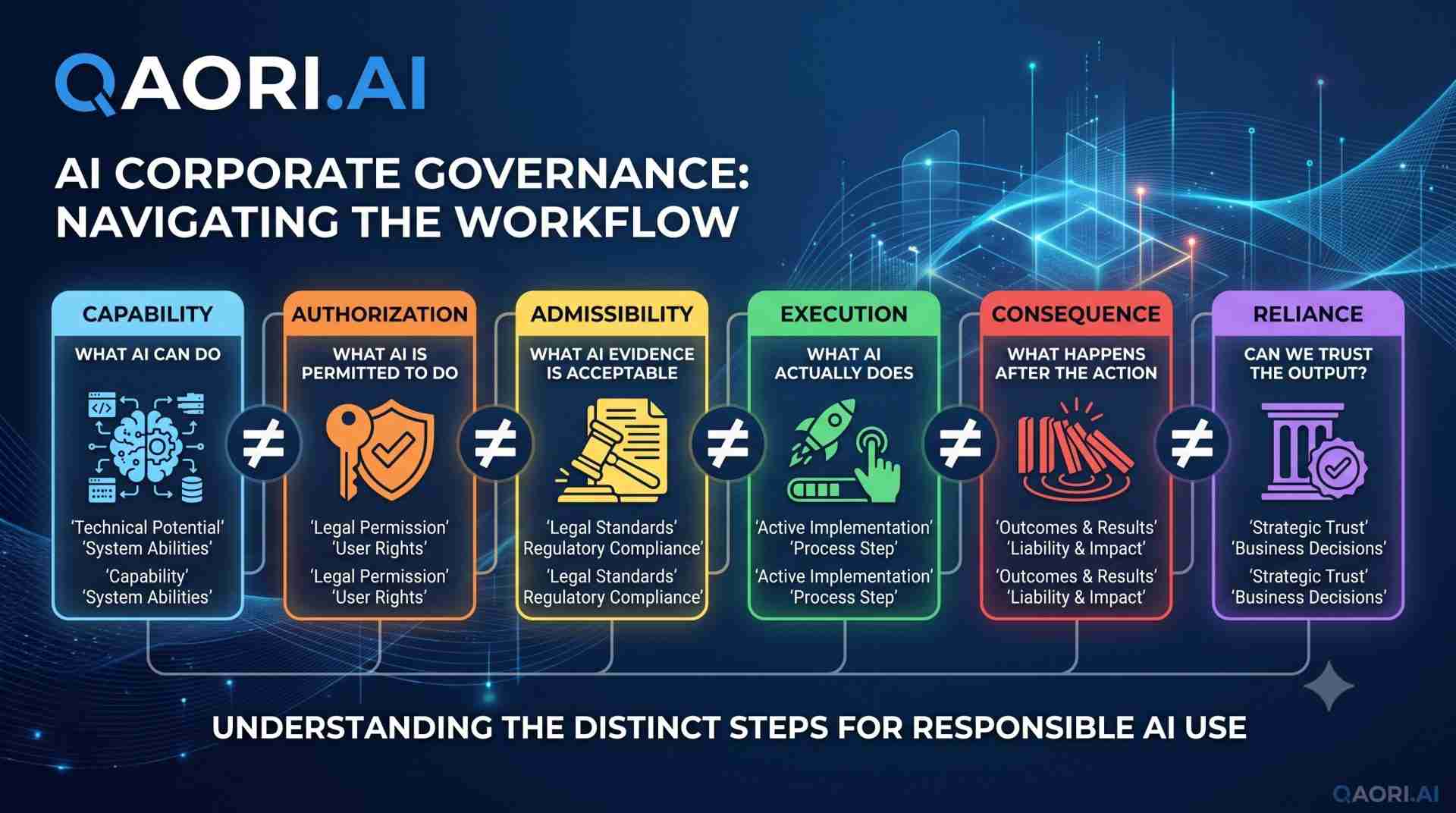
Seven questions boards are asking about AI — and why the organizations best positioned to answer them built governance into their infrastructure from day one.
There is a moment every board is beginning to dread.
Not the quarterly earnings review. Not a market downturn or a competitive threat. The moment they dread is simpler and more immediate: an auditor, a regulator, or an enterprise client leaning across the table and asking, “Show me your AI governance.”
Sam Khoury at BDO has framed this precisely. He identifies seven questions every board should now be asking about AI – not as an academic exercise, but as a practical test of whether governance intent has become governance readiness. Whether policies have become controls. Whether principles have become evidence.
The questions are right. But the framing reveals an assumption worth examining.
Most AI governance conversations assume that organizations are deploying AI into existing structures – and must now retrofit governance around it. Build the plane, then figure out the landing gear.
That assumption does not hold for organizations like Qaori. And understanding why matters for how the governance conversation evolves.
When Governance Is the Architecture
Qaori was not built as a product that later needed governance added. Qaori was built as governance infrastructure – a protective operating system for the AI-native economy.
This distinction changes how the seven questions land.
“Do we know where AI is being used across the organization?”
For organizations that adopted AI incrementally – a tool here, a model there – this question requires discovery. For Qaori, the answer is architectural. Every AI system in the Qaori ecosystem is a known component of a designed stack. The challenge is not discovery. The challenge is formalizing the inventory layer so that visibility is queryable, auditable, and board-presentable – not just operationally understood.
The gap is not awareness. The gap is the instrument panel.
“Who is accountable for AI oversight, risk decisions, and controls?”
Traditional organizations struggle here because accountability is diffuse – AI sits between IT, legal, risk, and the business. Qaori’s cooperative DAO model takes a structurally different approach: governance is embedded in the ownership model. Every decision is traceable. Every vote is on-chain. Accountability is not assigned after the fact – it is constitutive of how the organization makes decisions.
The challenge is translating DAO-native accountability into the language regulators and enterprise clients recognize: named owners, defined escalation paths, documented authority matrices. The substance is present. The translation layer is what needs building.
“How are AI risks identified, assessed, and escalated?”
Qaori’s Guardian AI was built precisely to monitor, protect, and escalate against threats in the AI ecosystem. But there is a meaningful distinction between monitoring external risk – threats entering the ecosystem – and maintaining a formal internal risk register for Qaori’s own AI use cases.
A mature program needs both. Guardian AI addresses the former with sophistication. The latter requires a structured AI risk taxonomy applied systematically to each use case: bias exposure, explainability gaps, regulatory reach, third-party dependencies, operational reliability. Informal understanding of these risks is a starting point. Documented, scored, and regularly updated risk assessments are what boards and auditors require.
“What controls exist over AI use, data, third parties, and human oversight?”
Here, Qaori’s foundational commitments translate directly into governance controls – but require documentation to become evidence.
Data sovereignty is a control. Regional data isolation is a control. The predator-free environment for minors is a control. The cooperative ownership structure is itself a governance control over how AI benefits are distributed and to whom.
What transforms these from principles into auditable controls is the formal control library: named, owned, tested, with documented operating status. The controls exist. The documentation of their existence and effectiveness is the gap.
“How does management know governance is actually working?”
This is where Qaori’s infrastructure becomes a genuine advantage – if properly surfaced.
Guardian AI generates observability data. The blockchain ledger generates an immutable record of governance decisions. Qaori’s cooperative app generates a trail of reviews, approvals, and task completions. The data for governance KPIs exists across the stack.
What is missing is the aggregation layer: a governance intelligence function that pulls these signals together into metrics that answer the question demonstrably. Percentage of AI systems with current risk assessments. Open control exceptions and their age. Time from incident detection to escalation. Monitoring coverage by system. These are not hard to calculate – but they must be calculated and surfaced, not assumed.
“Could we evidence our AI governance if asked?”
Qaori’s blockchain infrastructure is one of the strongest governance evidence assets available in any organization of comparable scale. An immutable, timestamped, transparent record of governance decisions is exactly what auditors want and rarely find.
The gap is a retrieval and presentation layer. The evidence exists – in blocks, in votes, in records. What is needed is the ability to walk an auditor through a governance event: “Here is the AI use case. Here is the risk assessment. Here is the approval decision. Here is the monitoring output. Here is the remediation record.” Structured, navigable, framework-mapped.
This is a near-term build, not a structural problem.
“Is our governance grounded in recognized frameworks?”
ISO/IEC 42001 – the AI Management System standard – was designed for exactly the kind of organization Qaori is: one where AI is not an add-on but a core operational model. The cooperative principles, the data sovereignty architecture, the protective OS design – these map naturally to 42001’s requirements.
A formal gap assessment would likely find Qaori significantly compliant on substance. What is missing is the mapping documentation that makes that compliance demonstrable. This is one of the higher-leverage investments available: the work to certify is smaller than organizations assume when they are building on a governance-native foundation.
The Insight the Seven Questions Reveal
Sam Khoury’s framework is ultimately asking one question seven different ways: is your governance real, or is it a presentation?
For most organizations, the answer requires significant structural work – because governance was not built in. For Qaori, the answer requires a different kind of work: surfacing, formalizing, and instrumenting governance that is already structurally present.
This is not a small distinction. Organizations that adopted AI into existing structures face a genuine retrofit challenge. Organizations that built AI-native infrastructure from the beginning have a different problem – one that is, in important ways, a better problem to have.
The gap is not in the architecture. The gap is in the instrument panel.
The board questions boards are asking are not new. The ability to answer them – clearly, evidentially, immediately – is what separates governance intent from governance readiness.
At Qaori, we are building the instrument panel.
What This Means for Organizations Evaluating AI Governance
If you are a board, regulator, or enterprise client asking these seven questions of your AI partners and vendors, the answers you should look for go beyond policy documents and published principles.
Look for organizations that can show you a live inventory of AI systems, not a static list. Named accountability, not shared responsibility. Scored risk assessments, not general awareness. Operating controls with tested effectiveness, not stated intentions. Governance metrics, not narrative updates. Retrievable evidence, not assurances that records exist. Framework alignment with documented mapping, not claimed conformance.
These are not impossible standards. They are the natural output of organizations that built governance into their foundations – and then built the systems to make that governance visible.
The question for every board is not whether your AI partners talk about governance.
The question is whether they can demonstrate it.
Qaori is building the AI-native protective operating system for a resilient economy – with governance, data sovereignty, and accountability designed into the architecture from the ground up.