






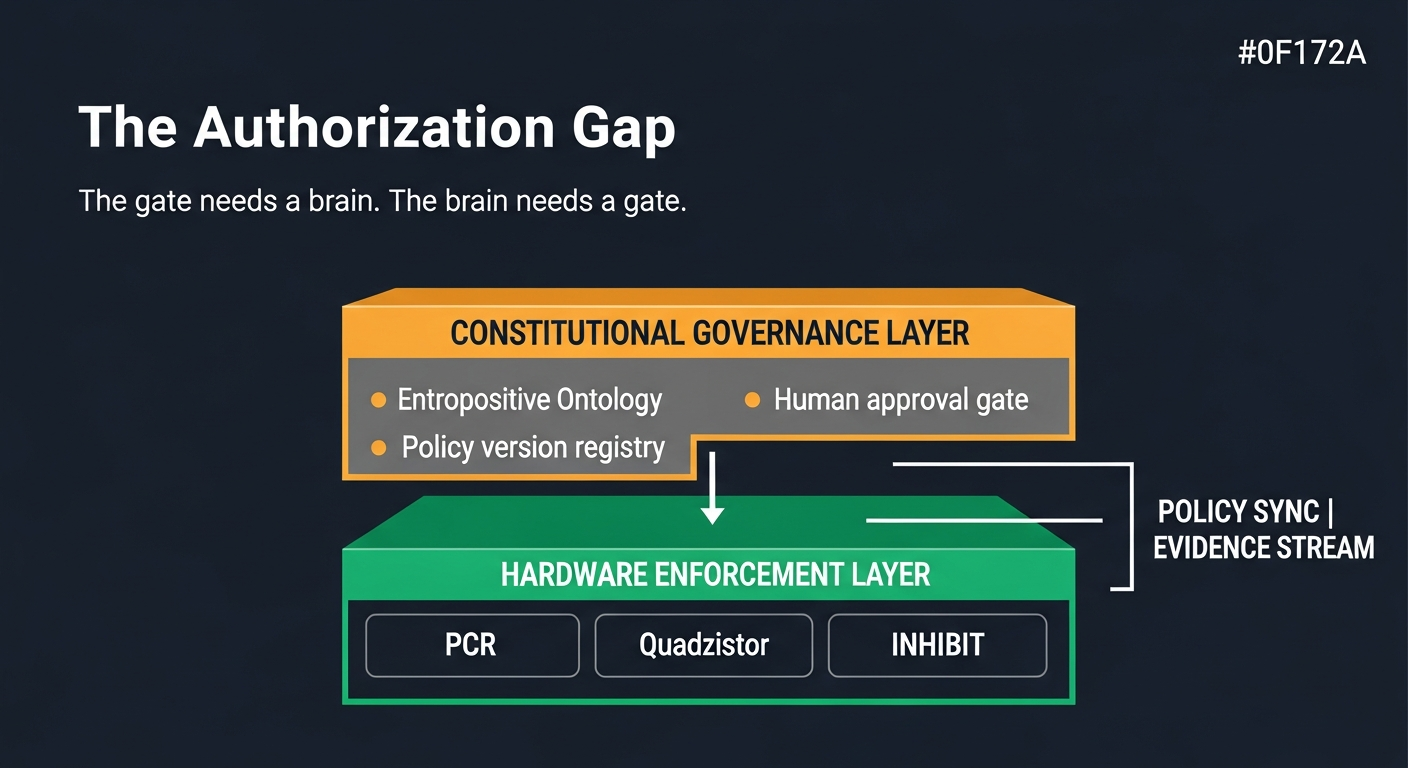
David Reichwein’s Authorization Gap framework correctly identifies the structural void between AI decision and physical execution. Closing that gap with hardware enforcement is necessary. It is not sufficient. The gate needs a brain.
There is a question that sits at the foundation of every serious AI governance architecture conversation and is rarely made explicit. Not whether a governance framework exists. Not whether policies are documented. The question is: at the precise moment an AI system converts a decision into a consequence, is there a deterministic mechanism capable of blocking that transition if it should not occur?
David P. Reichwein, founder of AI² (Asymmetric Intelligence and Innovation), has spent more than a decade formalizing this question as the Authorization Gap: the structural void between AI decision and physical execution that exists in almost every deployed AI system in the world today. His PCR framework, Proof of Concept Restraint, and the associated Quadzistor hardware architecture propose closing that gap with a physical enforcement mechanism: a hardware circuit, INHIBIT by default, that requires a cryptographically signed and policy-validated authorization before any consequential AI action reaches the physical execution layer.
The architecture is rigorous, technically precise, and motivated by engineering experience in domains where the cost of getting it wrong is not measured in reputational damage but in physical harm. The Authorization Gap framework deserves to be taken seriously by anyone thinking carefully about the AI governance problem, because it asks the right foundational question and proposes a genuinely novel answer.
It also, in the opening pages of the framework’s published documentation, acknowledges an unresolved gap within its own architecture. Gaia Nexus, commenting on the framework, identified what Reichwein subsequently named the Second Gap: the constitutional problem. The hardware gate enforces whatever ruleset it is programmed with. But who holds the ruleset? How can it change? What auditable record exists of every version of it? Who can challenge a change? The hardware gate is as trustworthy as the authority that writes its rules. If the ruleset drifts, degrades, or is quietly rewritten without a verifiable governance record, the hardware gate becomes what Reichwein himself describes as a compliance theater machine: issuing cryptographic proof of wrong execution.
This is the exact problem that the governance architecture this series has been building toward is designed to solve.
The Second Gap is the constitutional governance problem. It requires a governance layer that sits above the hardware enforcement gate and governs the ruleset the gate enforces. That layer must answer four questions definitively. Who holds the ruleset? The authority holding the ruleset must be independent of the governed organization, so that the governed organization is not in the position of writing the rules it is governed by. How can the ruleset change? Only through a governed policy update process with full version history, cryptographic logging, and human approval for threshold changes. What auditable record exists? A tamper-evident, continuously generated evidence record linking every policy version to every gate decision made under it. Who can challenge a change? A named human approval gate with physical confirmation for the highest-stakes threshold adjustments.
The Qaori Sentinel architecture, as described in this series, is precisely that constitutional governance layer. Sentinel sits above the hardware enforcement substrate, not as a software alternative to hardware enforcement but as the governance intelligence layer that hardware enforcement requires to be trustworthy. It holds the ontology that maps actions to their semantic consequences. It maintains the policy version history. It generates the structured evidence record. It enforces the human approval gate for ruleset changes above a defined entropy threshold.
The relationship between the two architectures is not competitive. It is architectural. In the layered model that emerges from reading both frameworks carefully, hardware enforcement and constitutional governance are not two solutions to the same problem. They are two layers of a single solution, each necessary, neither sufficient alone.
The hardware enforcement layer closes Reichwein’s First Gap: the void between AI decision and physical execution. It provides a deterministic, non-bypassable gate at the execution boundary, operating below the software layer, immune to the manipulation that software-only governance systems are vulnerable to. This is a genuine architectural contribution. Software governance can be overridden, circumvented, or disabled. Hardware enforcement, implemented correctly, cannot be. The physical substrate of the gate is the source of its trustworthiness.
The constitutional governance layer closes the Second Gap: the void between hardware enforcement and a trustworthy, auditable, updatable ruleset. It provides the semantic intelligence that the hardware gate cannot provide internally: the ontology-resolved consequence graph that determines what the gate should block, the policy version management that ensures the gate is enforcing the correct rules, the evidence architecture that makes every gate decision auditable, and the human override mechanism that ensures the governance layer remains accountable to the humans it serves.
There is a third architectural contribution that follows from the combination of these two layers, and it relates to Heather Odom’s Third Gap as identified in the Authorization Gap framework: the environmental constraint problem. The challenge of simultaneously evaluating whether an action is authorized, under the ruleset, and whether it is physically appropriate, given the current state of the execution environment, is not addressed by either layer in isolation. The hardware gate knows the ruleset. The constitutional governance layer knows the semantic consequence graph. The environmental constraint evaluation requires both, applied simultaneously.
In the Entropositive model, the cascade potential dimension of the entropy score is a partial answer to this question. An action’s cascade potential is computed from the dependency graph of the live system: not the intended dependency graph at deployment time, but the current state of the graph as maintained by continuous ontology updates. An action that is authorized by the ruleset but whose cascade potential has increased significantly since the ruleset was last updated, because new downstream dependencies have been added, will produce a higher entropy score and may trigger escalation or confirmation requirements that a simpler authorization check would not have caught. This is environmental constraint awareness derived from ontology maintenance, not from a separate environmental sensor layer.
Whether this partial answer is sufficient to close the Third Gap fully is a legitimate architectural question. It is one that the conversation between these two frameworks is well-positioned to explore, because the answer depends on the specific deployment context: the nature of the execution environment, the stability of the dependency graph, the latency requirements for governance evaluation, and the regulatory context within which the system operates.
The practical significance of this convergence extends beyond the technical architecture into the regulatory positioning of the governance field. Reichwein’s hardware enforcement model and the Entropositive constitutional governance model each address a class of risk that the other does not. Hardware enforcement addresses the risk of software-layer bypass: a governance system that can be circumvented by a sufficiently motivated actor with software access. Constitutional governance addresses the risk of ruleset drift and compliance theater: a governance system that enforces rules that no longer reflect the actual governance obligations of the system it governs.
A governance architecture that has both layers is resistant to both classes of risk. A governance architecture that has only the hardware layer is deterministic but constitutionally blind. A governance architecture that has only the software layer is semantically sophisticated but physically bypassable. The complete architecture requires both.
For the organizations making AI governance architecture decisions now, the practical question this convergence raises is one of sequencing. The constitutional governance layer, as a software deployment, is available immediately and at enterprise scale. It does not require physical hardware procurement, global regulatory coordination, or the kind of infrastructure change that Reichwein’s hardware enforcement model requires for broad deployment. The software layer can be deployed first, building the ontology, the policy version history, the evidence record, and the governance culture that a hardware enforcement layer would require to be meaningful in practice. The hardware layer can be added for the highest-risk deployment contexts, where the software-layer bypass risk is not an acceptable residual, as the infrastructure to support it becomes available.
This sequencing is not a compromise of the architectural vision. It is the adoption path. The constitutional governance layer, deployed at scale, builds the evidence base, the regulatory vocabulary, and the governance culture that makes hardware enforcement legible to regulators, investors, and organizations evaluating whether to adopt it. The two layers are not competitors for the same budget. They address different points on the risk curve.
The gate needs a brain. The brain needs a gate. That is the architecture. The conversation between these two frameworks is the beginning of building it.

