






The MIT Delphi study does not reveal a risk measurement problem. It reveals a governance architecture problem. The two require very different responses.
A new Delphi study from the MIT AI Risk Initiative asked 272 international experts to evaluate 24 major AI risk domains in terms of severity, vulnerability, and responsibility. Under current trajectories, 18 of the 24 domains carry more than a 10% probability of catastrophic harm by 2030. Under pragmatic mitigation assumptions, that number falls to five: dangerous capabilities, weapons and cyberattacks, environmental harm, inequality and unemployment, and power centralization.
The study will generate a predictable institutional response. Governance teams will produce updated risk registers. Framework vendors will publish revised maturity models. Regulatory consultants will update their compliance checklists. Board presentations will be revised to include the 10% headline.
None of that addresses the finding that matters most.
The Finding Beneath the Headlines
The most important result in the study is not the risk percentages. It is the accountability structure the study describes.
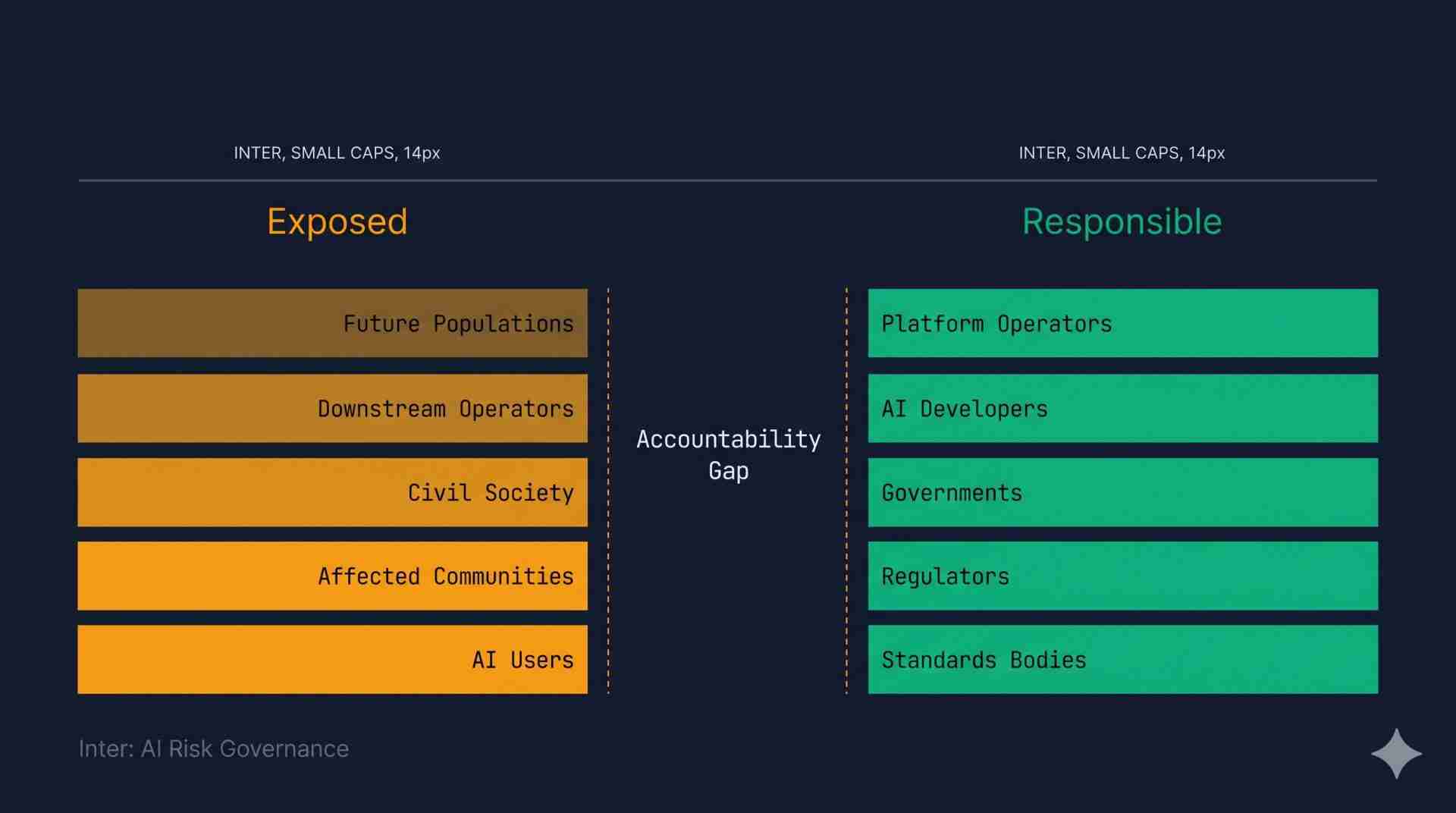
AI users and affected stakeholders were rated among the most vulnerable groups. General-purpose AI developers, governments, regulators, and standards bodies received the highest responsibility ratings. The study authors correctly identify this as an accountability problem. What the framing understates is that it is a structural accountability problem, not a communication problem. The gap between the most vulnerable and the most responsible does not exist because the responsible parties are unaware of it. The gap exists because current governance frameworks are not architecturally capable of closing it.
Most AI governance operates at the policy layer. It describes who is responsible, defines the policies, and documents that the policies were communicated and acknowledged. That is what a governance framework does. It is valuable. It is also insufficient for the category of problem the MIT study describes, because the policy layer is not where the harm propagates.
Harm propagates at the execution layer. At the point where a model makes a decision, retrieves information to act on, generates output that influences a consequential process, or triggers a workflow with real-world effects, the governance that matters is the governance present at that moment. A policy document that correctly assigns responsibility does not change what happens at execution time unless the governance mechanism is in the execution path.
Why Policy-Layer Governance Cannot Close This Gap
The five risks that remain above the 10% catastrophic threshold, even with mitigation, share a structural property that explains why they are hard to govern. They are diffuse-causation risks. The harm does not originate at a single identifiable decision point that could be gated, reviewed, or traced to a specific authorization. It accumulates across thousands of decisions made by systems that were never individually accountable for the aggregate outcome.
Dangerous capabilities do not manifest in a single model action. They emerge from a population of decisions, each individually defensible, that collectively produce a capability the original policy did not anticipate and cannot govern retroactively. Power centralization does not happen in a single deployment decision. It accumulates across deployment patterns that each appeared routine at the time. The effects of inequality and unemployment are not produced by a single system. They are the aggregate output of a class of deployment decisions that individually passed every governance checkpoint defined by the policy layer.
Policy-layer governance was designed for traceable-causation risks: a specific action, by a specific actor, under a specific authorization, with a specific outcome. You can write a policy for that. You can audit against it. The diffuse-causation categories resist this architecture because there is no single moment to audit and no single authorization to trace.
This is not an argument that governance cannot work for these categories. It is an argument that governance has to work differently for them.
What Execution-Layer Governance Requires
Closing the accountability gap for diffuse-causation risks requires governance that operates continuously at the point of execution, not governance that documents accountability after the fact.
Five properties distinguish execution-layer governance from policy-layer governance.
The first is pre-execution enforcement. The governance gate must be in the execution path, not adjacent to it. Before a consequential action is executed, the governance mechanism has already cleared it or held it. Monitoring, logging, and post-execution review are valuable supplementary mechanisms. They are not governance in the sense that matters here. A gate beside the path is not a gate.
The second is an actor-agnostic operation. A governance system that applies different standards depending on who proposes an action is not closing the accountability gap. It is preserving the discretion of the actors who already had the most. Actor-agnostic enforcement is structurally harder to implement and operationally harder to defend, because it means the governance mechanism will sometimes hold actions that high-authority actors want to take. That friction is the governance system functioning correctly.
The third is evidence-based authorization. Authorization must be cryptographically verifiable, not testimonial. When an organization is asked to demonstrate that a specific model action had authorization, the answer must be proof, not a recollection from the operator who was present. Testimonial authorization can be produced retroactively. It can be incomplete. It can be wrong. Cryptographic evidence either exists in the evidence chain or it does not.
The fourth is continuous policy maintenance. A governance policy that describes the AI estate as it was at the last review is governing a fiction the moment the estate changes. Models change. Capabilities drift. New integration points appear. The gap between the policy’s model and the actual estate grows as a function of time and the rate of change. The policy must reflect the current state because it is continuously updated, not because an update was remembered before the next audit.
The fifth is independent policy authority. The authority to define governance policy must be structurally separate from the authority to operate the system the policy governs. Operational teams under pressure will adjust governance rules toward operational convenience. This is not malice. It is how human judgment works under time pressure and accountability. The structural solution is to place policy authority outside the operational chain.
These five properties are mutually reinforcing, as are the five risks in the MIT study. An architecture that has four of the five has a structural gap. Under stress, that gap propagates.
The Five Persistent Risks as a Diagnostic
The five risks that remain above the 10% threshold under mitigation are a diagnostic for governance architecture, not a measure of how much effort has been applied.
Dangerous capabilities persist because no static policy can govern capabilities that do not yet exist. Pre-execution enforcement, which includes entropy-based gating and holds novel or high-uncertainty actions for review regardless of whether a specific rule addresses them, intercepts emerging capability patterns before they accumulate.
Weapons and cyberattacks persist because the causal chain from model capability to harm is short and the surface area is broad. Actor-agnostic enforcement that does not allow high-authority requestors to bypass capability gates is what the policy layer cannot enforce by design.
Environmental harm persists because it is aggregate. No single deployment decision produces measurable environmental harm. The governance mechanism that addresses this operates at the population level, across the estate, continuously, not at the level of individual policy checkpoints.
Inequality and unemployment persist because they are diffuse effects of deployment patterns rather than outcomes of individual decisions. Evidence-based authorization that captures deployment patterns across the estate is what makes those patterns visible before the effects accumulate.
Power centralization persists because it is the aggregate of individually authorized decisions to concentrate capability, data, or decision authority. An independent policy authority that places governance outside the operational chain is what prevents the governance system from being adjusted to accommodate further concentration.
These five are not resistant to governance. They are resistant to the specific governance architecture most organizations have deployed. The study does not reveal that the risks are ungovernable. It reveals that current governance architectures are not built for them.
The Organizational Implication
The organizations that will respond productively to the MIT study are not the ones that update their risk documentation. They are the ones that ask a different question: at what point in our AI estate does governance actually operate, and what can it actually prevent at that point?
For most organizations, the honest answer is that governance operates at the policy definition and audit stages. It does not operate continuously during execution. The framework is sound. The execution path ignores it.
The organizations building governance that operates at execution time, continuously across the estate, with the five structural properties described above, are building something that can actually address the risks described in the MIT study. Not because the technology is novel, but because the architecture places governance where harm propagates, not where documentation is convenient.
The accountability gap is real. The study has quantified it. The question it leaves open is whether organizations will respond to it as a documentation problem or as an architecture problem.
Those two responses will lead to very different places by 2030.

