






The Accountability Gap in AI Risk Governance
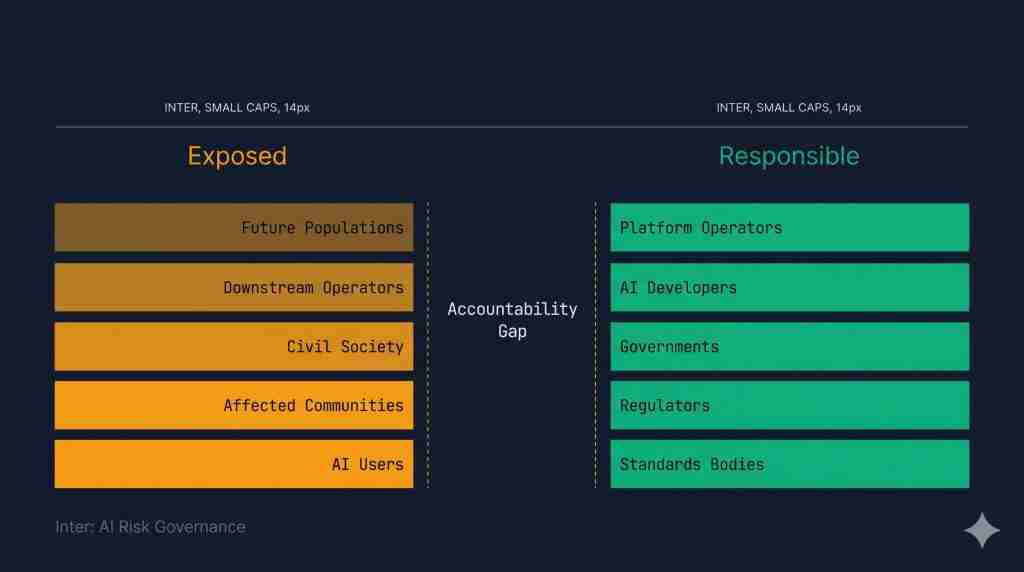
The MIT AI Risk Initiative Delphi study found that 18 of 24 AI risks carry a catastrophic probability of over 10% by 2030.
That number will drive much of the governance documentation.
Documentation is not the response the finding requires.
The most important result in the study is not the risk percentages. It is the accountability structure: AI users and affected stakeholders are rated most vulnerable, while developers, governments, and regulators are rated most responsible. The study authors call this an accountability problem. What they understate is that it is a structural accountability problem, not a communication problem.
The gap exists because most AI governance operates at the policy layer. Policies describe who is responsible. They do not ensure accountability at the execution layer, where decisions are made, and harm accumulates. A policy document that correctly assigns responsibility does not change what happens at execution time unless the governance mechanism is in the execution path.
The five risks that remain above the 10% catastrophic threshold, even with pragmatic mitigation, share a structural property. They are diffuse-causation risks. The harm does not originate at a single decision point. It accumulates across thousands of decisions made by systems that were never individually accountable for the aggregate outcome. No policy document closes a diffuse-causation risk.
What closes it is governance that operates continuously at execution time, is actor-agnostic, produces cryptographic evidence of authorization as a byproduct of normal operation, maintains a live model of the AI estate, and holds policy authority independent of the teams that operate the systems it governs.
These five properties are not a higher standard of compliance. They are a different architecture.
The organizations that view this study as a documentation problem and those that view it as an architecture problem are on different trajectories. The study has quantified where those trajectories lead.
Full argument, including what each of the five persistent risks tells us about current governance architectures and what a structural response requires, in a new article. Link in comments.
AIGovernance AIRisk EnterpriseAI ResponsibleAI GovernanceArchitecture