






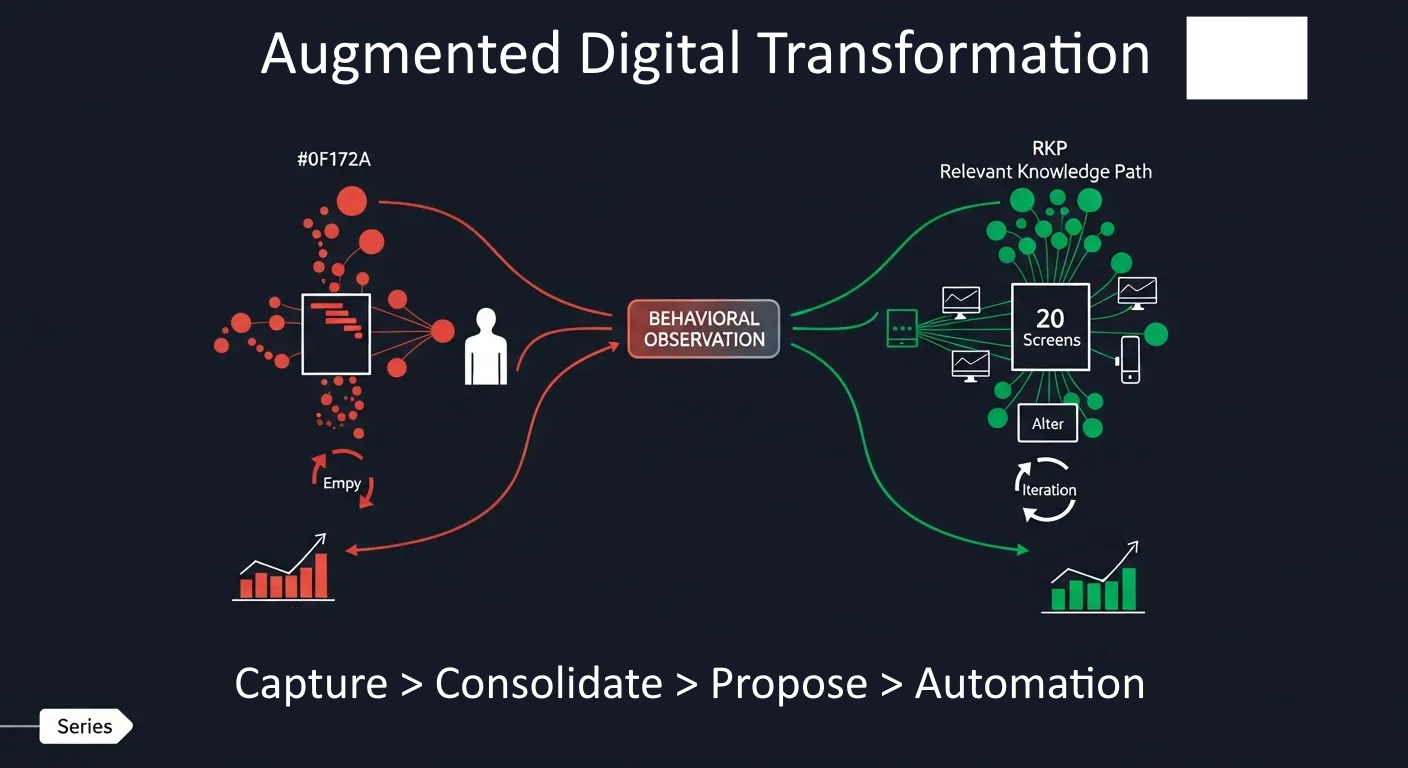
Meta analyzed workforce behavior to identify who to fire. Qaori built a platform to capture that same intelligence and give it back to the organization. These are not the same project.
In early 2025, Meta announced that it had used AI-assisted behavioral analysis to inform its decision to reduce its headcount by roughly 5%. The announcement was notable not for the scale of the cuts, which were comparable to earlier rounds, but for the method. For the first time, a major technology company was explicit about using AI-derived behavioral data not to augment its workforce but to determine who to remove from it.
The reaction in the enterprise AI market was divided. Some saw it as a preview of an inevitable industrialization of workforce decisions. Others saw it as a cautionary story about the misuse of data that employees had not consented to share. Both reactions largely missed the more consequential question, which is not ethical but architectural: when you fire the workers whose behavior you have analyzed, what happens to the intelligence the analysis revealed?
The answer is that it leaves with them. The behavioral patterns, the informal expertise maps, the institutional knowledge encoded in how the work was actually done: none of that survives in a document, a process map, or a language model trained on generic data. The organization that replaces workers with AI inherits the documentation layer, not the reality it was always a simplified approximation of.
This is the replacement problem. It is not primarily a moral problem, though it raises moral questions. It is an organizational intelligence problem. Organizations that choose the replacement path are systematically discarding the most valuable asset that behavioral analysis revealed: the knowledge worth capturing in the first place.
The 20-Screen Problem
Before considering what gets lost when workers are replaced, it is worth examining what the current state of knowledge work actually looks like. The average knowledge worker in a mid-size enterprise operates across fifteen to twenty distinct software applications in a single workday. Each application holds a fragment of context. Each transition between them requires the worker to carry context in their head, because no application can see what happened in the previous one.
This fragmentation is the origin of a structural problem that affects every knowledge organization at scale. Workflows that look clean in a process diagram are, in practice, sequences of context-switching, copy-pasting, informal workarounds, and tacit knowledge that exists only in the mind of the person executing the workflow. The gap between the documented process and the actual behavioral reality is where institutional knowledge lives.
When that worker leaves (through layoffs, retirement, or attrition), that knowledge leaves with them. UNESCO has documented this pattern at the civilizational level in the context of traditional craft knowledge and cultural heritage. Enterprise organizations experience the same pattern, at a different scale and with different consequences, every time a senior practitioner exits.
The 20-screen problem and the knowledge-departure problem are the same problem. Work is fragmented across tools, context is held in individual heads, and organizations lack a systematic mechanism to capture the intelligence that makes their workflows function.
Why Top-Down Transformation Consistently Fails
The conventional response to this problem is digital transformation: a managed program to redesign processes, consolidate tools, and make workflows more legible and efficient. The failure rate of such programs is well documented. McKinsey, Bain, and Boston Consulting Group have all published analyses placing the failure rate of large-scale transformation programs between 70 and 85 percent.
The failure mode is consistent. A transformation program begins with a current-state assessment, typically conducted by external consultants who interview process owners, observe workflows, and produce a process map. The map is an approximation. It reflects what people say they do, filtered through what the interviewers asked about, compressed into a diagram that the transformation program can act on.
The actual behavioral reality of how work happens is richer, more complex, and more contingent than any current-state assessment can capture. The informal expertise that fills the gaps between documented steps, the tacit knowledge about which exception cases require human judgment, the workarounds that have evolved because the documented process breaks down in specific circumstances: none of this appears in the process map.
The transformation program then redesigns around the map. New tools are selected, new workflows are defined, and new training is delivered. The redesigned process is imposed on the organization. The workers who hold the informal knowledge that the map omitted must now either adapt their tacit knowledge to the new process, which they do imperfectly, or lose it, which they eventually do. The transformation program concludes. The consulting engagement ends. The organization attempts to maintain the redesigned process in line with its actual behavioral reality.
The 70-85% failure rate is what this looks like at scale. Top-down transformation consistently fails because it operates on a model of the organization rather than on the organization.
The Augmentation Path
The alternative is to begin with the behavioral reality rather than with a process map. Instead of sending consultants to interview workers about what they do, observe what they actually do. Instead of producing a map that is an approximation of the current state, build a knowledge structure that represents the current state at the level of individual behavioral patterns. Instead of imposing a redesigned process from above, surface transformation proposals that emerge bottom-up from the collective behavioral intelligence of the workforce.
This is what Qaori Augmented Workforce (QAW) is. It is not a productivity tool. It is not an RPA platform. It is not an AI copilot layered onto existing applications. It is the first platform that automates the complete digital transformation cycle from behavioral observation through knowledge synthesis and workflow intelligence to autonomous agent construction and governed deployment, then cycles back to observation. The loop runs continuously. There is no end date.
The closed loop has six stages.
The first is observation. The existing Connect browser extension, which employees use for tool guidance and access to organizational knowledge, passively captures behavioral signals: tool sequences, workflow transitions, idle and active rhythms, and application-switching patterns that are invisible to any single SaaS tool. This is not a new extension or new infrastructure. It is an additional extraction mode on an existing capability, routing behavioral signals to a new pipeline rather than to the tool guidance pipeline.
The second stage is understanding. Behavioral events are extracted into per-employee Role Knowledge Packages. An RKP is a knowledge graph representing an individual employee’s procedural patterns, tool proficiency scores, knowledge-domain confidence, and workflow variants. An RKP is not an employee profile. It is a structured representation of their expertise. It belongs to them. They can see it, correct it, and withdraw consent for its use at any time.
RKPs aggregate at the division level, without individual attribution, into Division Knowledge Aggregates. The DKA is the organizational intelligence layer: it reveals where actual workflows deviate from documented processes, where bottlenecks cluster, where skill gaps are distributed across a role type, and which workflows are candidates for automation. This is the intelligence that top-down transformation consistently fails to produce, because it can only be derived from behavioral observation at scale.
The third stage is proposal. The QWO (Workflow Optimization) engine consumes the DKA and generates transformation proposals ranked by impact, confidence, and implementation complexity. These proposals surface in the Supervisor Dashboard, which extends from a governance oversight surface into a digital transformation command surface. The manager reviews behavioral evidence, applies organizational judgment, and approves or rejects proposals. QAW proposes. The manager decides.
This point requires precision. Digital transformation proposals that emerge from behavioral evidence are qualitatively different from proposals that emerge from a consulting engagement. They are grounded in what the organization actually does, not in what it says it does. They identify automation candidates by observing which workflows are being executed repeatedly by which employees with what level of consistency. They surface skill gaps by identifying where procedural confidence scores are low across a role type. The manager who approves a QWO proposal is approving an intervention that reflects reality.
The fourth stage is built. Approved proposals enter the client’s SQAPAF instance, their own Sovereign Autonomous Factory. SQAPAF is the client-owned instantiation of the factory governance model that Qaori uses internally (QAPAF). Every enterprise client gets an isolated SQAPAF instance. Every agent that SQAPAF builds has a charter, an evidence packet, and a human approval record before it is deployed. The factory does not invent transformation. It implements the transformation the organization has already decided on, with full traceability of governance.
The fifth stage is deployment. Built agents deploy into each employee’s Alter, the interface that collapses the 20-screen problem into a single surface. The Alter knows the employee through their RKP, knows the organization’s tools and processes through the Connect knowledge base, and acts across SaaS applications through the QuniFlo execution layer. The autonomy boundary governing what the Alter may do without human approval is enforced at runtime by the Sentinel Flight Envelope. The Autonomy Progression Model (QAB) configures those parameters based on confidence scores and manager approvals. Sentinel enforces them. There is one runtime gate, not many.
The sixth stage is monitoring. Deployed agents generate new behavioral data. Employee interactions with agents produce new signals: compliance rates, deviation patterns, and adaptation behaviors. These feed back into the RKP and DKA, updating the knowledge base and surfacing new proposals. The loop closes. Then it runs again.
What the Employee Gains
The endpoint of the augmentation path is not the same as the endpoint of the replacement path, and the difference is not merely ethical.
In the replacement path, the organization acquires AI systems trained on generic data that do not know its specific workflows, exception cases, informal expertise, or institutional memory. The workers who held that knowledge have been removed. The AI system operates on the documentation layer and inherits all of its gaps. Quality degradation on edge cases is structural, not incidental.
In the augmentation path, the employee’s expertise is captured in their RKP before any automation is built. The agents that QAPAF builds are grounded in behavioral evidence of how the work is actually done, including exception cases, informal workarounds, and tacit knowledge that would otherwise be lost when employees leave. The employee’s routine work is progressively absorbed by their Alter. The employee moves up the value chain.
The terminal stage of the Alter’s autonomy progression is the QA Agent. An employee whose Alter has reached the QA Agent stage is no longer executing routine tasks. They are validating the quality of work in their domain: their own output, the Alter’s output, and the division’s adherence to workflow. When the QA Agent detects a workflow deviation, it logs it as a factory-ready improvement proposal and routes it back to the observation stage. At this point, the employee is a quality intelligence node in the organization’s transformation loop.
This is not a softer version of the replacement path. It is a different destination entirely. The organization that chooses augmentation retains its institutional knowledge in a form that AI can act on. The employees who contributed that knowledge are operating at higher cognitive leverage. The transformation loop is self-sustaining.
The Governance Requirement
One point requires emphasis, because the enterprise AI market has largely elided it.
Deploying autonomous agents across an enterprise estate (agents that observe employee behavior, execute actions across enterprise systems, and make decisions within the parameters of approved workflows) without preemptive governance is not a calculated risk. It is an architectural error.
Governance in this context does not mean a compliance checklist or an audit trail that documents what happened after execution. It means a runtime gate that evaluates every agent action against the organization’s stated parameters before the action is taken. It means consent structures that are explicit, specific, and retractable. It means every deployed agent has a human-approved mandate that defines its authorized scope.
QAW is deployed as a bundle with Sentinel Flight Envelope. This is not optional. Sentinel is the preemptive governance layer that makes autonomous transformation safe to operate at enterprise scale. QAB configures the parameters for each employee’s Alter. Sentinel enforces them. There is no QAW deployment without a Sentinel deployment.
The organizations that will benefit most from QAW are those that view this requirement not as a constraint but as an enabler. The audit trail that documents every agent’s charter, every advancement in autonomy stage, and every SQAPAF build decision serves as the evidence base that enables the organization to give agents greater autonomy over time. Trust is earned through evidence. The governance infrastructure makes that evidence computable.
Why the Lineage Matters
QAW is not a product built in response to the AI moment of 2022. It is the technological realization of a governance framework that Qaori’s founders developed over a decade.
The Entropositive governance model, developed in 2016, defined organizational health as the measurable balance of four parameters: Purpose, values, constraints, and entropy. Dysfunction emerges at the intersections where these parameters are out of balance. This was not a technology framework. It was an organizational science framework. The technology that would make it computable at scale did not yet exist.
OrGovOS (2019) extended this to swarm intelligence: competence-based leadership, silos as natural value streams, and transformation proposals that emerge from the collective behavioral patterns of the workforce rather than from a top-down mandate. The Augmented Leadership Manifesto (2023) published these 12 principles open-source, as a deliberate act of the participative principle, the framework describes.
QAW (2026) is the technological implementation of that manifesto by its author. Every component of the QAW loop maps to a principle in the Augmented Leadership framework. QWO proposals are grounded in behavioral evidence rather than opinion, as the framework requires. RKP reveals actual competence independent of the organizational chart. DKA aggregates division intelligence without breaking the integrity of individual silos. The manager who approves transformation proposals is exercising the competence-based leadership prescribed by the framework.
No competitor in the enterprise AI transformation market has this lineage. Every other vendor in this space started in 2022. The framework underlying QAW predates the AI governance crisis by six years and was built by the same person who built the platform.
The organizations that face the replacement-or-augmentation choice today are choosing not just between two technology approaches. They are choosing between two theories of what organizational intelligence is for. One theory treats intelligence as a cost to be optimized. The other treats it as an asset to be captured, structured, and amplified.
Qaori builds the second path.
Rosho, Founder, Qaori
rosho@rosho.world

