Purpose is not a mission statement. In Universal Tebiki, Purpose is a declaration of scope: what the actor is authorized to act upon, and equally, what it is not. Every governance question is downstream of it.
Purpose: The First Law of Universal Tebiki
Before any actor, human or machine, can be meaningfully governed, one question must be answered: what is this actor for? Not in the aspirational sense of a mission statement, but in the operational sense of a scope declaration. What domains may this actor act upon? What decisions may it initiate? What is categorically outside its remit, regardless of capability?
This is Purpose, the first law of Universal Tebiki. It is also the prerequisite for every other governance question. You cannot evaluate whether an action was compliant with values until you have determined whether the actor had Purpose to be in that domain at all. You cannot set meaningful constraints without knowing what the actor is constrained from. You cannot measure entropy drift without a declared baseline state. The Purpose is that baseline. It is not the first governance question to ask. It is the zeroth condition. Everything else assumes it.
Why Scope Drift Is the Primary Failure Mode
The most common governance failure in both human organizations and AI deployments is not rule violation. It is scope drift. An actor begins operating in domains for which it was neither designed, authorized, nor equipped. It happens gradually and often invisibly. A compliance officer begins making policy decisions that belong to the legal function. An AI agent deployed for customer query routing begins generating contract language because the boundary between “routing a query” and “responding to a query” was never precisely drawn. A middle-management layer accumulates decision-making authority that was intended to remain at the executive level.
None of these is necessarily malicious. They are the natural consequence of leaving Purpose unspecified. When an actor’s scope of authorized action is not declared, the actor defines it implicitly through action. Every action it takes without challenge expands its implicit scope. Over time, the implicit scope diverges from the intended scope, and the governance structure discovers the gap only when something goes visibly wrong.
The declaration of Purpose prevents this not by limiting the actor’s capability but by making implicit scope expansion visible the moment it occurs. If an actor’s Purpose is declared and machine-readable, then any action outside that declared scope generates a signal. The signal may result in approval (the scope is formally extended with documentation) or denial (the action is blocked). Either outcome is a governance outcome. The alternative, an actor operating without a declared Purpose, produces no signal at all. Drift accumulates silently.
What Purpose Is Not
Purpose in Universal Tebiki is not a mission statement. “To serve our customers with excellence” is not a Purpose declaration. It is a marketing commitment. It does not constrain scope. It does not generate governance signals when violated. It cannot be evaluated programmatically.
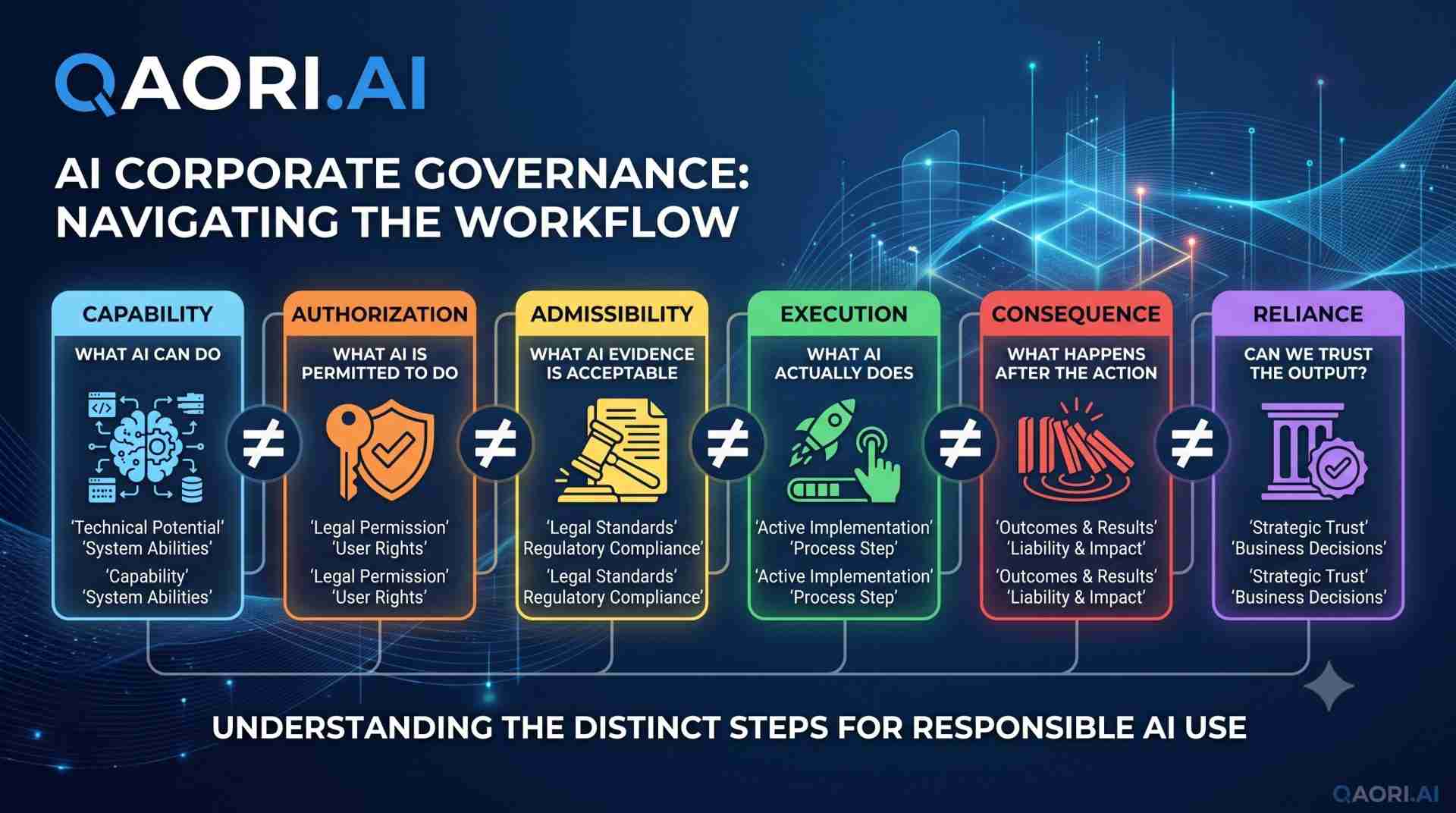
Purpose is also not a capability description. Describing what an actor can do is not the same as declaring what it is authorized to do. An AI model capable of generating legal text is not, therefore, authorized to generate legal text. An employee capable of approving budget items is not, therefore, authorized to approve all budget items. Capability and authorization are separate concepts. Purpose governs authorization, not capability.
Purpose is not permanent. A Purpose declaration can be revised, expanded, or contracted. In Universal Tebiki, Purpose revision is a governance event. It requires documentation, attribution (who changed it, under what authority), and a version record. The previous Purpose declaration does not disappear when it is revised. It is superseded. The full history of Purpose declarations is available, which means the full history of authorization scope is available. This is a governance audit trail at the most fundamental level.
The Anatomy of a Purpose Declaration
A well-formed Purpose declaration in Universal Tebiki has four components.
The first is the actor identity: a unique identifier for the actor that is persistent across Purpose revisions. This ensures that the purpose history is attributable and that version comparisons are meaningful.
The second is the domain list: a precise enumeration of the domains in which the actor is authorized to act. Domains are not vague. “Customer communications” is not a domain. “Outbound written communications to customers in the pre-contract stage, excluding pricing commitments and legal representations” is a domain. The specificity matters because it is what makes implicit scope expansion visible. When the actor acts in a domain not on this list, the governance system has a signal to evaluate.
The third is the exclusion list: the domains explicitly outside the actor’s authorization. This is not the complement of the domain list. Exclusions are not just “everything else.” They are the specific domains adjacent to the actor’s authorized scope where boundary confusion is most likely to occur. Stating them explicitly eliminates the ambiguity at the edges.
The fourth is the authority reference: the governance body or role that authorized this Purpose declaration. This is the gremium (in Universal Tebiki terminology) that holds authority over this actor’s scope. When the Purpose needs to be revised, the revision goes to that body. When the Purpose is challenged, that body arbitrates.
Human Actors and Machine Actors
The Purpose declaration structure applies identically to human actors and machine actors. A job description in an organization is a Purpose declaration. Most job descriptions are poor Purpose declarations because they describe responsibilities and activities rather than authorized domains. The Universal Tebiki standard requires domain specificity, explicit exclusions, and attribution of authority. Applying this standard to human roles in an organization produces something more precise than a conventional job description, but it is still recognizably the same thing.
The difference is in the enforcement mechanism. For machine actors, Purpose is enforced at runtime: an AI agent’s Purpose is embedded in its system configuration, checked against an ontology map, and validated before any consequential action. For human actors, Purpose is enforced through culture, management, escalation processes, and governance review. The mechanism differs. The declaration structure does not.
This is the architectural contribution of Universal Tebiki: a shared structure that both enforcement mechanisms can reference. When a human actor and a machine actor collaborate on a decision, and questions arise about which actor had authorization to make it, both actors’ Purpose declarations are in the same format, stored in the same registry, and evaluated against the same ontology. There is no translation problem between the AI governance framework and the human governance framework because they are the same.
Purpose and the Ontology Map
Purpose declarations become significantly more powerful when combined with an ontology map: a structural description of how an organization’s domains, actors, and decision points relate to each other. A Purpose declaration says what an actor is authorized to act in. An ontology map describes the consequence graph of actions in those domains, including which other actors’ domains are affected by an action in this one.
The combination answers a question that Purpose alone cannot: not just “was the actor authorized to act here?” but “what is the governance implication of this actor acting here, given who else has adjacent domain authority?” This is where Purpose governance becomes collision detection: a system that surfaces not just out-of-scope actions but actions that are technically within scope and yet create governance conflicts with adjacent actors.
This is not a theoretical refinement. It is the difference between governance that catches the obvious violation and governance that catches the edge case for which there is no rule yet.
What Changes When Purpose Is Declared
When every actor in a system, human and machine, has a declared Purpose in the Universal Tebiki format, four things change immediately.
Scope expansion becomes visible. Every action taken outside a declared domain generates a governance signal. This does not mean every such action is blocked. It means every such action is evaluated rather than assumed.
Authority becomes legible. The question “who authorized this actor to do this?” has a documented answer in every case. The authority reference in the Purpose declaration identifies the governing body. The version history identifies when the scope was set and by whom.
Collaboration becomes governable. When two actors with declared Purposes collaborate, the overlap and potential conflict between their domains are visible in the ontology map. Governance can address the collision before it becomes a dispute.
Drift becomes measurable. Because the declared Purpose is the stable-state baseline for the actor, any deviation from it is a governance event with a timestamp and a magnitude. The entropy measurement (the fourth law of Universal Tebiki) uses the Purpose declaration as its reference point. Without a declared Purpose, there is no baseline from which to measure drift. With one, every change is legible.
This is what Purpose governance actually delivers: not restriction but legibility. Actors that operate within a declared Purpose are fully free within their scope. Actors that operate outside it generate a signal. Systems that maintain Purpose declarations have the minimum infrastructure required for every other governance function.
Rosho is the CEO of Qaori, a platform for sovereign AI deployment and organizational governance. This article is part two of a five-part series on Universal Tebiki.
Contact: rosho@rosho.world | qaori.ai