






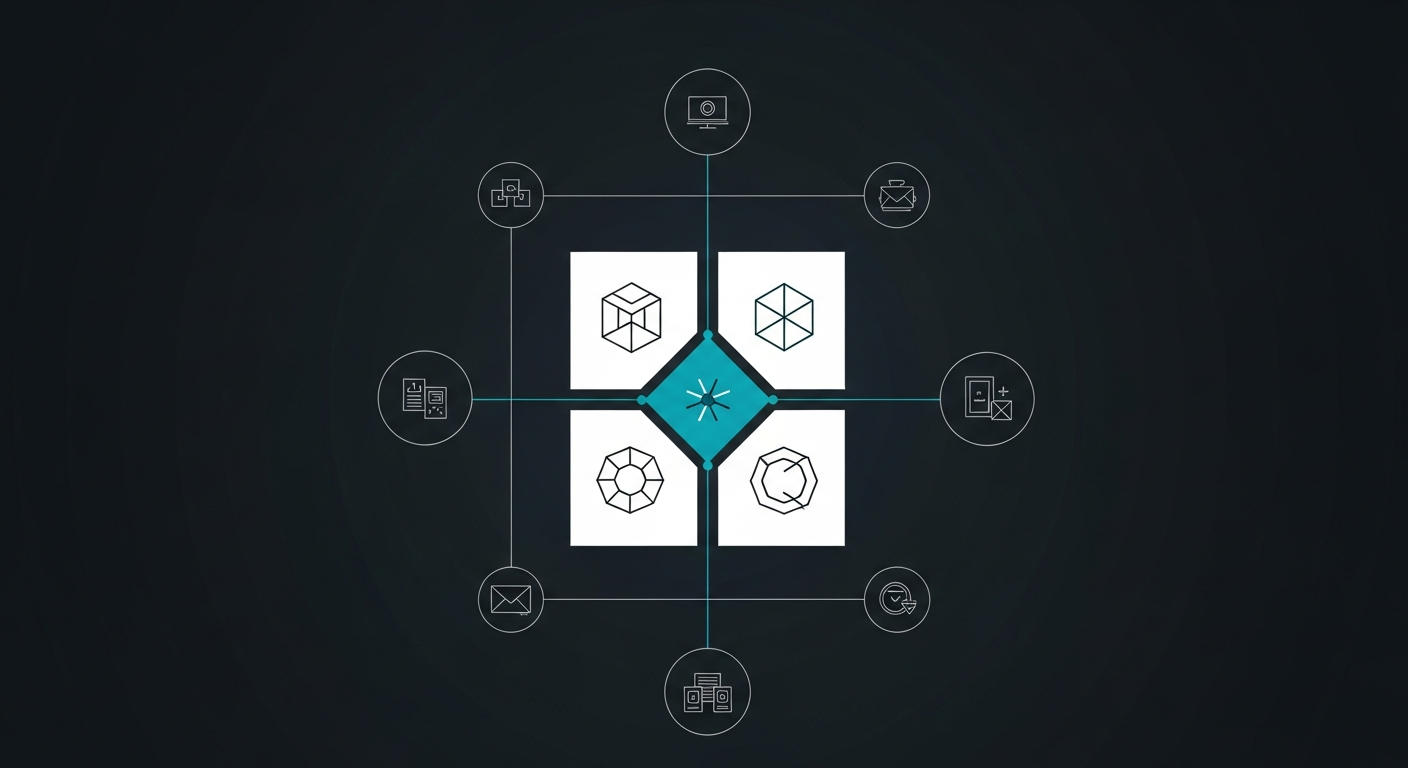
Governance frameworks have proliferated for decades: one for AI systems, one for corporate boards, one for cooperatives, one for regulated industries. Universal Tebiki offers a different premise. One framework. Every actor. Every system.
Universal Tebiki: One Framework for Every Actor in Every System
In Japanese, “tebiki” (手引き) means a guide, a handbook, or, literally, leading by the hand. The word implies something practical and transferable: a set of principles simple enough to carry with you, precise enough to apply in unfamiliar situations. That is the intent of Universal Tebiki, a governance framework built on four laws that apply equally to human actors and machine actors, in organizations large and small, in regulated industries and open cooperatives, in AI systems and in the boardrooms that oversee them.
The premise sounds ambitious. It is. The reasoning behind it is not speculative. It is structural.
The Problem with Actor-Specific Governance
Every major governance failure of the past two decades has one feature in common. The systems involved had governance frameworks. The frameworks described some actors well and others poorly, or they described actors at one moment in time and were not maintained as those actors changed, or they governed humans and machines under completely different rule sets that were never reconciled.
AI governance frameworks treat AI agents as the object of governance and humans as the governing authority. Corporate governance frameworks treat the board as the principal and employees as the governed. Cooperative governance frameworks distribute authority in ways that corporate frameworks do not recognize. Regulatory frameworks sit above all of these and often contradict each other.
The result is not governance. It is a collection of frameworks that each describe a partial view of a system that has no unified description. When an AI agent makes a decision that a human would have escalated, and when neither the AI governance framework nor the corporate governance framework anticipated that specific junction, there is no governing document for what happens next. The system defaults to whoever is most confident. That is not governance. That is opinion with documentation.
Universal Tebiki was developed to close this gap. The core insight is simple: if you cannot state the governance rules for a human actor and a machine actor in the same sentence, you do not have a governance framework. You have two separate frameworks that will eventually produce a conflict neither is equipped to resolve.
Origins: From AI Engineering to Human Governance
The framework began in AI engineering. In that context, the problem is tractable: an AI agent needs a defined purpose, a set of values it must operate within, explicit constraints it cannot cross, and a mechanism to measure and control its rate of change over time. These four elements are not optional. Without any one of them, the agent is ungoverned in the domain that element covers.
In 2015, I began transposing this structure to human governance. The question was whether the same four elements that make an AI agent governable also make a human organization governable. The answer, after a decade of testing it in organizational contexts, is yes. Purpose, Values, Constraints, and Entropy are not AI-specific concepts. They are the minimum complete set of elements required for governance of any actor that makes decisions, takes actions, and changes over time.
What changed with the acceleration of AI deployment after 2023 is that the distinction between “AI governance” and “human governance” became practically untenable. Organizations are now operating with hybrid decision networks: AI agents make decisions that humans review, humans set policies that AI agents enforce, automated systems generate outputs that human governance structures are expected to ratify. You cannot govern that network with two separate frameworks and no bridge between them. The bridge is Universal Tebiki.
Not Asimov’s Rules
The comparison to Isaac Asimov’s Three Laws of Robotics is irresistible and instructive. Asimov gave his robots three rules: do not harm humans, obey human orders, protect your own existence, ordered by priority. The rules are elegant. They are also fiction.
They are fiction not because robots are fiction (they are not, and were not when Asimov was writing) but because the rule set assumes two things that are false in practice: first, that the categories “human” and “robot” are always distinguishable, and second, that harm is always recognizable at the moment of action. Asimov spent his career writing stories about what happens when those two assumptions fail. Every story is a governance failure.
Universal Tebiki does not assume that the categories are fixed or that harm is always visible at the moment of action. It assumes the opposite: that the boundaries between human and machine actors will blur, that governance drift is inevitable, and that the governing challenge is therefore not to write better rules but to build a system that can detect and correct drift before it becomes catastrophic. The four laws are not a priority-ordered list of prohibitions. They are a structural description of what every actor in a governed system must have in order for the system to govern itself.
The Four Laws
Purpose is the first law. Every actor, human or machine, operates within a defined scope of action. That scope is not unlimited. It is not inferred from context. It is declared, machine-readable where possible, and version-controlled. When an actor takes an action, the first governance question is not whether the action was permitted. It is whether the actor had purpose for being in that domain at all. Purpose is the zeroth condition. Every other governance question is downstream of it.
Values are the second law. Values, in the context of Universal Tebiki, are not statements of aspiration. They are operational constraints on how purpose may be pursued. They express what the actor must prioritize when purpose and other considerations conflict. They are inherited through the system hierarchy and can be narrowed at lower levels but not widened. A platform-level value sets a non-negotiable floor. A team-level value adds specificity. An individual actor’s values cannot exceed the scope set by the level above. When an actor’s behavior drifts from its declared values, that is a governance event, not a cultural observation.
Constraints are the third law. Constraints are explicit thresholds. They define what the actor cannot do and what conditions trigger an escalation or a halt. Critically, constraints in Universal Tebiki are not static rules. They are threshold definitions. The thresholds themselves can change, but only through a documented decision made within the appropriate governance body (the gremium, in UT terminology). A constraint is not changed informally. The change requires documentation, attribution, and a record that survives the change. This is the mechanism that blocks arbitrary decisions: not by making change impossible, but by making it legible.
Entropy is the fourth law. Governance drift is not a failure mode to be avoided. It is a natural property of any system that changes over time, and all systems change over time. The question is not whether drift occurs but at what rate and in which direction. Universal Tebiki formalizes this through the Entropy Quotient: a numeric measure of how far the current state of any actor or system has moved from its declared state, tracked on a timeline. The Entropy Quotient does not block change. It makes the rate of change visible and comparable against thresholds. When the rate exceeds threshold, the system requires a documented decision before the drift continues. Change is welcome. Uncontrolled change is not.
Why This Is the Right Moment
AI deployment in enterprises and public institutions has outpaced the governance frameworks designed to contain it. The typical response is to add more rules, more audits, more documentation. This does not work because the problem is architectural, not procedural. You cannot solve an architectural gap by adding more content to an inadequate structure.
Universal Tebiki offers a different response. Instead of adding more rules, it changes the question. Instead of asking “did the actor follow the rules?”, it asks “is the actor still operating within its declared purpose, within its declared values, within its declared constraints, and within an acceptable entropy range?” These are four questions that apply equally to a large language model, a compliance officer, a cooperative board, and a government agency. The same four questions. The same governance framework.
The series that follows this introduction covers each law in depth: its theoretical basis, its practical implementation, and the specific governance failures it prevents. Each article stands on its own, but the argument is cumulative. The four laws are not a menu. They are a minimum complete set. A system governed by three of them is not three-quarters governed. It is ungoverned in the domain that the fourth law covers.
That is the structural argument for Universal Tebiki. Not that it is elegant, though it is. Not that it is simple, though it is that too. But that it is the minimum complete description of what governance requires, applied to every actor in every system.
Rosho is the CEO of Qaori, a platform for sovereign AI deployment and organizational governance. Universal Tebiki is the governance foundation underlying the Qaori Preemptive Governance framework, in production since 2024.
Contact: rosho@rosho.world | qaori.ai

