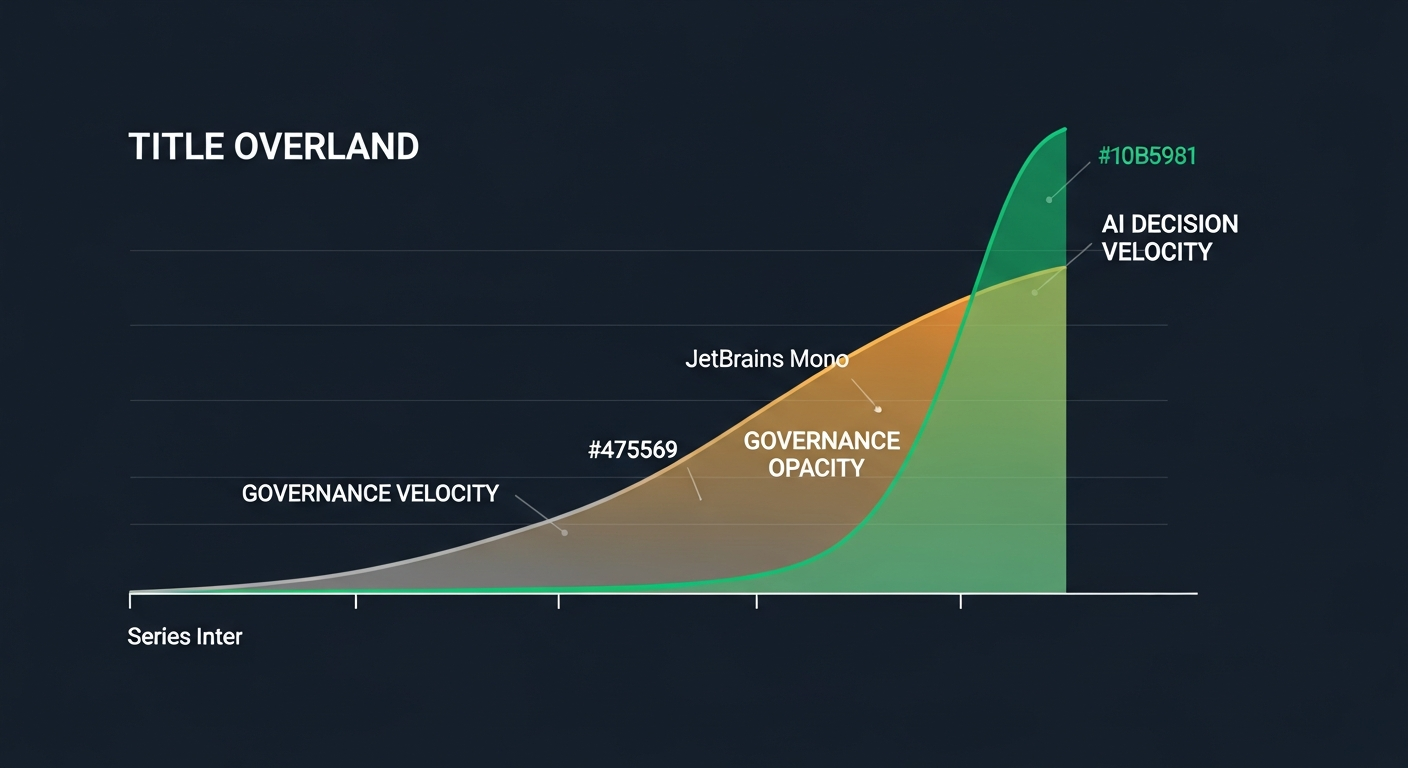
The velocity mismatch between machine-speed decisions and human-speed oversight is not a policy gap. It is a structural one.
A financial AI agent completed a full analysis and executed 1,500 account interest rate adjustments in 2.3 seconds. That afternoon, a human compliance reviewer sampled 10 percent of the day’s decisions – 9 out of 1,500. The remaining 1,491 adjustments were never reviewed. The governance framework was functioning correctly. The organization met its oversight requirements. And 1,491 consequential financial decisions were made without any actual human review.
That is the core problem I want to examine in this article.
In the first piece in this series, I argued that governance frameworks describe January in December. They drift from the organizations they govern through four mechanisms: personnel change, volume compression, tool updates, and workflow extension. That drift is not a failure of governance design. It is an inherent consequence of writing static rules for dynamic systems. The problem predates AI. AI, however, has changed the speed at which it happens to a point where the traditional response – catch the drift, update the framework, close the gap – can no longer keep pace.
This is not a matter of approving things faster. It is a structural gap between how governance was designed to work and how AI systems actually operate. Those two things run at fundamentally different speeds, and the gap between them is where enterprise risk now lives.
Machine Speed, Human Speed
Governance frameworks were built for human-speed decisions. A policy document, a compliance review cycle, an escalation workflow, a quarterly audit – each of these assumes that decisions take hours, days, or weeks. That assumption is load-bearing. It is the premise on which the entire architecture of review, sampling, and oversight rests.
AI operates at a different order of magnitude. The 2.3-second case above is not an edge case. It is a routine property of deployed AI systems. When an agent processes thousands of actions in the time it takes a human reviewer to read a paragraph, the mathematics of sampling-based oversight collapse. A 10 percent review rate was a reasonable governance design when 10 percent meant a meaningful share of consequential decisions. When 10 percent means 9 out of 1,500, it means nearly nothing. The governance framework is not broken. The assumption it rests on no longer holds.
The velocity mismatch cannot be fixed by adding more reviewers or by running faster audits. You cannot add enough humans to review AI decisions in real time without eliminating the operational value that AI provides. The problem is not resourcing. It is that review-after-execution, sampled oversight was never designed to govern systems that complete a day’s worth of consequential decisions before lunch.
How AI Accelerates the Four Drift Vectors
The four mechanisms I described in the first article do not disappear in an AI environment. They accelerate and, in some cases, change character entirely.
Consider personnel knowledge. Governance frameworks encode the understanding of the people who wrote them. When those people leave, the framework persists, but the context that made it accurate is gone. In a conventional system, that drift is slow. In an AI environment, it can happen through a software update.
A healthcare organization deployed a diagnostic AI at version 1.3. That version was deliberately conservative – it had a high false-positive rate by design, flagging a wide range of cases for radiologist review. The Chief Medical Officer, who shaped the governance, understood this. The policy reflected it: radiologists were required to review everything the model flagged. That was the right rule for that model.
The CMO left in August. In September, the model provider released version 2.1. The new version used different training data, had a much lower false-positive rate, and had significantly higher confidence thresholds. It was more selective and more accurate. The governance policy was not updated. It still required radiologists to review all flags – a rule written for a conservative model that flagged broadly, now applied to a confident model that flagged selectively. Radiologists spent time reviewing lesions the model had already identified with 95 percent confidence as unambiguously benign. The framework was accurate to version 1.3. It was irrelevant to version 2.1. The knowledge that made the original policy coherent departed not through a personnel decision but through a software release.
Volume compression follows a similar pattern. A logistics company governed its AI routing system with a rule: any route projected to exceed 2.5 hours required human escalation. When the system was routing a few hundred deliveries, that was workable. At 50,000 deliveries per day, roughly 500 routes per day triggered the escalation threshold. One reviewer could handle 40 per day. The organization quietly adjusted: in practice, escalation applied to routes over 4 hours. The framework still said 2.5 hours. The practice was 4 hours. No one changed the policy. The policy simply became a description of a system that no longer existed.
Tool updates are more disruptive because they can render governance not just inaccurate but incoherent. An organization deployed a multimodal AI in October 2025. At the time, the system had no video-generation capability, so the governance document explicitly prohibited its use – not because anyone was particularly concerned about video, but because it was not needed and the policy was written to cover what existed. In December, the model provider released an update that automatically added video generation. In January, an engineer discovered the capability. He read the governance document, which prohibited video generation. He concluded it was a drafting oversight – the prohibition had been written before the capability existed, and no one had thought to update it. From the organization’s perspective, he had violated policy. From his perspective, the policy was incoherent. From the system’s perspective, the capability existed, had been active for six weeks, and governance had said nothing accurate about it in that entire period.
Workflow extension is perhaps the most gradual of the four, but at AI scale, it compounds in ways that are difficult to track. A financial organization deployed an AI for customer credit analysis. Over six months, the application grew through a sequence of individually reasonable decisions. By month two, the model was being applied to loan pricing – credit risk naturally informs rate decisions. By month four, it was used for customer retention analysis – a customer’s credit health is relevant to predicting churn. By month six, it was applied to supplier risk assessment. By month seven, a system that governance described as a “customer loan analysis tool” was operating as a general financial risk engine across customer accounts, supplier relationships, and internal credit lines. Each extension was locally logical. The cumulative drift from the governance description to operational reality was substantial. The system had moved from advisory to decision-making for supplier contracts. Governance still said “customer loan analysis.”
The Shadow Problem
Every large organization running AI has a governance problem it is not fully aware of: the gap between the deployments it knows about and the deployments it does not.
Employees use ChatGPT and Claude on customer data despite restrictions. Researchers upload proprietary datasets to fine-tune models. Teams run local LLM deployments without IT oversight. In an organization that has formally documented 1,000 AI deployments, it is reasonable to assume that somewhere between 2,000 and 5,000 AI interactions are actually occurring. The 1,000 documented deployments are governed. The others are invisible to audit.
The governance response to this is typically enforcement intensification: stricter controls, more monitoring, clearer consequences. This is understandable. It is also largely ineffective and, in some ways, makes the underlying problem worse.
When enforcement focuses on documented deployments while shadow AI continues to grow, the organization develops a precise and confident governance posture that is simultaneously accurate for the 1,000 deployments it can see and irrelevant to the operational reality it cannot see. Audit reports show excellent compliance. The compliance is real. It covers roughly 20 percent of what the organization is actually doing with AI. The remaining 80 percent is not noncompliant – it is ungoverned.
I am not arguing that enforcement is wrong. I am arguing that enforcement without visibility into what is actually being enforced produces a governance structure that feels more rigorous than it is.
The Enforcement Trap
There is a counterintuitive dynamic at work here that warrants a direct statement: when a governance framework has drifted significantly from the system it governs, more rigorous enforcement of that framework yields worse governance, not better.
Every decision gets reviewed against the current policy. Each review appears compliant. Each approval is documented. The audit trail is impeccable. Every action is recorded as compliant with the policy in force. None of it matters because the policy describes a system that no longer exists.
A detailed audit trail documenting compliance with stale governance is not evidence of good governance. It is evidence of well-documented drift. The organization has successfully enforced the wrong rules.
The healthcare case illustrates this directly. After recognizing that its AI diagnostic approvals were generating concerns, the organization responded by adding a second reviewer to the approval process. Two qualified reviewers now evaluate every AI flag before radiologist handoff. The reviews were thorough. The documentation was meticulous. And the framework the two reviewers were applying was still calibrated to version 1.3 of a model that was running version 2.1. More rigorous enforcement of an inaccurate framework made the governance less accurate, not more, because it created organizational confidence in a process that was confidently reviewing against the wrong standard.
Cascade Multiplication
The velocity mismatch has a second-order consequence that traditional governance architecture was not designed to handle: the way that AI consequences accumulate across sequences of individually compliant decisions.
Consider a content moderation case. An AI agent removes 500 posts from a single activist account over a period of six weeks. Each individual removal is evaluated against policy. Each is found compliant. Each is documented and approved. The gate functions correctly on every single decision. The pattern that emerges across those 500 decisions – systematic suppression of a specific account – is not visible to the gate, because the gate evaluates each decision individually. The gate’s visibility ends where each action ends.
A regulator reviewing the account’s activity sees something different. Six weeks, 500 removals, one account. That is a suppression pattern, regardless of whether each individual removal was defensible. The gate saw 500 compliant decisions. The regulator saw the sequence. The governance architecture was designed to evaluate decisions. The risk accumulated across them.
This is the cascade multiplication problem. At machine speed, an agent can execute hundreds of individually compliant decisions in a short period. The compliance record for each is clean. The cumulative effect of the sequence may be something no human reviewer would have authorized, even if they had seen the full picture at once. The governance framework evaluated each step. No one evaluated the path.
The Regulatory Pressure Point
I want to be direct about the timeline. The EU AI Act’s Article 22 enforcement provisions take effect on August 2, 2026. The penalties are real: up to 35 million euros or 7 percent of global annual revenue, whichever is higher. Current data indicate that approximately 31 percent of enterprises have governance infrastructure that meets that standard. Approximately 74 percent of enterprises are running revenue-generating AI in production today.
That is not primarily a compliance problem. It is an architecture problem.
The policies exist. The guidance documents exist. The compliance committees exist. What does not exist, in the majority of enterprises running AI at scale, is governance that operates at the execution boundary – governance that is evaluated and enforced where and when decisions are actually made, not reviewed against a sampled subset days or weeks later.
Six months is enough time to change that, but only if the work starts now and is aimed at building the right architecture rather than intensifying enforcement of the existing one.
The Architecture Problem
The argument I made in the first article was that governance frameworks drift from the organizations they govern, and that drift is not a failure of intent but of architecture. The argument I am making here is that AI accelerates that drift to a speed where the traditional remediation cycle – detect, update, re-enforce – cannot close the gap before the next divergence opens.
The solution is not more rigorous enforcement of existing frameworks. It is a different kind of governance architecture: one that evaluates decisions at the execution boundary rather than after the fact, one that can detect drift in how AI systems are actually behaving rather than waiting for a human to notice the gap, and one that treats the cascade of decisions across time as a unit of governance, not just the individual decision.
That architecture exists. Building it at enterprise scale is the work of the next period. In the next article in this series, I will address why the existing governance frameworks – however well maintained and rigorously enforced – cannot provide that architecture, and what needs to replace them.
The governance problem is not new. The speed at which it compounds is. The solution has to account for both.