By Rosho, Founder, Qaori, the Brain Company in Japan. Building Sovereign Company Brains for the baby-boomers 団塊世代 succession wave. GDPRS/APPI-compliant.
April 26, 2026
Every organization has someone like this. The person who knows why a particular process works the way it does. The one who remembers which customer asked for the exception, three years ago, and why we agreed. The one who can tell you that the official document is technically correct, but the real answer is buried in a Slack thread from 2021. The colleague who quietly says, “Don’t do it that way, we already tried, two years ago.”
Then one day, that person leaves. Or changes department. Or gets promoted into a role where they no longer have time to explain things. Or simply retires.
The company does not collapse. Operations continue. Reports are still produced. But something quietly disappears, and it is not data, documents, or files. It is wisdom.
For decades, HR has been responsible for hiring, onboarding, engagement, performance, culture, compliance, and retention. That was already a substantial agenda. But a new responsibility is now emerging, and it sits uneasily across all the others: HR is becoming the function responsible for organizational continuity. Not in the technical, disaster-recovery sense, but in the human sense. Can a company continue to think clearly when key people move on? Can new employees understand not only what the company does, but why it does it that way? Can managers transfer judgment, context, and lessons learned without turning every senior employee into a full-time trainer? In short: can the organization remember?
This is becoming one of the most important strategic questions for HR leaders, and most companies are not yet equipped to answer it.
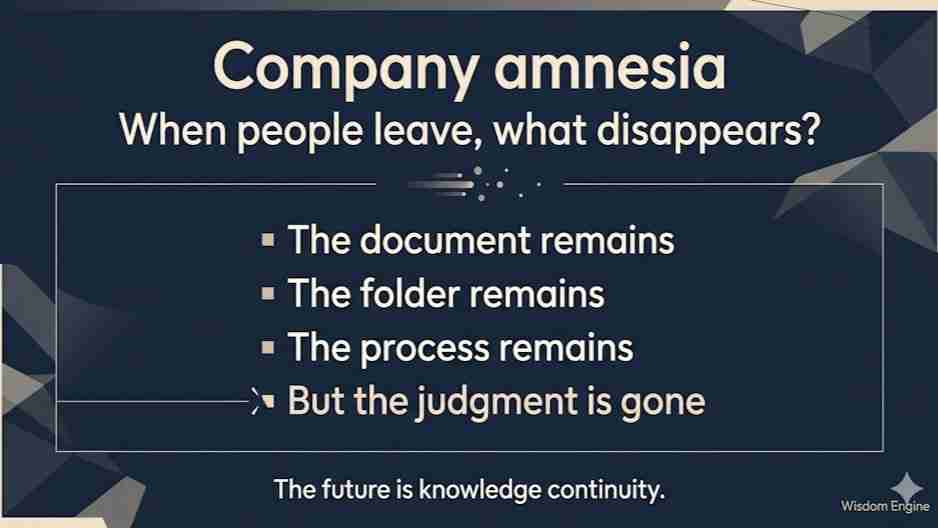
The instinctive response is to point at the existing knowledge stack. Most organizations already have folders, wikis, onboarding documents, learning management systems, recorded meetings, intranets, handbooks, and process libraries. The problem is not that knowledge does not exist. The problem is that the knowledge that exists is fragmented, often outdated, hard to trust, and disconnected from real human experience. A document can state what the policy is, but rarely explains why the policy exists. A checklist captures the steps, but not the judgment behind them. A recorded meeting preserves the words, but seldom what actually mattered. This is why so many companies are simultaneously rich in information and poor in clarity. They have storage. They do not have continuity.
The real loss, when an experienced person walks out the door, is not “knowledge” in the abstract. It is interpretation. The company loses how that person reads situations, recognizes patterns, and applies the shortcuts built from years of mistakes. It loses context around customers, partners, internal politics, cultural norms, and invisible risks. It loses the quiet sentence that saves three weeks of work, “we already tried that, here is what happened.” Over time, the cost surfaces in places HR knows well: new employees take longer to become effective, managers repeat old mistakes, teams reinvent processes that were already discarded for good reasons, and senior people become bottlenecks because they are the only living index of how the company actually operates. Everyone is busy, but the organization is not necessarily becoming wiser.
This is where I believe the next generation of HR technology has to evolve. Not toward storing more information, we already have too much, but toward preserving, connecting, and activating collective wisdom. That is the idea behind what I call a Wisdom Engine.
A Wisdom Engine is not a database, not a chatbot, and not a document search tool. It is a living continuity layer for the organization. It captures the reasoning behind decisions, not just the decisions themselves. It connects people, documents, experiences, and lessons learned, so that context travels with the work rather than with the individual. It helps new employees understand the “why” faster, helps managers avoid repeating known mistakes, and helps the organization preserve judgment before it walks out the door. The goal is not to replace human mentors. The goal is to make mentorship scalable.
HR managers are uniquely positioned to lead this shift. This is not only an IT problem, and it is not only a knowledge management problem. It is a people continuity problem, and HR sees the early signals long before anyone else does: which teams depend too heavily on one individual, where onboarding quietly fails, which questions new employees keep asking, where the cost of turnover is accumulating before it ever shows up in a financial report. That makes HR the natural owner of the knowledge continuity conversation, even when the technology lives elsewhere.
The question is no longer “how do we document our processes?” The better question, the one that will increasingly define resilient organizations, is: how do we make sure our company keeps learning, even as people move?
In the coming years, talent acquisition, retention, and training will continue to matter. But there is another capability, less visible today, that will separate resilient companies from fragile ones: organizational memory. A company that remembers onboards faster, makes better decisions, protects culture across growth and change, and turns individual experience into shared intelligence.
That is the future worth building now. Not another folder. Not another static knowledge base. A living Wisdom Engine, because when people leave, their wisdom should not leave with them