By Rosho, Founder, Qaori, the Brain Company in Japan. Building Sovereign Company Brains for the baby-boomers 団塊世代 succession wave. GDPRS/APPI-compliant.
April 28, 2026
Most HR teams can quote the cost of hiring a new employee with surprising precision. They know the cost of advertising a role, the time spent in interviews, the agency fee, the average salary, the onboarding budget, and the rough cost of training in the first ninety days. These numbers are visible because they pass through invoices, payroll, and HRIS dashboards. They are easy to add up.
The cost of forgetting, on the other hand, is almost never measured. When a senior employee leaves, when a team is reorganized, when a project closes without a proper handover, the organization quietly loses something that does not appear on any financial line. It loses interpretation, context, and accumulated judgment. It loses the small pieces of knowledge that prevent repeated mistakes and shorten difficult decisions. Nothing breaks visibly, so nothing is reported. And yet, in many companies, this invisible loss is now larger than the cost of hiring itself.
It is worth asking, very directly: how much does our company actually spend, every month, because it has forgotten things it once knew?
A practical way to answer this is to break the cost of company amnesia into recognizable buckets. The point is not to produce a single perfect number. The point is to make the loss visible enough that leaders can see it, discuss it, and decide to act on it.
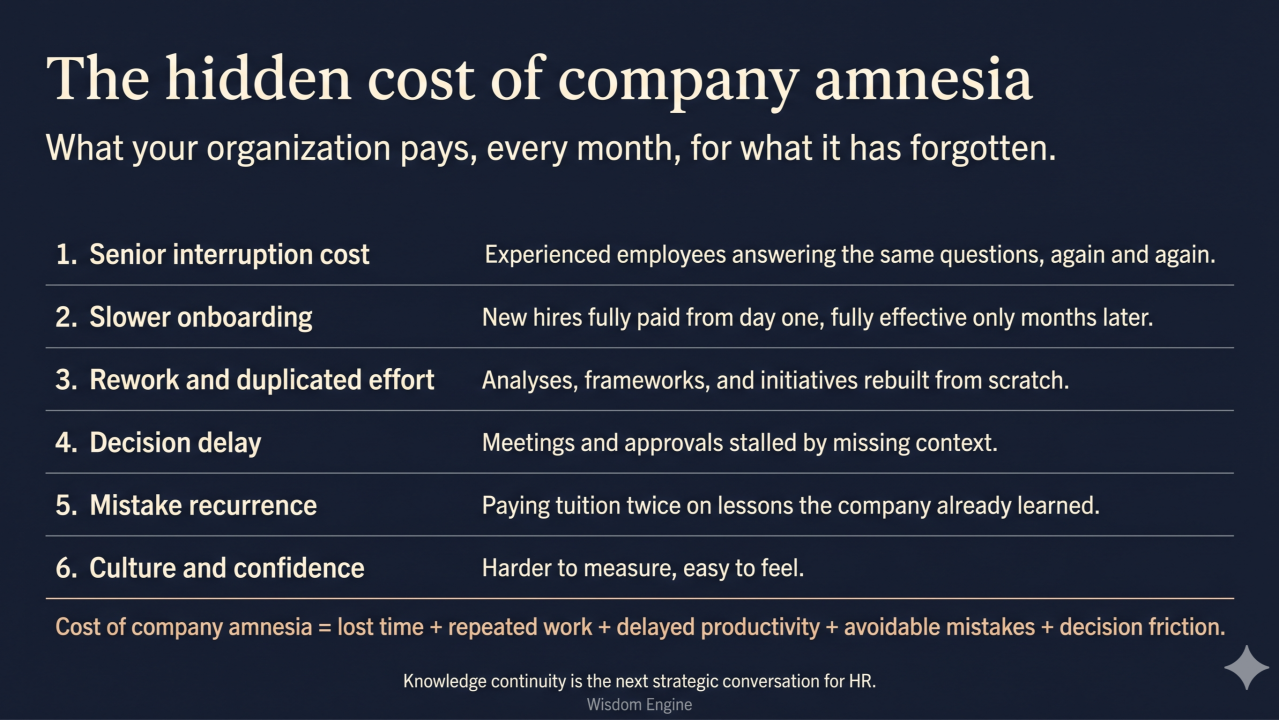
The first bucket is repeated questions and senior interruption cost. In most teams, the same questions are asked over and over by different people across months and years. Experienced employees, often the most expensive in the company, spend a meaningful share of their week answering them. They explain why a process is shaped a certain way, why a particular client is sensitive, why a previous attempt did not work. Each interruption looks small. Multiplied across a year and across the most senior people in the organization, it is easily one of the largest hidden costs in the business.
The second bucket is slower onboarding and time-to-productivity cost. Every new hire eventually becomes effective. The real question is how long that takes. Companies with weak organizational memory often need six, nine, or twelve months before a new employee can operate with confidence. The salary is paid in full from day one, but the value is delivered slowly. The gap between the two is a real cost. It also has a less visible second effect: it locks senior employees into the role of permanent trainers, which reduces their own output.
The third bucket is rework and duplicated effort. Without a shared memory, teams repeatedly rebuild things that already exist somewhere in the company. New analyses repeat old analyses. New frameworks duplicate old frameworks. New initiatives revisit conclusions that were reached, and discarded, two or three years earlier. The work feels productive because people are busy. The organization, however, is paying twice for the same thinking.
The fourth bucket is decision delay cost. When the context behind a past decision is missing, current decisions take longer. Meetings multiply. Approvals stall. People hesitate, not because the question is hard, but because no one is sure what was already decided, by whom, and why. Decision delay rarely appears as a line item, but it shows up everywhere: in slipping deadlines, in shifted launches, in commercial opportunities that pass before the company is ready to respond.
The fifth bucket is mistake recurrence cost. This is one of the most expensive forms of amnesia. The company makes a costly mistake, learns from it, and then, years later, makes a very similar mistake because the people who lived through the first one have moved on. Failed product launches, poorly negotiated contracts, misjudged client situations, and operational incidents often follow patterns the company has already seen. Without continuity of memory, every generation of employees pays the tuition again.
The sixth bucket is harder to quantify but very real: culture and confidence cost. When employees feel that “no one really knows how this works around here,” trust in the organization declines. Decisions feel arbitrary. Newer employees become cautious because they cannot tell which advice is current and which is outdated. Senior employees become exhausted from being the only living index. Over time, this affects engagement, retention, and the willingness of people to take ownership. It is difficult to put a precise euro or dollar figure on this. It is not difficult to feel its presence in any organization that has been growing or changing quickly.
A simple way to summarize the picture, in prose rather than a spreadsheet, is this. The cost of company amnesia is the sum of lost time, repeated work, delayed productivity, avoidable mistakes, and decision friction, plus a slower erosion of culture and confidence. Some of these can be estimated quite reasonably. Others can only be approximated. Together, they form a number that, in most mid-size and large organizations, is significant enough to deserve a place in serious strategic conversations.
There is then a separate question, often more uncomfortable: what is the cost of doing nothing about it?
The honest answer is that the cost of doing nothing rarely stays flat. It compounds. As the company grows, more people join who never met the colleagues who built the original processes. As tools change, older context is left behind in retired systems. As reorganizations happen, informal networks that once carried memory are broken. The organization does not suddenly become forgetful. It becomes a little more forgetful every quarter, and the price of that forgetting rises with the size and complexity of the business. The larger the company, the more expensive informal memory becomes.
Doing nothing also has a strategic cost that is easy to underestimate. Organizations that cannot retain context are slower to adapt. They take longer to integrate acquisitions. They lose more value during succession. They struggle to scale their best practices from one team to another. In a market where speed of learning is becoming a serious competitive advantage, a company that keeps forgetting is, in effect, paying a tax on its own growth.
This is why, for HR and operational leaders, knowledge continuity should no longer be treated only as a documentation problem. It is a financial and operational problem. It belongs in the same conversation as turnover cost, productivity, and risk. The questions are concrete. How much senior time is consumed every week answering questions that have been answered before? How long does it really take for a new hire in a critical role to reach full effectiveness? How often do we repeat mistakes the company already paid for once? How many decisions are delayed because the reasoning behind a previous one cannot be reconstructed?
Once these questions are asked seriously, the next step becomes clearer. The traditional response, “let us write more documentation,” is necessary but not sufficient. Documents capture what was decided, rarely why. They preserve outputs, not judgment. They age quickly and are trusted unevenly. The deeper need is for a continuity layer that sits alongside people and tools, and that helps the organization preserve context, decisions, lessons learned, and practical judgment as they are formed, not years later when they are already half forgotten.
This is the perspective behind what I call a Wisdom Engine. It is not a new database, not just another chatbot, and not a replacement for human mentors. It is a way of treating organizational memory as critical infrastructure: capturing reasoning, connecting it to people and work, and making it available to the next person who needs it, in the moment they need it. The aim is simple. New employees should not have to rediscover what the company already knows. Senior employees should not have to be the sole keepers of context. Decisions should be made with the benefit of what has already been learned.
Companies are already paying the cost of company amnesia. The choice is not whether to spend money on the problem. The choice is whether to keep paying it quietly, in interruptions, repeated work, slower onboarding, and recurring mistakes, or to start investing, deliberately, in continuity. Once the cost becomes visible, the business case usually answers itself.