






By Rosho, Founder, Qaori, the Brain Company in Japan. Building Sovereign Company Brains for the baby-boomers 団塊世代 succession wave. GDPRS/APPI-compliant.
April 29, 2026
A new dataset called SWE-chat, released this month by researchers from Stanford, NYU, Princeton, and Anthropic, is the first attempt to look honestly at how AI coding agents are actually used in the wild. It collects 6,000 real coding-agent sessions from open-source developers, more than 63,000 user prompts, and over 350,000 agent-tool calls. It is, to my knowledge, the largest empirical window we currently have into the daily reality of working with coding agents, rather than the polished reality of curated benchmarks.
The findings deserve careful attention from anyone building, buying, or governing AI software systems.
Three numbers, in particular, should be read slowly.
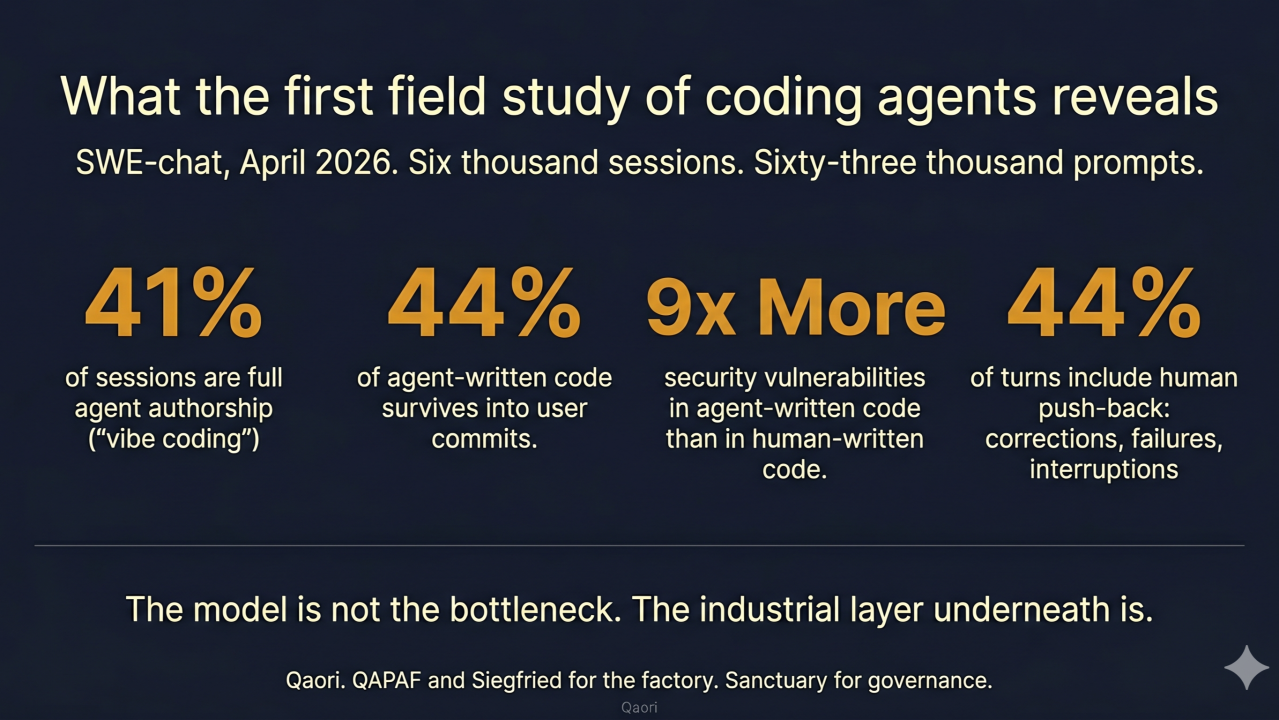
41% without human review
First, in roughly forty-one percent of sessions, the agent authors virtually all the committed code. The researchers call this “vibe coding.” In another twenty-three percent of sessions, the human writes everything. Real usage is bimodal. People are not gently co-authoring with their agent. They are either delegating almost entirely or stepping in and doing it themselves.
44% never reach commit
Second, only forty-four percent of agent-produced code survives into user commits. More than half of what the agent writes is discarded, rewritten, or quietly abandoned. The model is producing a great deal of motion. The system, taken as a whole, is not yet producing a corresponding amount of durable work.
9 x more security vulnerabilities
Third, and most importantly for anyone thinking about governance, agent-written code introduces more security vulnerabilities than human-authored code. In sessions where the agent writes virtually all the code, the rate is roughly 0.76 vulnerabilities per 1,000 committed lines, against 0.08 for human-only commits. That is approximately nine times higher. The dominant categories, detected by static analysis against the standard CWE ruleset, are path traversal, OS command injection, SQL injection, and unsafe format strings. These are not exotic findings. They are the foundational classes of insecure code that the industry has been trying to eliminate for two decades.
To this, the paper adds one more uncomfortable detail. In forty-four percent of all turns, users push back against the agent through corrections, failure reports, or interruptions. The relationship between humans and coding agents in the field is not a smooth collaboration. It is a constant negotiation, conducted under deadline pressure, by people who often have no way to verify what is being shipped on their behalf.
If we step back from the numbers, the picture that emerges is recognizable to anyone who has run a serious engineering organization. We have introduced a new class of worker, extremely productive in the narrow sense, into systems that were never designed to supervise it. We have given that worker write access to source code, configuration, infrastructure, and increasingly to live environments. And we have done so without a coherent operational layer underneath.
This is the gap that Qaori has been built to address.
Qaori does not approach AI agents as productivity toys. It approaches them as a new industrial workforce that requires its own factory, its own quality discipline, and its own governance fabric. The SWE-chat paper, in many ways, describes precisely the conditions Qaori was designed for.
There are two parts of the Qaori platform that speak directly to what this study reveals.
The first is QAPAF, the Qaori Autonomous Software Factory, and within it, the security discipline we have internally codified under the Siegfried doctrine. QAPAF is the application layer where actual software gets built and shipped. This isn’t a chat window with a coding agent attached. It is a structured factory, with defined roles, work packages, mandatory documentation reads, registry-based service resolution, conventions that cannot be silently violated, and an explicit prohibition on shortcuts that look efficient in isolation but become catastrophic at scale.
Siegfried sits inside QAPAF as the security and refactoring discipline. It is the principle that any code, whether written by a human, an agent, or a combination of both, must undergo a security gap analysis before it is considered production-ready. It assumes, by default, that agent-authored code is more likely to contain quiet vulnerabilities, exactly as the SWE-chat data now confirms across thousands of real sessions. It refactors aggressively when patterns drift. It treats secure hosting, dependency hygiene, secret handling, and authentication boundaries as first-class engineering concerns rather than afterthoughts.
In practical terms, this means that when an agent in QAPAF generates code, that code is not simply committed because it compiles or because the test runner is green. It is evaluated against a security and architectural baseline. If the code introduces a vulnerability class that Siegfried recognizes, it is flagged, refactored, or rejected. The 44% survival rate described by the SWE-chat researchers isn’t, in our environment, a matter of human intuition catching half the problems. The factory is engineered to filter agent output through layers that don’t get tired, don’t face deadline pressure, and don’t approve a pull request because the team wants to go home.
The second part of the platform is the Sanctuary, which is the governance and compliance orchestration layer of Qaori.
Sanctuary is not a dashboard, nor a policy document. It is an architectural layer. It sits between the agents, the factory, and the outside world. It enforces what we call active constraints, rather than passive guardrails. The distinction matters. A passive guardrail asks an agent to behave; an active constraint makes certain behaviors impossible by construction.
Inside Sanctuary, several things happen at the same time. EU AI Act obligations are translated into operational rules that the platform itself respects, drawing on the framework articulated by Luca Salvadori. Data sovereignty is enforced at the routing level, not promised in a privacy notice. Authentication and identity flow through a controlled boundary, so that no agent ever speaks to a regulated system on behalf of a user without a verifiable, auditable chain of authority. Compliance evidence is generated as a byproduct of normal operation, not retrofitted before an audit.
What the SWE-chat findings make clear is why this kind of orchestration layer is no longer optional. If 41% of sessions are now genuine vibe coding, with the agent writing almost everything, then the question of who is accountable for the resulting system can no longer be answered by gesturing toward a developer who barely touched the code. Accountability has to be carried by the platform. The platform must be able to say, with evidence, what was generated, by which agent, under which constraints, against which version of which policies, and with which security checks applied. Sanctuary is the layer that makes this possible.
There is a second reason this matters, which has less to do with regulation and more to do with the basic economics of trust.
For me, the most striking number in the SWE-chat paper is not the security finding. It is forty-four percent of turns in which users push back against the agent. That is the sound of a workforce that is not trusted. It is the sound of professionals redoing, correcting, and undoing what their tools have produced. It is, in pure operational terms, an enormous tax on attention and morale.
A factory and a governance layer, properly built, do not eliminate human judgment. They concentrate it where it matters. They free experienced engineers from being permanent line-by-line referees and allow them to focus on architecture, intent, and edge cases. They turn the agent from a chatty co-author into a disciplined contributor that operates inside a known envelope. The push-back rate, in that environment, becomes a useful signal rather than a daily ordeal.
This is the broader argument I have been making for some time. The interesting question is no longer whether AI agents can write code. They can, and the SWE-chat dataset shows that they are doing so at scale, with mixed results. The interesting question is what kind of industrial layer we build underneath them. Without that layer, we get exactly what the paper describes: a bimodal mess of full delegation and full rejection, with security drifting downward and trust eroding turn by turn.
With that layer, something quite different becomes possible. Agents become a workforce. Code becomes an auditable artifact. Compliance becomes an emergent property of the system rather than a quarterly scramble. The governance conversation shifts from “can we trust this output” to “how do we expand the envelope responsibly.”
QAPAF and Siegfried address the first half of the problem by treating secure hosting, security gap analysis, and refactoring as load-bearing parts of the factory. Sanctuary addresses the second half by giving the platform a coherent governance and compliance orchestration layer that the agents, the humans, and eventually the regulators can all rely on.
The SWE-chat researchers describe a world that is already here. Six thousand sessions. Sixty-three thousand prompts. Three hundred and fifty thousand tool calls. Half the agent-written code is thrown away. Vulnerabilities rising. Users push back almost half the time.
The question for leaders is no longer whether to use coding agents. They are already in your repositories, on your laptops, and inside your workflows. The question is whether the surface they touch has been engineered for them or merely opened to them. That is the work Qaori is doing, deliberately, layer by layer, so that when the next dataset is published, the numbers tell a different story.
Reference: Baumann, Padmakumar, Li, Yang, Diyi, Koyejo, “SWE-chat: Coding Agent Interactions From Real Users in the Wild,” arXiv:2604.20779, April 2026.

