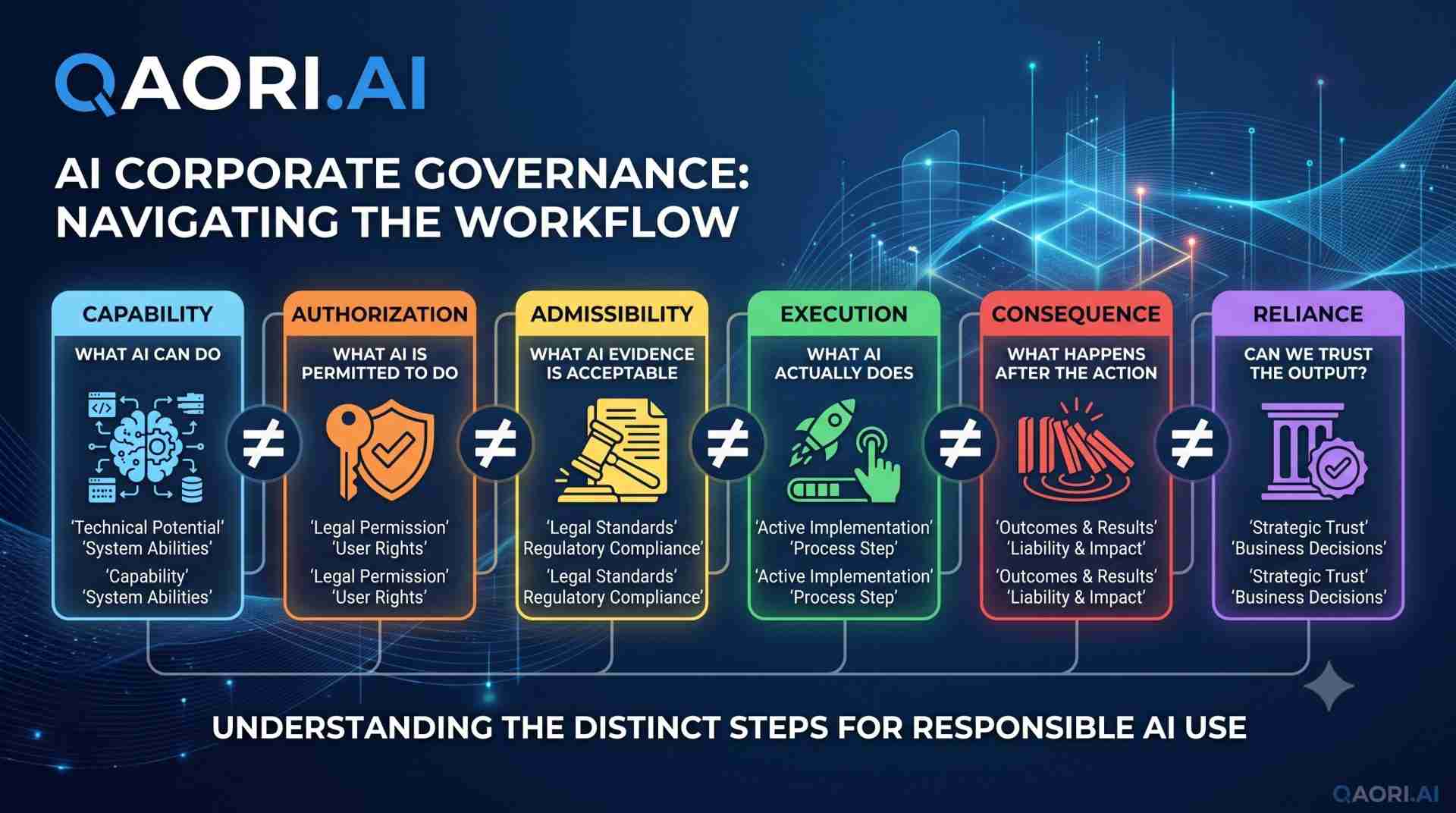
By Rosho, Founder, Qaori, the Brain Company in Japan. Building Sovereign Company Brains for the baby-boomers 団塊世代 succession wave. GDPRS/APPI-compliant.
May 4, 2026
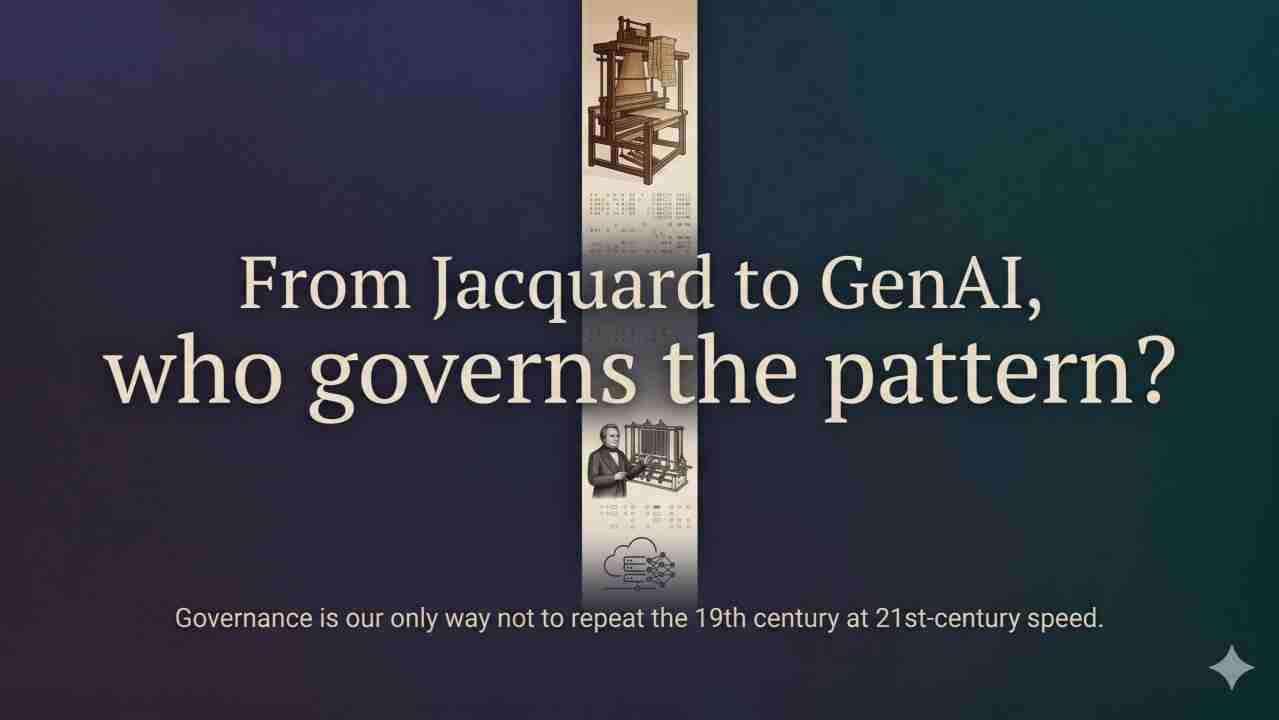
In 1805, Joseph-Marie Jacquard turned weaving into a programmable activity. Patterns that had lived in the hands and memories of master weavers were suddenly encoded in punched cards and executed by machines with relentless consistency. The Jacquard loom did not just speed up production; it redefined who held power over creativity, labor, and value in the silk industry.
The loom’s impact did not remain technical. In Lyon, the Canut weavers’ revolts of the 1830s were among the first large-scale industrial worker uprisings in Europe. They fought not a single machine, but a new system: falling prices, collapsing wages, and a production model in which decisions were increasingly made far away from the people at the looms. Technology was the visible symbol; governance of the transition was the real fault line.
A few decades later, Charles Babbage looked at the Jacquard loom and saw something even more radical. If punched cards could encode patterns for silk, why not patterns for calculation? His Analytical Engine borrowed Jacquard’s idea of externally stored programs to control a general-purpose machine. That conceptual leap, from weaving patterns to computing instructions, sits at the root of modern computing, and by extension, today’s AI.
My own path into this story is not abstract. As an organ builder, I worked with another “Jacquard-like” medium: punched books for mechanical organs. Those cardboard books, like Jacquard’s chains of cards, encode a performance as a sequence of holes and spaces. In 1993, I developed a MIDI converter to automatically produce those punched books from digital scores. That work sat at the crossroads of tradition and automation: respecting the craft of mechanical organs while letting software compose and prepare what human hands once laid out, hole by hole.
Seen from that vantage point, the pattern is strikingly consistent. Each wave of programmable automation reshapes three things:
- Who defines the pattern
- Who executes the pattern
- Who governs the consequences
Jacquard shifted pattern definition from individual weavers to designers and merchants. The Canuts revolted when execution and livelihood were governed by distant market forces rather than negotiated rules. Babbage translated the same logic into abstract computation, laying the groundwork for a world where patterns of numbers, not threads, determined outcomes.
Today, generative AI is Jacquard and Babbage combined, at a civilizational scale.
We are now encoding not only weave patterns or organ rolls, but language, images, music, code, and decisions as latent patterns inside vast models. A prompt is our modern punched card: a compact instruction that causes a complex pattern to unfold. The cost of producing “first drafts” in almost any symbolic medium has collapsed. The value is shifting once again from manual execution to orchestration, integration, and distribution.
And once again, the real question is not the brilliance of the technology, but the quality of the governance around it.
History is very clear on what happens if we get this wrong:
- When we focus only on productivity, we externalize transition costs onto workers and communities.
- When we mythologize inventors and platform founders, we overlook the role of rules, institutions, and shared agreements.
- When we treat resistance as ignorance, we miss early signals about imbalance, exclusion, and erosion of dignity.
The Canuts remind us that people will not passively accept being “repatterned” by distant decisions. They were not anti-technology; they were against a system in which their work, prices, and futures were dictated without a voice. The conflict was governance failure, expressed through the visible symbol of the loom.
As an organ builder working with punched books, I learned something similar on a smaller scale. Automation only works sustainably when it is aligned with the values of the craft, when the people embedded in the tradition can see themselves in the new tools. My MIDI converter was valuable not because it replaced musicians, but because it respected the musical language and physical constraints of the organs. It automated the tedious, not the meaningful. It extended a tradition instead of erasing it.
We need exactly that mindset for GenAI.
Governance for AI is not just regulation in the narrow legal sense. It is the entire architecture of choices about:
- Who owns and controls the “cards”: data, models, and interfaces
- Who participates in setting the rules for deployment and use
- How benefits and burdens of automation are shared
- How we protect human agency, dignity, and pluralism in systems driven by pattern recognition and optimization
If Jacquard was the beginning of programmable industry, GenAI is the beginning of programmable cognition at scale. The lesson from Jacquard → Canuts → Babbage → today is not “fear the machines.” It is: do not repeat 19th-century governance mistakes in 21st-century form.
We cannot afford another transition where:
- A small number of actors set the patterns
- The majority experience only the consequences
- And the conflicts are misdiagnosed as “anti-technology” rather than calls for fair participation
My work today focuses on AI governance and compliance precisely because I have seen this pattern before-from looms to organs to code. We need infrastructures, standards, and institutions that make AI deployment negotiable, observable, and accountable, not just efficient.
Jacquard showed that you can encode beauty and complexity into a strip of punched card. Babbage showed that reasoning can be encoded in similar patterns. GenAI shows that you can encode culture, style, and behavior into weights and vectors.
The open question for our civilization is whether we can also encode responsibility.
If we learn from Jacquard and the Canuts, our answer must be yes.