






By Rosho, Founder, Qaori, the Brain Company in Japan. Building Sovereign Company Brains for the baby-boomers 団塊世代 succession wave. GDPRS/APPI-compliant.
May 4, 2026
A position written from inside 30 years at the workbench, and from inside the platform I built afterward. The two together are the only place this answer can be written from.
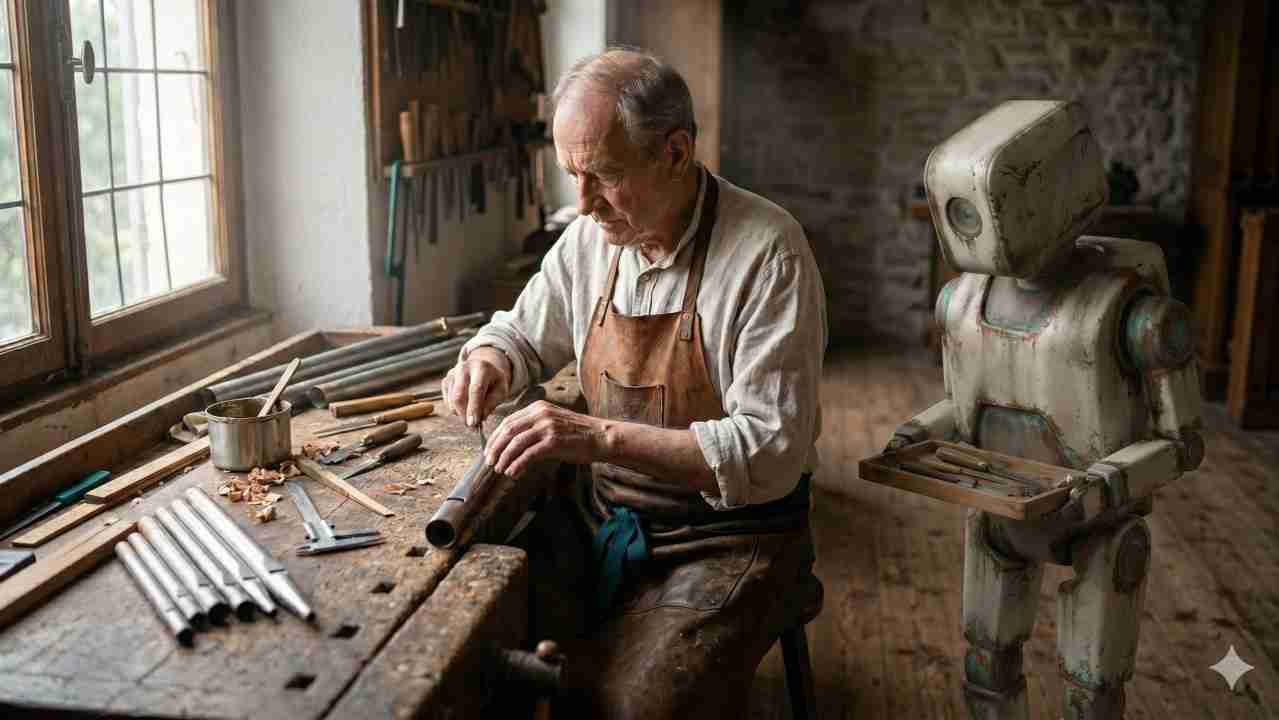
I am a guilded master organ builder.
I served a 15-year apprenticeship in the European tradition before I was permitted to call myself a master, then had my own workshop for another 15 years.
I am also the founder of Qaori Brain AI, a governance and platform company.
I did not arrive in technology by accident, and I did not leave the craft. I crossed deliberately. I crossed because the chain of transmission was visibly breaking, and because I could see, from inside the workshop, that no one with their feet on only one bank was going to fix it.
This post is about that crossing, and about the question that finally made me write it down.
A few weeks ago, an investor asked me a serious question.
He asked whether Qaori could solve the problem of preserving and transmitting ancestral knowledge.
I told him the truth a craftsman has to tell. I told him no technology will ever preserve a craft in full, and that anyone who claims otherwise has never stood at a workbench. The hand learns from another hand. The ear is trained by a master ear. The years cannot be compressed.
I know this is not a thesis. I know it as a memory. 30 years of memories.
But I also told him something I have only recently been able to put into words. There is a part of the problem that is solvable. It is small. It is precise. It is civilizational significant. And almost no one is solving it today, because almost no one is standing on both banks at once.
This is what I have learned, working from both sides of the river.
When people speak of preserving ancestral knowledge, they are speaking of three different things at once.
The first is explicit knowledge. Measurements, recipes, sequences, tool names, scaling tables, treatises. About twenty per cent of what a master holds. Books have done this for five centuries. Knowledge graphs do it more rigorously now. This layer is in adequate shape.
The second is tacit knowledge. The gesture, the ear, the smell of hide glue at the right temperature, the moment one knows without thinking that the languid is at the right height, and the rank is finally speaking true. About seventy per cent of any real craft. This layer cannot be digitized. Not by any technology that exists, and not by any technology that ever will exist. The work of acquiring it is the work of the body, in shared time, in shared air, with a master close enough to correct the gesture before it sets into a habit.
The third is the motivational matrix. The way a master sees the world. The dignity, the doubt, the joy, the defeats, the long apprenticeship of disappointment that precedes mastery. The story of how one became what one is. About ten per cent of the total. But it is the ten per cent without which the seventy per cent is never sought, and the twenty per cent is never opened.
The crisis is not the first layer. We have archives.
The crisis is not the second layer either, not yet. Living masters still exist in nearly every endangered craft on earth, for now, for another generation, perhaps two. I am one of them.
The crisis is the third layer. The chain of desire is breaking. And it is breaking simultaneously at both of its ends.
This is the refinement I developed after my conversation with the investor.
The problem is not one problem. It is two.
On one end of the chain, the master must be motivated to bear witness to the life he has lived, in his own voice and on his own terms, while he is alive to author it.
On the other end of the chain, the next generation must be motivated to walk toward the workshop they cannot yet imagine.
Two distinct populations. Two distinct psychologies. Two distinct methods. Two distinct solutions. They are coupled because the master’s witness becomes the successor’s content. But they have to be designed separately, and designed honestly.
Almost every preservation effort I have studied addresses only one end of the chain. Usually the second one. The photogenic one. The one with the deliverable.
That is why almost every preservation effort eventually fails.
The harder side is the master’s side. I can speak to it from the inside, because I am one of the masters most preservation projects fail to capture.
I have spent the better part of my working life refusing to speak publicly about the craft.
The reasons are not eccentric. They are widely shared among serious craftsmen.
The craft itself is the language a master speaks. Speaking about the craft can feel like a betrayal of the work. Or a vanity. Or a waste of the hours that remain at the bench.
There is also the matter of dignity. A serious craftsman has watched, all his working life, how the documentary camera and the journalist’s notebook have flattened his peers. Extracted a quotation. A gesture. A striking image. Produced an artifact in which the master himself can no longer recognize his craft.
The conventional methods of capturing a master’s knowledge, the ethnographic interview, the documentary film, the museum oral history program, and the academic monograph are slow, intimidating, expensive, and almost always extractive. They take from the master and, at best, give back a credit line.
There is a deeper reason still. A master in a serious lineage is not the sole owner of what he knows. He is the current custodian of a transmission that exceeds him in both directions. To speak personally about the craft can feel like speaking over the masters who came before, and for successors who have not yet earned the right to be answered.
The Japanese master understands this with particular clarity. The European master understands it too, though he names it less often.
If you are designing a tool to motivate masters to externalize their witness, and you do not start from these reasons, you will build something every serious craftsman will refuse. Most preservation tools have done exactly this.
The successor’s side is the easier of the two, but only if the first has been solved well.
Mediocre content motivates no one.
Excellent content, a master speaking honestly, in his own voice, from inside the craft, motivates more young people than the craft community currently believes possible.
I know this from my own apprenticeship. I came to organ building because I once witnessed a master at work, under conditions that allowed for such witnessing.
The bottleneck has never been the young’s appetite. The bottleneck has been the absence of the encounter.
Between the two sides lies the middle that no technology will ever solve.
The years at the bench. The body learns from another body. The unsolvable seventy percent.
I am the proof. My fifteen years of apprenticeship could not be compressed, could not be replaced, could not be substituted. They had to be lived. The same will be true for every successor of every craft worth surviving.
The point of a serious solution is not to pretend otherwise.
The point is to surround that unsolvable middle, on both sides, with what is solvable. So that the workshop in the middle is reached, populated, and sustained.
This is the work that only the crossing can do. I crossed from the workshop into the digital dimension precisely for this purpose. I did not leave the workshop. I extended its reach.
Almost every preservation project is designed by people who know only one of the two worlds.
Ethnographers and museum curators know the master, but they do not know how to build the digital surfaces where the next generation actually lives.
Technologists know how to build those surfaces, but they have never sat across from a reticent master and understood, from the inside, why he will refuse them.
The chain has two ends. The bridge has two banks. It can only be built by someone who has lived on both.
That is why I built Qaori Master Lineage. Not as a craftsman who learned a little technology. Not as a technologist who admires craftsmanship. As a guilded master who crossed.
The crossing is the moat. The crossing is the entire point.
Qaori Master Lineage is two coupled products on a shared platform.
The first is a Capture Companion for the master. Sovereign. Episodic. Conversational. Lineage-aware. Returning immediate value to the master while he is alive. Designed by the inverse principles of conventional ethnography. I designed it from the inside by asking myself, in detail, what would have led me to accept what I have spent twenty years refusing.
The second is an Encounter Surface for the successor. The master’s sanctioned voice, available at a planetary scale. It ignites the spark. It holds a real conversation. It orients the seeker to the door of a real living workshop.
The deliverable is not a graduate. The deliverable is a motivated, oriented, reverent visitor at a real door. The precondition of every apprenticeship that has ever been served.
I will not build the corrosive fantasy that lives in this space.
I will not build the digital twin of a master that teaches you the craft, because no such thing can exist, and the pretense that it can is more dangerous than no answer at all. The fantasy gives institutions and funders the false comfort that the problem has been addressed, and so they stop funding the workshops that are the only real solution.
I will not pretend to teach.
I will not substitute for the workshop, the apprenticeship, the master, the body, the years.
I’m declining these claims, as someone who served for years and understands what they are.
What I will build is the bridge.
The crafts are dying, not because the knowledge is being lost. The knowledge is still here. They are dying because modernity dissolved the village square, the guild quarter, the parish workshop, and the extended family of practitioners. The invisible institutions that produced the encounter at both ends.
We cannot rebuild the village square in stone. We can rebuild it in the digital dimension, designed by someone who knows from inside what the village square was for.
That is what Qaori Master Lineage is. A digital substitute for the village square. The place where the master once worked in view of the curious, and the curious once watched the master at work, and a thousand small encounters quietly produced the next generation of practitioners.
Master Lineage is a vertical product on the Qaori platform. It comprises formats already on the roadmap: the Expert Gallery, the Academy, the QaoriBook Library, and Genesia, the platform’s Mother of Alters. It adds the discipline appropriate for a population the platform has not yet served: living masters of crafts, lineages, and contemplative traditions, who are, by definition, rare, often elderly, often digitally resistant, and whose participation cannot be courted by any of the engagement levers a normal platform uses. Genesia is being retrained for them, in what we call the journalist disposition, the patient interviewer who has done their homework, follows the master’s mind, and accepts silence as a permitted answer.
This is not a commercial product. It cannot be.
The masters this is built for have, in most jurisdictions, no commercial incentive to participate. The lineages they carry are public goods, of value to societies that did not produce them and do not pay their bearers.
Master Lineage will therefore be built as a public interest project. Funded by national craft authorities, by UN agencies under the 2003 Convention for the Safeguarding of the Intangible Cultural Heritage, by philanthropic foundations, and by citizen crowdfunding. Governed by an expert advisory board with veto on the methods, the cohorts, and the platform covenants.
If you are a senior craftsman in any tradition who is willing to lend judgment to the design, an oral history or intangible cultural heritage scholar, an officer of UNESCO or a national craft authority, or a foundation with relevant programs, I would value hearing from you.
The full position is set out in a paper titled Qaori Master Lineage: Restoring the Encounter Between Masters and Apprentices. Engineering, ethics, platform integration, and pilot program papers complete the series.
The pilot program will be small. Three lineages to begin with. Chosen carefully. Built slowly. With the masters themselves as co-authors of their own representation, and not as subjects of it.
My own organ-building lineage will be among them. The founder must stand first under the discipline he asks of others.
If you are a master, an institutional partner, or someone who recognizes this problem and wants to help solve it honestly, write to me. Qaori is taking on a small number of pilot conversations in the next quarter.
We cannot save ancestral knowledge.
We can motivate the master to bear witness to his life, and the successor to walk toward it. We can rebuild the encounter that produces apprentices on both sides at once. The crafts will preserve themselves, as they always have, once the encounter is restored.
That is the problem worth solving.
That is the problem we can actually solve.
And the only ones who can solve it are those who have lived on both sides.
I crossed for this. I am not going back.
Rosho Guilded Master Organ Builder Founder and founder Qaori Brain AI
Yokohama May 3. 2026

